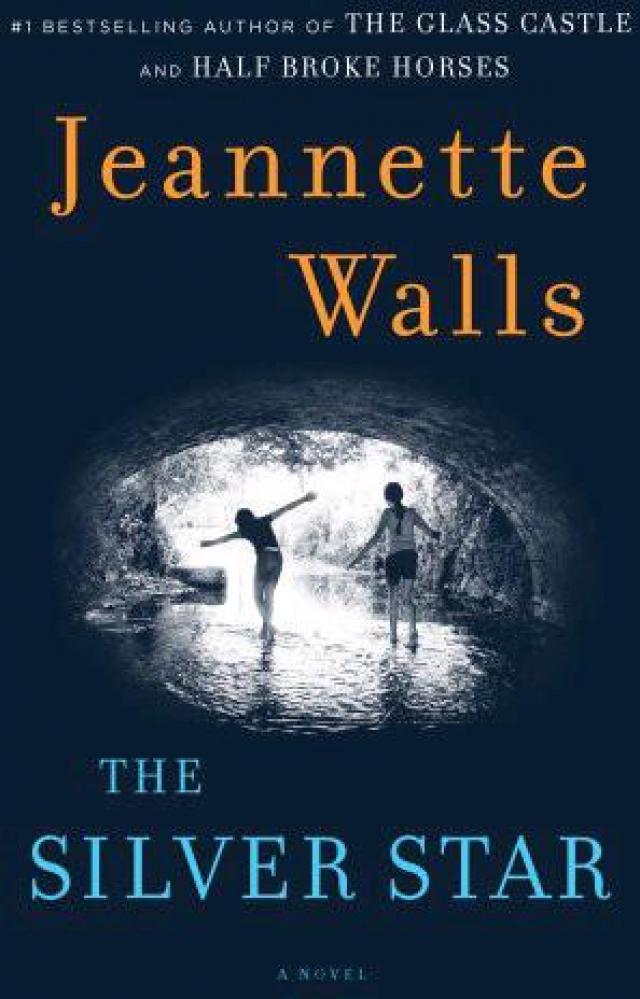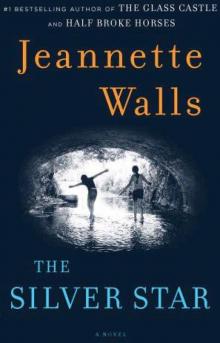
The Silver Star, Jeannette Walls has written a heartbreaking and redemptive novel about an intrepid girl who challenges the injustice of the adult world—a triumph of imagination and storytelling.It is 1970 in a small town in California. “Bean” Holladay is twelve and her sister, Liz, is fifteen when their artistic mother, Charlotte, a woman who “found something wrong with every place she ever lived,” takes off to find herself, leaving her girls enough money to last a month or two. When Bean returns from school one day and sees a police car outside the house, she and Liz decide to take the bus to Virginia, where their Uncle Tinsley lives in the decaying mansion that’s been in Charlotte’s family for generations.An impetuous optimist, Bean soon discovers who her father was, and hears many stories about why their mother left Virginia in the first place. Because money is tight, Liz and Bean start babysitting and doing office work for Jerry Maddox, foreman of the mill in town—a big man who bullies his workers, his tenants, his children, and his wife. Bean adores her whip-smart older sister—inventor of word games, reader of Edgar Allan Poe, nonconformist. But when school starts in the fall, it’s Bean who easily adjusts and makes friends, and Liz who becomes increasingly withdrawn. And then something happens to Liz.Jeannette Walls, supremely alert to abuse of adult power, has written a deeply moving novel about triumph over adversity and about people who find a way to love each other and the world, despite its flaws and injustices.About the AuthorJeannette Walls was born in Phoenix, Arizona, and grew up in the southwest and Welch, West Virginia. She graduated from Barnard College and was a journalist in New York City for twenty years. Her memoir, The Glass Castle, has been a New York Times bestseller for more than five years. Walls lives in rural Virginia with her husband, the writer John Taylor. Excerpt. © Reprinted by permission. All rights reserved.CHAPTER FIVEThe birds woke me early the next morning. I had never heard such noisy birds. I went to the window, and they were everywhere—in the trees right outside, on the ground, swooping in and out of the barn like they owned the place, all the different chirps and tweets and warbling making this incredible commotion. Liz and I got dressed and walked down to the house. When we knocked on the front door, there was no answer, so we went around to the back. Through a window, we could see Uncle Tinsley moving around inside the kitchen. Liz rapped on the windowpane, and Uncle Tinsley opened the door but blocked it like he had the night before. He had shaved, his wet hair was combed, the part was straight, and instead of his bathrobe, he was wearing gray trousers and a light blue shirt with TMH monogrammed on the pocket.“How did you girls sleep?” he asked.“Just fine,” Liz said.“The birds sure are noisy,” I said.“I don’t use pesticides, so the birds love it around here,” Uncle Tinsley said.“Did Mom call, by any chance?” Liz asked.“Afraid not.”“She does have the number, right?” I asked.“This number hasn’t changed since we got it—two, four, six, eight,” he said. “First phone number handed out in Byler, so we got to choose it. Speaking of choosing, how do you like your poached eggs?”“Hard!” I said.“Soft,” Liz said.“Have a seat over there.” He pointed to some rusty cast-iron lawn furniture.A few minutes later, he came out carrying that same silver tray, loaded up with a stack of toast and three plates that each had a poached egg in the center. The plates had gold curlicues around the rim, but the edges were chipped. I picked up a corner of my egg and scooted a piece of toast under it, then stabbed the yolk with my fork, chopped up the white part of the egg, and mushed it all together.“Bean always mutilates her food,” Liz told Uncle Tinsley. “It’s disgusting.”“It tastes better mixed up,” I said. “But that’s not the only reason. First of all, you don’t have to take as many bites, so it saves time. Second, you don’t have to work as hard chewing, because if it’s all mushed up, it’s sort of prechewed. Finally, food gets all mixed up in your stomach anyway, so that’s obviously the way it was meant to be.”Uncle Tinsley gave a little chuckle and turned to Liz. “Is she always like this?”“Oh, yeah,” Liz said. “She’s the Beanhead.”We offered to wash the dishes, but Uncle Tinsley insisted it was easier if he did them himself, without a couple of kids underfoot. He told us to go off and do whatever girls our age did.Liz and I walked around to the front of the house, where there were two big trees with shiny dark leaves and big white flowers. Beyond them, on the far side of the lawn, was a row of huge green bushes with a gap in the middle. We walked through the gap and found ourselves in an area surrounded by the dark green bushes. A few tough irises pushed up through the weeds in old, overgrown flower beds. In the center was a round brick-edged pond. It was full of dead leaves, but in the water beneath, I saw a flash of brilliant orange.“Fish!” I yelled. “Goldfish! There’s goldfish in this pond!”We knelt and studied the orange fish fluttering in and out of the shadows beneath the clumps of dead leaves. I decided this would be a great place for Fido to have a swim. The poor turtle had to be feeling cooped up after all that time in his box.I ran back to the barn, but when I opened the Tupperware, Fido was floating in the water. He’d seemed fine when I fed him earlier. I set him down on the tabletop, scooting him along with my finger, trying to jump-start him, even though I knew it was hopeless. Fido was dead, and it was all my fault. I had thought I could protect Fido and take care of him, but that bus trip had been too much for the poor little guy. He’d have been better off if I’d left him in Lost Lake.I put Fido back in the Tupperware dish and carried him out to the pond. Liz put an arm around me and said we needed to askUncle Tinsley where to bury him.Uncle Tinsley was still puttering in the kitchen when we knocked.“I thought the two of you were going to go off and play,” he said.“Fido died,” I said.Uncle Tinsley glanced at Liz.“Bean’s turtle,” she said.“We need to know where to bury him,” I said. Uncle Tinsley stepped out of the house and closed the door behind him. I handed him the Tupperware dish, and he looked down at Fido. “We bury all the family pets in the family cemetery,” he said. He led us back to the barn, where he picked up a shovel with a long wooden handle, then we all headed up the hill behind it.“Fido’s a peculiar name for a turtle,” he said as we walked along.“Bean really wanted a dog,” Liz said, explaining how Mom had told us it was always the kids who wanted the pet but the mother who ended up taking care of it, and she had no interest in walking and cleaning up after a dog. So she’d bought me a turtle.“Fido means ‘I am faithful,’ ” I said. “Fido was a very faithful turtle.”“I bet he was,” Uncle Tinsley said.Beyond the barn were a bunch of dilapidated wooden buildings. Uncle Tinsley pointed out the smokehouse, the milking shed and the foaling shed, the henhouse, the icehouse, and the springhouse, explaining that Mayfield used to be a real working farm, though hands did most of the work. He still had all 205 acres, including a stretch of woods, as well as the big hay field where the cemetery was. These days, a farmer up the road, Mr. Muncie, hayed the field and gave Uncle Tinsley eggs and vegetables in return.We passed through an orchard, Uncle Tinsley showing us the apple, peach, and cherry trees, and out into a large pasture. At the top of the pasture, a cluster of trees shaded the family cemetery, which was surrounded by a rusting wrought-iron fence. The cemetery was weedy, and a number of the weathered old headstones had toppled over. Uncle Tinsley led us to one well-tended grave with a newish headstone. This was Martha’s, he said, with a vacant spot next to it for him when the time came.The pets, he explained, were buried around the perimeter, near their owners. “Let’s put Fido near Martha,” Uncle Tinsley said. “I think she would have liked him.”Uncle Tinsley dug a small hole, and I placed Fido in it, using the Tupperware dish as his coffin. I found a nice piece of white quartz for a headstone. Uncle Tinsley gave a short eulogy. Fido had been a brave and indeed a faithful turtle, he said, who had made the long and perilous journey from California in order to serve as a guardian for his two sister-owners. Once he’d gotten them safely to Virginia, Fido’s job was over, and he felt free to leave them for that secret island in the middle of the ocean that is turtle heaven.The eulogy made me feel a lot better about both Fido and Uncle Tinsley. On the way back down the hill, I asked about the goldfish we’d found in the pond. “The fish are koi,” Uncle Tinsley said. “That was Mother’s garden. One of the finest private gardens in all of Virginia, back in the day. Mother won prizes for it. She was the envy of every lady in the garden club.”We swung around the barn and the big white house came into view. I started telling Uncle Tinsley about my house dream and how, when we first arrived at Mayfield, I realized it was the actual house in the dream.Uncle Tinsley became thoughtful. He rested the shovel against an old water trough in front of the barn. “I guess you’d better see the inside of the house, then,” he said. “Just to make sure.”We followed Uncle Tinsley up the big porch steps. He took a deep breath and opened the door.The front hall was large and dark, with a lot of wooden cabinets that had glass doors. Everything was a mess. Newspapers, magazines, books, and mail were stacked high on the tables and the floor, alongside boxes of rocks and bottles filled with dirt and sand and liquids.“It may look a tad cluttered,” he said, “but that’s because I’m in the middle of reorganizing everything.”“It’s not so bad,” Liz said. “It just needs a little tidying up.”“We can help,” I said.“Oh, no. Everything’s under control. Everything has its place, and I know where everything is.”Uncle Tinsley showed us the parlor, the dining room, and the ballroom. Oil paintings hung crooked on the walls and a few were falling out of their frames. The Persian carpets were worn and frayed, the silk curtains were faded and torn, and the stained wallpaper was peeling away from the walls. A grand piano covered with a dark green velvet cloth stood in the big ballroom with the French doors. There was all this stuff piled on every available surface— more stacks of paper and notebooks, antique binoculars, pendulum clocks, rolled-up maps, stacks of chipped china, old pistols, ships in bottles, statues of rearing horses, framed photographs, and all these little wooden boxes, one filled with coins, another with buttons, another with old medals. Everything was coated with a thick layer of dust.“There sure is a ton of stuff in here,” I said.“Yes, but every single thing you see has value,” Uncle Tinsley said. “If you have the brains to appreciate it.”He led us up a curving staircase and down a long hall. At the end of the hall, he stopped in front of a pair of doors that faced each other. Both had brass door knockers shaped like birds. “This is the bird wing,” Uncle ...
Read online