

Stop them dead, p.1
Stop Them Dead, page 1


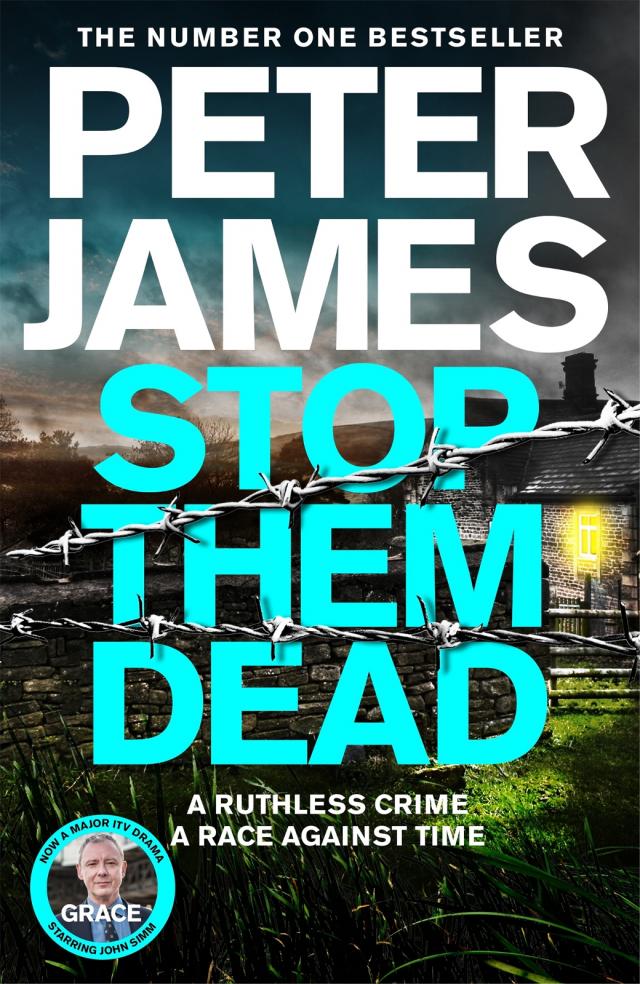
STOP THEM DEAD
PETER JAMES
Contents
AUTHOR’S NOTE
1
2
3
4
5
6
7
8
9
10
11
12
13
14
15
16
17
18
19
20
21
22
23
24
25
26
27
28
29
30
31
32
33
34
35
36
37
38
39
40
41
42
43
44
45
46
47
48
49
50
51
52
53
54
55
56
57
58
59
60
61
62
63
64
65
66
67
68
69
70
71
72
73
74
75
76
77
78
79
80
81
82
83
84
85
86
87
88
89
90
91
92
93
94
95
96
97
98
99
100
101
102
103
104
105
106
107
108
109
110
111
112
113
GLOSSARY
CHART OF POLICE RANKS
ACKNOWLEDGEMENTS
THEY THOUGHT I WAS DEAD
PROLOGUE
1
2
3
4
5
6
7
To all our canine friends who have been, or still are, victims of the illegal trade in dogs.
I hope this helps give you a voice.
AUTHOR’S NOTE
Although the time period of this novel is set when the world was suffering from the effects of the Covid pandemic, this is a work of fiction. I hope, dear reader, you will forgive me for taking the liberty of making amendments to some events, dates and timings that would have been affected by the government restrictions.
1
Thursday, 25 March 2021
Tim Ruddle was a reluctant disciple of Winston Churchill’s maxim that success is the ability to go from failure to failure with no loss of enthusiasm. And if failure had been an Olympic sport, he could have taken gold countless times over, he rued as he lay in bed unable to sleep on this stormy late March night, unlike his wife, Sharon, who was as usual lost to the world beside him. She could sleep for England and if sleeping was an Olympic sport, she would sure as hell be on that podium.
He so envied her that ability. He could not remember when he’d last had a good night’s sleep, a night when he hadn’t lain awake worrying about this latest chapter in their life, then needed to get up and pee. Once, moving to the countryside and buying a farm had been their dream. The good life. Their two kids brought up away from all the violence and the other crap that London threw at you. Back to nature. The idyll that existed only in the pages of books. Not the grim reality of a farmer’s life. The regulations. The subsidies that everyone else seemed eligible for except themselves.
They’d tried diversifying, opening a farm shop, and had recently been granted planning application to create a petting zoo and cafe. Both of them loved animals and had created a small revenue stream from alpaca-walking. But so far their biggest source of income from Old Homestead Farm was quite by accident and a very welcome surprise. Thanks to the massive rise in demand for dogs due to the lockdowns, the blue French bulldog puppies their beloved pet, Brayley, had given birth to just seven weeks ago, were worth a staggering £3,000 each.
In breeding her, it had originally been their intention to keep a least one of the puppies, but the injection of badly needed cash they would get from the sales would help considerably with their new project. The five puppies were awaiting collection by their new owners in a week’s time, after their inoculations.
Outside in the barn across the farmyard below their bedroom window, Rudi, the proud father, had begun barking. Rudi regularly barked at the wind, at rustling leaves, and most of all at Enemy No. 1, the aircraft that regularly flew overhead on their flight path to Gatwick Airport whenever the wind was blowing from the east, as it was tonight. Sharon frequently joked that Rudi was pretty effective: during the year they had been here not a single aeroplane had landed on their fields!
But Rudi’s bark was different tonight. Ferocious, as if he was genuinely troubled by something out there in the darkness. And after a few moments, Sally, their female Labrador, who rarely ever made a sound – as if she had a mute button permanently pressed – started up too.
Worried the noise would wake their kids, Tim slipped out of bed and padded, naked, across to the window, parted the curtains and peered out into the darkness. As he did so he heard a sound, faint but distinct. The rumble of a diesel engine. One, or was it two? He glanced at his watch: 1.23 a.m.
Their farm was down a track, over a mile from the road – and that was just a quiet country lane. They had never been troubled by cold callers and no one ever drove up the rutted, potholed track by mistake. Anyone who came here had a reason and the last nocturnal visitors, a couple of months ago, had been a bunch of youths from a nearby caravan site, lamping rabbits.
Norris Denning, their elderly farmhand, who had come with the farm as a long-time employee – and had been a godsend to them – lived with his wife in the former gamekeeper’s cottage, a few hundred yards back down the track. He’d sent the lampers packing.
The sound of the engines became louder. Nearer. And as it did so the barking of the dogs became more manic. Then Tim saw the silhouette of an off-roader vehicle, with no lights on, enter his farmyard. It was followed by another, a pickup truck.
He felt a stab of fear. What the hell was going on? These weren’t lampers.
Then he saw the flare of a flashlight behind them. Heard a shout, an angry shout. Norris’s voice. ‘HEY!’ the farmhand shouted.
Sharon stirred. ‘Was going on?’ she murmured sleepily.
‘Call the police,’ Tim said, quietly and urgently. ‘Call 999 and say we have intruders.’
He pulled on some jeans and a sweatshirt, hurried downstairs, and shoved his feet into his wellingtons. Then he grabbed his Barbour jacket and the large torch from the shelf above the boot rack by the front door, switched it on, opened the door and shone the powerful beam ahead.
And stared in bewilderment, anger momentarily masking his fear. In the beam he saw Norris standing, feet planted, torch crooked under one arm and pointing a shotgun at the intruders. ‘What the hell do you think you are doing?’ he yelled in his Sussex burr. ‘You clear off right away, you hear me?’
‘Fuck off, Grandad, go back to bed,’ one of them jeered at the elderly farmhand. Then he grabbed the shotgun by the barrel and ripped it out of Norris’s hands.
2
Thursday 25 March
Through the blustery drizzle, behind the man now holding Norris’s shotgun, Tim saw the barn doors were open, and figures were moving around inside. Parked outside, engines still running, were an old Range Rover with its tailgate up and a Ford Ranger pickup in front of it. Two dogs, Rudi and Brayley, were barking furiously.
Striding forward, Tim called out more assuredly than he felt right now, ‘Norris, it’s all right, I can handle this.’ Turning to the man with the shotgun, he shouted, ‘What do you want?’ As he did so, two men came out of the barn, holding a net full of wriggling creatures. The puppies, Tim saw to his horror. ‘Those are my dogs, what do you think you’re doing?’ he demanded, his voice masking his fear and sense of utter helplessness.
Over to his left he saw Norris’s jigging flashlight and a moment later heard him shout, ‘No, Tim, leave this to me, I’ll stop them.’ Norris, who walked with a limp from a tractor accident years back, hobbled forward several paces. ‘Give me my gun back and clear off NOW, the bloody lot of you!’
Tim felt momentarily helpless and terrified, as if he was trapped in one of those nightmares he sometimes had where he wanted to run but his legs wouldn’t work and couldn’t get any traction. His brain was spinning. He had a shotgun and a rifle, but they were locked in a cabinet down in the cellar. If Sharon had called the police, it would be a good while before they got here, far too long.
‘YOU!’ Norris yelled, lumbering towards the Range Rover as one of the men closed the tailgate then jumped into the back of the car. The engines of both vehicles were gunning now. Norris, wielding his flashlight, hur ried to the front of the Range Rover and stood resolutely in front of it, shining the beam straight into the eyes of the driver.
Tim heard the roar of an engine and the slithering of tyres spinning. Horrified, he could see what was about to happen. Not even thinking about his own safely, the former rugby player hurled himself at the farmhand and with all his considerable strength shoved him away to the side, watching him fall clear of the vehicle, the torch clattering to the ground beside him.
Then he turned and, standing between its glaring headlights, faced the Range Rover, putting his arms up in furious defiance, shining the torch straight through the windscreen at two ugly, scowling faces. ‘You stop right there!’ he shouted.
From somewhere behind him he heard Sharon scream, ‘Tim, no! Tim, no! The police are on their way!’
Before he had time to react, and to his shocked disbelief, the Range Rover began moving forward, striking him firmly, with the force of a concrete wall, in the midriff. Were they seriously trying to run him over? As the vehicle slowly picked up speed, pushing him backwards faster and faster, he panicked. This could not be happening, not here in this beautiful sanctuary. Please God. There was no way he could jump clear. In desperation, he pressed his hands on the warm bonnet, frantically trying to get a grip on the metal surface and running backwards, faster and faster to try to stay upright and not go under the front bumper. Faster.
The torch fell from his hands.
Faster.
He could not keep it up. He was going – going to go – falling—
Then his back struck something hard. Sharp edges against his calves and his back. The Ford Ranger pickup, he realized.
‘No!’ he screamed. ‘NO!’
And heard Sharon’s scream, too.
The Range Rover crushed his midriff agonizingly, jetting all the air out of his lungs, as searing flames of pain burned up through his chest and down through his whole body.
He stared in agony and disbelief as the vehicle began backing away now. The headlights were no longer dazzling. As if the batteries in them were exhausted and giving out. No brighter than two candles now. His legs were no longer supporting him. He flailed with his arms, falling, falling. It seemed to be an age before he landed on his face in the mud.
Again he heard his wife’s voice. A torchlight momentarily shone in his eyes, blinding him. Then he heard Sharon’s screaming. ‘Oh God, no. Stay with me, Tim.’
‘I’m – I’m OK, he said, but was struggling through the pain to speak. ‘I feel a – a bit – faint.’
He was dimly aware she was kneeling beside him, opening his coat. He heard her say, as if she were somewhere in the distance, ‘I can’t see any blood, that’s good.’
‘That’s good,’ he gasped weakly.
‘I’ve called the police,’ she repeated. ‘They’re on the way. I’m calling an ambulance.’
‘Ambulance,’ he echoed. And dimly heard three pips. She was dialling, he realized.
‘Open your eyes, darling,’ he heard. And felt a faint squeeze on his hand. Heard her say, ‘Ambulance.’ And then some moments later, ‘Hello, please, we need an ambulance – I just called the police who are on their way and we need an ambulance urgently, please.’
‘Ambulance,’ he murmured. He heard Sharon give the address and directions. Heard her say, ‘Crushed between two vehicles.’
Her voice was getting fainter.
‘He’s breathing, but he’s pale and very clammy.’
‘I’ll – I’ll be OK,’ he wheezed. ‘Just a bit – a bit—’
‘Yes, I’ll get a blanket, keep him warm. No, I won’t, I won’t try to move him, but it’s cold. Please ask them to hurry.’
‘I love you,’ he rasped.
‘I love you. Stay strong, you’re OK, the ambulance is on its way.’
Her voice was faint now. Somewhere in the distance. So faint. Fading.
The pain, at least, was fading now too.
3
Thursday 25 March
Eldhos Matthew had wanted to be a police officer since he was nine years old and had watched a reality cop show on television. He’d been glued to the screen as two officers had pursued a stolen car across a city – he could not remember where; he just remembered the excitement as the stolen car had driven on the wrong side of the road, against the oncoming traffic and then out into a dark rural road, and listening, enthralled, to the voices of the police over the radios.
The pursuit had continued with a helicopter watching the chase through a night vision camera, before the car had crashed on a bend, and two shadowy figures had leaped from the vehicle and were chased on foot, under the glare of the helicopter’s searchlight, and each brought to the ground.
That’s what I want to do! he had thought right then. And from then on, until his mid-teens, pretty much the only television programmes he watched were cop shows – real-life or drama. When his parents or brothers and sisters wanted to watch something else, he retreated to his room in the family home in Brighton and watched them on his laptop. While all his school friends were absorbed in gaming in their free time, he just binge-watched anything that had police in it.
At some point his interest switched from the officers carrying out traffic stops, pursuits, drugs raids, to those solving murders, especially dramas like Line Of Duty, CSI and Endeavour. He found he had a natural talent for getting ahead of the detectives in most of the dramas.
He’d always loved solving puzzles, and his mother, a psychotherapist who worked as a marriage guidance counsellor, told him he had a sharp brain. From an early age he regularly played chess with his father, a mortgage broker, who had taught him, and from around the age of twelve Eldhos began beating him regularly. At fifteen he had become chess champion of the Dorothy Stringer school, and when he had the time, between schoolwork and the endless detective shows, he played chess on the internet with several opponents around the world.
But neither of his parents were enamoured by the notion, as he approached school leaving age, of his joining the police. His mother feared for his safety; his father, a pragmatic man, who had brought his family to England from their native India in search of a more prosperous life, was unhappy with his eldest son’s ambition. In a heart-to-heart conversation he warned Eldhos he would never become rich working for the police, and in an organization that in his opinion was still institutionally racist, he would always struggle for promotion.
Eldhos had replied that he wasn’t interested in becoming rich, that what he wanted was a career where he could make a difference to the world, and he genuinely believed he could make a difference. As to the racism, he could deal with that if it happened, and it seemed all of those prejudices were changing, and he was determined to play a part in that.
He was now, at twenty-one, two years and three weeks into his career with Sussex Police. Just three weeks out of his probationary period, and due to several members of his section being off with Covid, he was single crewed in a response car, based out of Haywards Heath. He had already put in his application for a transfer to CID and at the moment, with a shortage of detectives in the force, the future for his chosen path was looking good.
And on this drizzly March night, as he cruised the dark, silent streets of the small county town ten or so miles north of the city of Brighton and Hove, he was waiting, as he did every night he was on patrol, for a shout from the Control Room to send him off on the kind of action he craved, but which rarely happened.
So far tonight he had stopped a car with a tail-light out, and leaned in to smell the driver’s breath for alcohol, but there was no trace. The young woman, a shift worker, was heading home from Gatwick Airport. He politely told her to get the bulb replaced and allowed her on her way without breathalysing her. Then he’d had a short Grade One blue light run, after a report of two men acting suspiciously outside a computer store in the High Street, where a burglar alarm was ringing. But when he got there, it turned out to be a fault and the manager and a work colleague were trying to deactivate it.
Eldhos had just made up his mind to head back to the nick for a coffee and to eat the chicken salad and chocolate bar that he’d brought along for his supper, when he heard the calm voice of a controller over the radio.
‘Whisky Mike One-Seven-One.’
He clicked the button on his mic and responded with pride, ‘Whisky Mike One-Seven-One.’
‘Whisky Mike One-Seven-One, we have a report of intruders at Old Homestead Farm, Balcombe. We have the caller on the line and she’s very frightened.’






