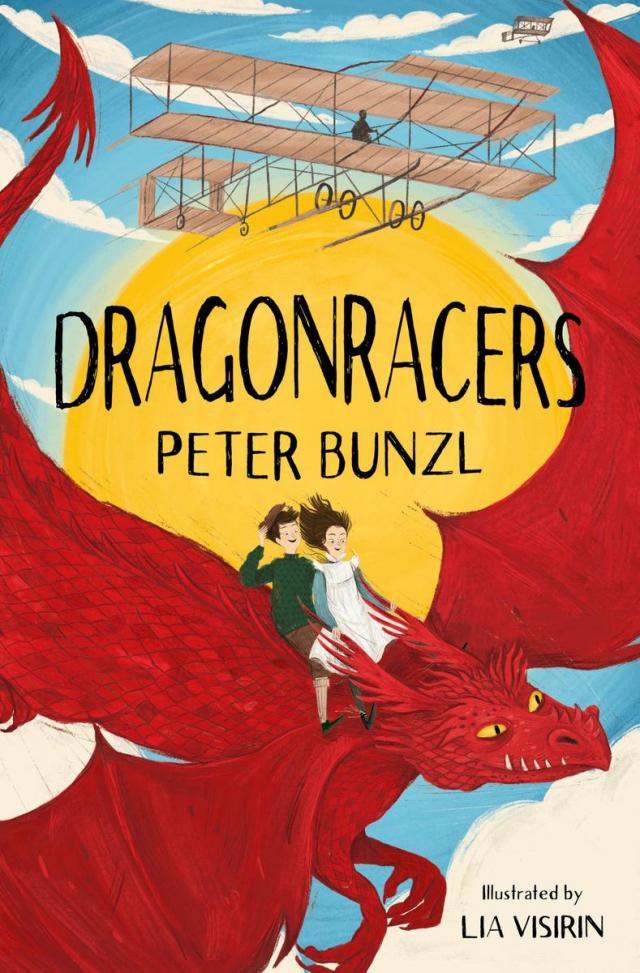
Dragonracers, p.1
Dragonracers, page 1


To Georgia
Contents
Title Page
Dedication
1 Kitty Hawk
2 Test Flight
3 The Egg
4 The Hatchling
5 “Brave Pilots Wanted!”
6 Growth Spurt
7 Flying Practice
8 Race Day
9 Enter the Dragon
10 Flying High
11 Last Leg
12 Big Finish
13 Flying Lessons
Author’s Note
Copyright
Chapter 1
Kitty Hawk
My name is Kitty Hawk. My brother’s name is Harris Hawk. This is a story about the first time we flew. That’s when I became the world’s first “Bird Girl” and Harris became the world’s first “Bird Boy”. That’s what the newspapers called us after our great adventure – just like the very first pilots, who were called “Bird Men”.
Our dad, Peregrine, is chief aircraft engineer to Mr Claude Grahame-White, the most famous “Bird Man” in Britain. Mr Grahame-White is Dad’s boss, but he still insists that my brother and I call him Claude.
Harris and I are twins. We were born in 1900, at the start of a great new century. Our mum died when we were babies, and Dad has taken care of us since then. He says that Mum might be gone, but her love remains, burning bright like the sun. Mum is up there in Heaven, high above the clouds, shining her light down to brighten our days.
Harris, Dad and I live in a cottage on the edge of Hendon Airfield, where Dad works. Hendon Airfield belongs to Claude, and it wasn’t always the big aerodrome it is now, with lots of planes flying in and out. At the time of this story, it was a grass field from when it used to be farmland, with two new aircraft hangars that Claude had built.
The aircraft hangars had curved roofs and each could house one aircraft. The bigger hangar housed Claude’s biplane, which is an aeroplane with two wings on each side that are placed one above the other. In the bigger hangar there was also a workshop with tools.
No one ever went in the smaller hangar. It housed an old monoplane – an aeroplane with only one wing on each side. The monoplane was never used. Dad called it “the injured bird” because one of the wings was broken. He and Claude had been waiting for months for the parts to arrive so they could fix it.
At the front of each hangar were two big doors that slid open. It meant you could wheel the aircraft out and onto the airstrip without their wings getting caught. The airstrip was a plain patch of mown and flattened grass with pegs along each side. It was just long and wide enough for those small early aircraft to taxi down and take off.
I had never been up in an aircraft myself – Dad always said it was too dangerous for children. But I loved to imagine how it would feel – to soar upwards, your heart lifting as you moved off the ground. Every time I thought about it I felt excited.
The Wright brothers had made the first aircraft flight powered by an engine in 1903, when I was three. That flight had lasted for 12 seconds and reached a height of 36 metres and a speed of 6.8 miles per hour. How incredible it must have been to do something that everyone else thought was impossible!
Since then, aircraft had developed a lot, but people were still only flying short distances. There had been short trips in France and America, and a daredevil flight across the English Channel in 1909. But for safety reasons, most pilots stuck to flying in circles above their home airfields.
I had asked Dad if I could learn to fly, but he told me of the people who had died in air crashes. Dad said I was too young for him to let me take that risk and, besides, it took a long time to learn the skills to fly.
I knew that wasn’t true. Claude had been a pilot for less than a year, and he had already learned to fly two planes. He had got his pilot’s licence in January and now it was only April.
Before he took up flying, Claude had been a cyclist, a balloonist and driven motor boats and racing cars. But I wasn’t interested in anything else. I was obsessed with flying from the start. I promised myself I would learn someday, just like Claude. But for the moment all I could do was watch from the sidelines.
Chapter 2
Test Flight
16 April 1910
Claude’s plan was to start Britain’s first flying school. Today he was doing a practice run, taking off from Hendon Airfield. He wanted to be familiar with the biplane so he was ready to start teaching pupils how to fly it.
Harris and I hung around the airstrip as Dad made his last checks on Claude’s aircraft in his blue overalls. I watched Dad carefully, trying to take in each detail and remember everything he did. Harris didn’t pay much attention. He had his nose in a book. He had always been more interested in reading than flying.
Harris loved dragon stories. He had a book called The Legends of Dragons that he read over and over again. He thought dragons were far more interesting than aeroplanes. But dragons didn’t exist. Aeroplanes were right there in front of us. Modern pilots like Claude Grahame-White were changing the world one flight at a time. Even though I wasn’t able to fly myself, I still wouldn’t have wanted to be anywhere else but here, watching history being made.
All the pre-flight checks were completed for Claude’s practice run. Harris and I helped Dad push the wooden biplane through the open doors at the front of the bigger aircraft hangar and out onto the airstrip.
In the distance we could hear the hum of Claude’s motorcar engine, and he soon pulled up in his brand-new car, a Daimler. Claude wore black overalls and a thick waterproof coat to guard against the cold. On his head he wore a fur-lined leather hat with large ear flaps and a chin strap to keep it on. Over his eyes Claude wore driving goggles. It was a motorist’s outfit, but it was also perfect for flying.
Claude jumped down from his car and hurried over to the plane to check everything was in order. The plane’s wings wobbled in the wind. The wires stretched between them hummed like they were playing a tune.
“Good job, Peregrine,” Claude said to Dad when he had finished inspecting the plane. “She looks about ready to fly.”
Claude climbed into the pilot seat. Dad gave the propeller a spin to start the plane’s engine. The engine came to life, whirring the propeller round fast. Dad, Harris and I stepped back as the small aeroplane trundled along the ground, picking up speed.
Claude pulled back the joystick, and the plane rose from the ground at an angle. Wind whistled around the wings. It was the perfect take-off. The best I’d seen Claude do. I felt as if my heart soared with the plane, and I looked around for Harris to see if he had noticed the take-off. But Harris had his nose back in his dragon book.
I raced down the runway, chasing Claude in the aircraft. The plane floated ten, then fifteen, then twenty metres off the ground, climbing steadily. The engine purred and the propeller whirred, pulling the aircraft upwards. Soon Claude and his biplane were a hundred metres above me, soaring in the sky.
Claude turned the aircraft to the right calmly and swept in a wide circle around the airfield. I followed, chasing him around the perimeter until I passed Dad and Harris back at the start of the runway. Claude was high above the airfield by now, speeding at a tremendous rate. The aircraft soon passed over our heads for a second time.
I spun around, tracking the plane with my gaze. I felt dizzy and elated, almost as if I was flying her myself. I covered my eyes as the biplane cut in front of the sun. She was a tiny shadow now, far off in the distance. The wind picked up, and we waited anxiously for the biplane’s return.
Soon we saw her coming back. She was gliding down towards the airfield. A crosswind picked up, and Claude pulled back from the landing at the last minute. He circled the landing strip again.
When the wind calmed, Claude brought the biplane down onto the grassy runway. The aircraft’s rubber wheels and wooden sleds hit the ground, and she came to a juddering stop. Dad ran towards the aircraft to check she wasn’t damaged. Harris and I joined him.
“Did you see her in the crosswind, Peregrine?” Claude said as Dad looked over the plane. “She handles like a dream!”
“You’re a good pilot, Claude,” Dad replied. “You make it look easy.”
I tugged at Dad’s sleeve and asked, “When will it be my turn to fly?”
“I’ve told you a hundred times, Kitty,” Dad snapped. “It’s too dangerous.”
“Flying’s not for children,” Claude laughed. “Stick to the ground where you belong, Kitty.”
“You should spend more time reading, like your brother,” Dad said, patting Harris’s arm. “Or you’ll fall behind at school.”
I was so angry with the pair of them. I promised myself one day I would show them both that I could fly. And Harris too.
Chapter 3
The Egg
After Claude’s practice flight, Dad was busy chatting to Claude about the plane. Harris and I left the runway and went to the pond in the woods behind the airfield.
Harris sat on a log and read his dragon book. I threw a rock in the pond. I enjoyed throwing rocks in the water when I was cross. I liked the big splashes they made.
“Why didn’t you defend me against Dad and Claude?” I asked Harris.
“Sorry!” he said, not raising his eyes from his book.
“So you should be,” I grumbled. I was still angry that Dad wouldn’t even think about letting me fly. Flying was all I had ever wanted to do, ever since I’d first seen an aeroplane last year. It was at Dad’s first aircraft engineering job, at the Farman Flying School in France.
I remember the day we arrived by horse and cart at the tiny village where the flying school was. I could hear the puttering of the aeroplane engines far above us before I saw them. Then we rounded the corner of the road and saw six aircraft circling overhead. Harris had looked up from his book, and we’d stared at the aircraft together as the planes rode on the breeze.
“Biplanes,” Dad said. “They’re the most up to date in the world. They look like enormous wooden kites.”
“Or dragonflies,” I said.
“Or dragons,” Harris said.
The aircraft didn’t really look like any of those things. They were like nothing else, with their own special kind of magic. “I’m going to fly them one day,” I promised myself. And that was the start of my obsession with flying.
We met Claude at the Farman Flying School. He had been training to be a pilot, and Dad was the engineer on his practice plane. When Claude graduated from the flying school, he offered Dad a job in London. The job was to be head engineer at a new flying school Claude was planning to set up in Hendon. That was how we’d ended up here, living beside this airfield in the middle of nowhere. Dad was not just the head engineer here – he was the only engineer. At least so far.
I looked up at the sun and the beautiful clouds drifting past. I threw another rock into the pond. “One day I’ll show them,” I muttered angrily as I watched the splash and ripples from the rock fade away. “I’ll take to the skies and be the best pilot of them all.”
Suddenly, there was a glitter on the surface of the pond, like sunlight, or magic. It flickered in my eyes for a moment before it disappeared. Then I saw something in the water.
It looked like a gleaming marbled pearl the size of a football. It was half stuck in the mud at the bottom of the pond, at arm’s length from the shoreline.
“Harris!” I called.
Harris looked up from his book and jumped down off his log to see what I had found. “Let’s get it,” he said. “It might be worth something.”
We didn’t want to get our clothes wet, so we took off our shoes and socks. Harris rolled up his trousers, and I scrunched up the hem of my skirt in my hands.
The mud sucked at our feet as we stepped into the cold pond, slopping between our toes and over our ankles. When we were standing above the thing, Harris put his hands around one side of it. I put my hands around the other, and we tried to yank it free. It was lighter than I expected. The outside felt like a strong shell. The whole thing came away easily, popping out of the mud.
We pulled it from the water, and I saw at once that it was a beautiful egg. It was so big that it must have been laid by the largest bird in the world. Maybe a bird as big as an aeroplane! But that was impossible. Flying creatures as big as an aeroplane didn’t exist.
The egg’s shell was white and covered in tiny gold cracks. It was perfectly round like a gigantic marble. Harris and I saw how beautiful it was and decided to take it home.
“We can ask Dad what kind of egg it is when he comes back from work,” Harris suggested. But I shook my head. I was still in a mood with Dad.
“Let’s keep it our secret,” I said.
Chapter 4
The Hatchling
It was late morning when Harris and I carried the enormous marbled egg back to our cottage. Dad was still working on the other side of the airfield. I could see him out of the window, on the airstrip, tinkering with Claude’s biplane.
“I wonder what kind of bird this egg is from,” Harris said. He fetched his nature book from the shelf and flicked through the pages, but there was nothing in it that looked like our egg.
Then he had another thought. He opened up his book, The Legends of Dragons. There was an illustration of a dragon’s egg in it. It looked exactly like the egg we had found.
“It’s a dragon’s egg!” Harris said, pointing at the drawing eagerly.
My mouth fell open. “But … but that’s impossible,” I said.
“Impossible things happen all the time,” Harris said. “People once thought it was impossible for a machine to fly in the sky. And now they do. Maybe it’s possible that dragons exist too?”
“Do you actually think that’s true?” I asked. I was feeling a little bit doubtful about all of this, but part of me was also excited. If it was true, then Harris and I would have our very own real-life dragon! My head spun thinking about it. “Does your book tell you how to hatch a dragon’s egg?” I asked.
“It does,” Harris said. He looked very serious as he consulted his book. “It says we should put the egg somewhere flaming hot.”
“You mean like a fire?” I asked.
“That’s right.”
“Are you sure it won’t burn?” I said.
Harris shook his head. “Fire can’t harm dragons. They’re immune to heat.”
We lit a fire in the fireplace and waited until it was roaring hot. The room was so warm that we took off our jumpers. Then we carefully placed the egg in the tall flames. At this point I was still not so sure there was anything alive inside the egg. Perhaps we would just end up with a cooked egg yolk?
We waited. The fire surrounded the egg, and it began to shimmer. Then the egg glowed as if it was absorbing all of the fire’s heat. The gold cracks in the egg’s surface sparkled like lightning. Then suddenly it cracked open. A pair of yellow eyes with black slit pupils peered through the crack and blinked.
I yelped in shock. Harris had been right. There was a creature inside, and the heat of the fire had made it hatch.
We watched as the creature crawled out of the egg. It was red and scaly and covered in glittering pieces of broken eggshell. It scrunched up its eyes and then opened its mouth and yawned. Its jaw was full of sharp yellow teeth as thin as needles.
Harris let out a low gasp. We hadn’t really believed it was possible. Yet here it was – a baby dragon!
The baby dragon stretched out its legs and body to their full lengths. It was about the size of a kitten and had a long, pointed tail with a scaly arrowhead on the end.
Harris and I watched, amazed, as the baby dragon crawled across the burning coals to perch on the tiles in front of the fire. Finally, it unfurled a pair of leathery wings and flapped them until the embers in the fire glowed brightly and the flames leaped higher.
The dragon turned and gobbled up a few flaming coals from the fireplace. When it was finished, the dragon opened its mouth and licked its lips and its sharp teeth with a long, forked tongue. Then it burped out a plume of grey smoke from its mouth and nostrils.
“Does the book say whether it can breathe fire?” I asked Harris, taking a step back. If a dragon could eat fire, I thought it could probably breathe fire.
Harris studied his book once more and replied, “Baby dragons don’t breathe fire until they’re at least a month old.”
That was good to know. It wouldn’t burn the house down. Yet. Then I thought of something else. “Will it try to eat us?” I asked.
Harris shook his head. “It won’t harm us. We were the first thing it saw. It’s made a bond with us. It thinks we’re its parents. It thinks humans are its family now, and dragons don’t attack their families.”
I shivered with relief, then scooped the dragon up and held it in my arms like a baby. The dragon smiled at me and purred softly, nuzzling its nose into my chest. Its skin felt dry and scaly. It had just been in the fire, but the dragon felt barely warm. My heart beat hard at the excitement of holding my very own dragon. Or was it the dragon’s heart I could feel, beating as loud as my own?
“We should hide the dragon until we’ve decided what to do with it,” I said.
“Hide it where?” Harris asked.
I looked out of the window. “How about in there?” I said, nodding at the smaller aircraft hangar that was never used.
And so Harris and I snuck out the back door to hide the dragon in the smaller hangar before Dad came home for lunch. We decided it would be safe in there as no one ever went in. It was the bigger hangar that was always used. Still, we had to go the long way round, behind both hangars, to make sure we weren’t seen by Dad or Claude.