First blood, p.1
First Blood, page 1


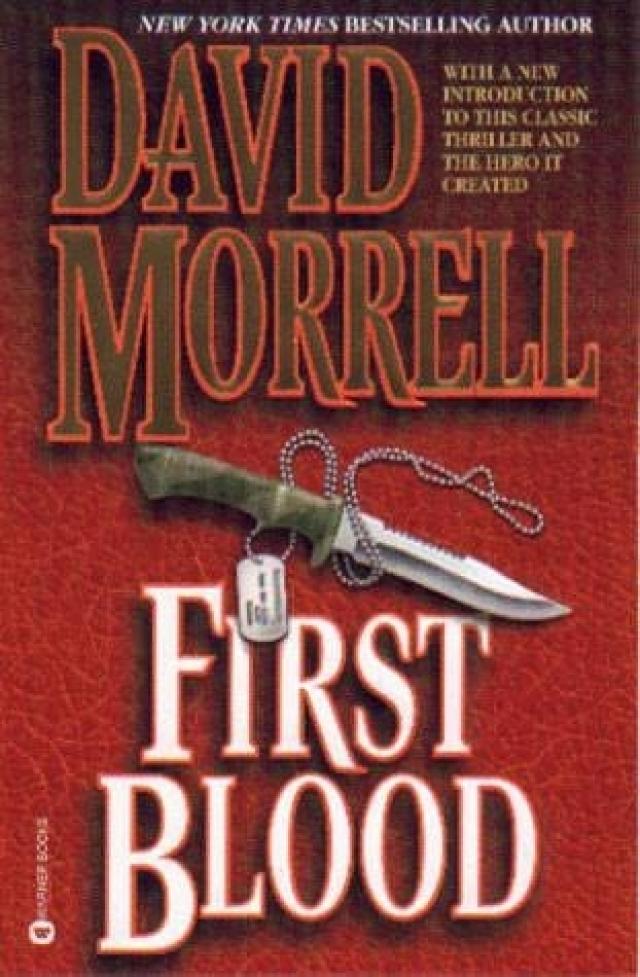
DAVID MORRELL
First Blood
Copyright © 1972 by David Morrell
Introduction copyright © 1990 by David Morrell
A portion of the introduction first appeared as part of an article by the author in Playboy magazine, copyright© 1988 by David Morrell.
All rights reserved.
FIRST BLOOD
to Philip Klass and William Tenn: each in his own way
Contents
Introduction
Part 1
1
2
3
4
5
6
7
8
9
10
11
12
13
Part Two
1
2
3
4
5
6
7
8
9
10
11
12
13
14
15
16
17
Part Three
1
2
3
4
5
6
7
8
9
10
11
12
13
14
15
16
17
18
19
20
21
22
23
About the Author
INTRODUCTION
In the summer of 1968, I was 25, a graduate student at the Pennsylvania State University. Specializing in American literature, I’d finished my master’s thesis on Ernest Hemingway and was starting my doctoral dissertation on John Barth. But in my heart, what I wanted to be was a novelist.
I knew that few novelists made a living at it, so I’d decided to become a literature professor, an occupation in which I’d be surrounded by books and allowed time to write. A Penn State faculty member, Philip Klass, whose science-fiction pseudonym is William Tenn, had given me generous instruction in the techniques of fiction writing. Still, as Klass had explained, “I can teach you how to write but not what to write about.”
What would I write about?
By chance, I watched a television program that changed my life. The program was The CBS Evening News, and on that sultry August evening, Walter Cronkite juxtaposed two stories whose friction flashed like lightning through my mind.
The first story showed a firefight in Vietnam. Sweaty American soldiers crouched in the jungle, shooting bursts from M-16s to repel an enemy attack. Incoming bullets kicked up dirt and shredded leaves. Medics scrambled to assist the wounded. An officer barked coordinates into a two-way radio, demanding air support. The fatigue, determination, and fear on the faces of the soldiers were dismayingly vivid.
The second story showed a different sort of battle. That steamy summer, the inner cities of America had erupted into violence. In nightmarish images, National Guardsmen clutched M-16s and stalked along the rubble of burning streets, dodging rocks, wary of snipers among devastated vehicles and gutted buildings.
Each news story, distressing enough on its own, became doubly so when paired with the other. It occurred to me that, if I’d turned off the sound, if I hadn’t heard each story’s reporter explain what I was watching, I might have thought that both film clips were two aspects of one horror. A firefight outside Saigon, a riot within it. A riot within an American city, a firefight outside it. Vietnam and America.
The juxtaposition made me decide to write a novel in which the Vietnam War literally came home to America. There hadn’t been a war on American soil since the end of the Civil War in 1865. With America splitting apart because of Vietnam, maybe it was time for a novel that dramatized the philosophical division in our society, that shoved the brutality of the war right under our noses.
I decided my catalytic character would be a Vietnam veteran, a Green Beret who, after many harrowing missions, had been captured by the enemy, escaped, and returned home to be given America’s highest military distinction, the Medal of Honor. But he would bring something back with him from Southeast Asia, what we now call post-traumatic stress disorder. Haunted by nightmares about what he had done in the war, embittered by civilian indifference and sometimes hostility toward the sacrifice he had made for his country, he would drop out of society to wander the back roads of the nation he loved. He would let his hair grow long, stop shaving, carry his few possessions in a rolled-up sleeping bag slung over his shoulder, and look like what we then called a hippie. In what I loosely thought of as an allegory, he would represent the disaffected.
His name would be … I get asked about his name a lot. One of my graduate school languages was French, and on an autumn afternoon, as I read a course assignment, I was struck by the difference between the look and the pronunciation of the name of the author I was reading: Rimbaud. An hour later, my wife came home from the grocery store. She mentioned that she’d bought some apples of a type that she’d never heard about before: Rambo. A French author’s name and the name of an apple collided, and I recognized the sound of force.
While Rambo represented the disaffected, I needed a contrasting character to represent the establishment. Another news report, this time in print, aroused my indignation. In a southwestern American town, a group of hitchhiking hippies had been picked up by the local police, stripped, hosed, and shaved—not just their beards but their hair. The hippies had then been given back their clothes and driven to a desert road, where they were abandoned to walk to the next town, thirty miles away. I remembered the harassment that my own recently grown mustache and long hair had caused me. “Why don’t you get a haircut? What the hell are you, a man or a woman?” I wondered what Rambo’s reaction would be if, after risking his life in the service of his country, he were subjected to the insults that those hippies had received.
In my novel, the establishment’s representative became a police chief, Wilfred Teasle. Wary of stereotypes, I wanted him to be as complex as the action would allow. I made Teasle old enough to be Rambo’s father. That created a generation gap, with the added dimension that Teasle wishes he had a son. Next, I decided that Teasle would be a Korean War hero, his Distinguished Service Medal second only to Rambo’s Medal of Honor. There were many other facets to Teasle’s character, and in each case, the intention was to make him as motivated and sympathetic as Rambo, because the viewpoints that divided America came from deep, well-meant convictions.
To emphasize their polarity, I structured the novel so that a scene from Rambo’s perspective would be followed by one from Teasle’s, the subsequent scene from Rambo’s, the next scene again from Teasle’s. That tactic, I hoped, would make the reader identify with each character and at the same time feel ambivalent about them. Who was the hero, who the villain, or were both men heroes, both men villains? The final confrontation between Rambo and Teasle would show that in this microcosmic version of the Vietnam War and American attitudes about it, escalating force results in disaster.
Nobody wins.
Due to the rigors of graduate school, I didn’t complete First Blood until after I’d graduated from Penn State in 1970 and taught at the University of Iowa for a year. Following the book’s publication in 1972, it was translated into twenty-one languages and eventually became the basis for a well-known film.
The latter was a decade in the making. I had sold the film rights to Columbia Pictures in 1972. One year later, Columbia sold the rights to Warner Bros. Then Warner Bros sold … Well, for ten years after its publication, the novel passed through three movie companies, eighteen screenplays, and such directors as Richard Brooks, Martin Ritt, Sydney Pollack, and John Frankenheimer. Meanwhile Paul Newman, Al Pacino, Steve McQueen, Clint Eastwood, Robert De Niro, Nick Nolte, and Michael Douglas were all considered to play Rambo. The novel became a Hollywood legend. How could so much money and so much talent be spent on an enterprise that somehow couldn’t get off the page?
Part of the reason was the mood of the Seventies. America’s involvement in Vietnam had ended badly, and feelings about the war were bitter. The few films that referred to Vietnam (Coming Home, for example) reflected that attitude. Then came the Eighties. Ronald Reagan was president. He promised to make America feel optimistic again. The defeat in Vietnam seemed far behind.
At that point, Andrew Vajna and Mario Kassar, two film distributors who’d been successful in the Asia, decided to become producers. Seeking a project, they happened upon First Blood and decided that with modification the story would play well in America. More important, their experience in foreign film markets told them that the movie, if it emphasized action, would attract large audiences around the world.
In the process, some changes were made from my novel. The film’s locale was shifted from Kentucky to the Pacific Northwest (to avoid harsh winter weather; ironically, the production was shut down by a blizzard). Rambo acquired the first name John (“When Johnny comes marching home”). Also he was made less lethal than in my novel. In the film, Rambo throws a rock at a helicopter, causing a demented sharpshooter to fall to his death. Later, Rambo bumps a stolen truck against a pursuing police car filled with gun-blazing deputies; they crash into a car at the side of the road. Neither incident is in the novel. That’s the total body count in the film. The police chief—now a stereotypical redneck—is badly wounded but lives. But in my novel the casual ties are virtually uncountable. My intent was to transpose the Vietnam War to America. In contrast, the film’s intent was to make the audience cheer for the underdog.
The most important change between my novel and the film almost didn’t occur. I had been determined that there be no winners, and so both the police chief and Rambo die. In the novel, Sam Trautman (I thought of him as a continuation of the allegory, as “Uncle Sam,” the Special Forces officer who trained Rambo, who made Rambo what he is) blows the top of his former student’s head off with a shotgun. A variation—in which Rambo commits suicide—was filmed. But test audiences found that conclusion too depressing. The film crew returned to Canada to stage a new ending, and Rambo lived. Thus, inadvertently, it was possible to do sequels prompted by the film’s success.
The first sequel, 1985’s Rambo (First Blood Part II), was an international box-office sensation. An action film, it was intended as an entertainment. But because it dealt with a highly-charged political issue (whether or not there were American prisoners of war in Vietnam), it was also extremely controversial (as was the second sequel, 1988’s Rambo III, which dealt with the Soviet invasion of Afghanistan). President Reagan didn’t seem to mind the controversy, however. One evening during a televised press conference, he said that he had seen a Rambo movie the night before and now he knew what to do the next time there was a terrorist hostage crisis. Unfortunately, many people equated the Rambo movies with America’s military policy, to the point that while I was on a book tour in Britain in 1986, I read with dismay this London Times headline: “U.S. Rambo Jets Bomb Libya.”
I wasn’t involved with the films. However, I did write a novelization for each of the sequels in an effort to supply the characterization that they omitted. I felt that it was important to remind readers of what the novel’s Rambo had been about. In the Seventies and early Eighties, the book had been taught in high schools and universities across the country. For years, I had received numerous letters from teachers telling me how strongly students had responded to the novel and its issues. But by the mid-Eighties, the controversy generated by the films had caused teachers to shy away from the book. It was no longer included on reading assignments. The letters stopped. Not that I object to the movies. Their level of action is nowhere as extreme as current examples of the genre. Politics aside, the sequels are a lot like westerns or Tarzan films (although in retrospect I think Rambo III was too much like an old movie). At the same time, I think it’s ironic that a novel about political polarization in America (for and against the Vietnam War) was the basis for films that resulted in similar polarization (for and against Ronald Reagan) a decade after the novel was written.
Sometimes I compare the Rambo books and movies to trains that are similar but headed in different directions. Sometimes I think of Rambo as a son who grew up and out of his father’s control. Sometimes I read or hear Rambo’s name in a newspaper, in a magazine, on the radio, on television—in reference to politicians, financiers, athletes, whomever—used as a noun, an adjective, a verb, whatever—and it takes me a moment before I remind myself that if not for The CBS Evening News, if not for Rimbaud, my wife, and the name of an apple, if not for Philip Klass and my determination to be a fiction writer, a recent edition of The Oxford English Dictionary wouldn’t have cited this novel as the source for the creation of a word.
Rambo. Complicated, troubled, haunted, too often misunderstood. If you’ve heard about him but haven’t met him before, he’s about to surprise you.
David Morrell
PART ONE
1
His name was Rambo, and he was just some nothing kid for all anybody knew, standing by the pump of a gas station at the outskirts of Madison, Kentucky. He had a long heavy beard, and his hair was hanging down over his ears to his neck, and he had his hand out trying to thumb a ride from a car that was stopped at the pump. To see him there, leaning on one hip, a Coke bottle in his hand and a rolled-up sleeping bag near his boots on the tar pavement, you could never have guessed that on Tuesday, a day later, most of the police in Basalt County would be hunting him down. Certainly you could not have guessed that by Thursday he would be running from the Kentucky National Guard and the police of six counties and a good many private citizens who liked to shoot. But then, from just seeing him there ragged and dusty by the pump of the gas station, you could never have figured the kind of kid Rambo was, or what was about to make it all begin.
Rambo knew there was going to be trouble, though. Big trouble, if somebody didn’t watch out. The car he was trying to thumb a ride with nearly ran him over when it left the pump. The station attendant crammed a charge slip and a book of trade stamps into his pocket and grinned at the tire marks on the hot tar close to Rambo’s feet. Then the police car pulled out of traffic toward him and he recognized the start of the pattern again and stiffened. “No, by God. Not this time. This time I won’t be pushed.”
The cruiser was marked CHIEF OF POLICE, MADISON. It stopped next to Rambo, its radio antenna swaying, and the policeman inside leaned across the front seat, opening the passenger door. He stared at the mud-crusted boots, the rumpled jeans ripped at the cuffs and patched on one thigh, the blue sweatshirt speckled with what looked like dry blood, the buckskin jacket. He lingered over the beard and the long hair. No, that’s not what was bothering him. It was something else, and he couldn’t quite put his finger on it.
“Well then, hop in,” he said.
But Rambo did not move.
“I said hop in,” the man repeated. “Must be awful hot out there in that jacket.”
But Rambo just sipped his Coke, glanced up and down the street at the cars passing, looked down at the policeman in the cruiser, and stayed where he was.
“Something wrong with your hearing?” the policeman said. “Get in here before you make me sore.”
Rambo studied him just as he himself had been studied: short and chunky behind the wheel, wrinkles around his eyes and shallow pockmarks in his cheeks that gave them a grain like weathered board.
“Don’t stare at me,” the policeman said.
But Rambo kept on studying him: the gray uniform, top button of his shirt open, tie loose, the front of his shirt soaked dark with sweat. Rambo looked but could not see what kind his handgun was. The policeman had it holstered to the left, away from the passenger side.
“I’m telling you,” the policeman said. “I don’t like being stared at.”
“Who does?”
Rambo glanced around once more, then picked up his sleeping bag. As he got into the cruiser, he set the bag between himself and the policeman.
“Been waiting long?” the policeman asked.
“An hour. Since I came.”
“You could have waited a lot longer than that. People around here don’t generally stop for a hitchhiker. Especially if he looks like you. It’s against the law.”
“Looking like me?”
“Don’t be smart. I mean hitchhiking’s against the law. Too many people stop for a kid on the road, and next thing they’re robbed or maybe dead. Close your door.”
Rambo took a slow sip of Coke before he did what he was told. He looked over at the gas station attendant, who was still at the pump, grinning, as the policeman pulled the cruiser into traffic and headed downtown.
“No need to worry,” Rambo told the policeman. “I won’t try to rob you.”
“That’s very funny. In case you missed the sign on the door, I’m the Chief of Police. Teasle. Wilfred Teasle. But then I don’t guess there’s much point in telling you my name.”
He drove on through a main intersection where the light was turning orange. Far down both sides of the street were stores squeezed together—a drug store, a pool hall, a gun and tackle shop, dozens more. Over the top of them, far back on the horizon, mountains rose up, tall and green, touched here and there with red and yellow where the leaves had begun to die. Rambo watched a cloud shadow slip across the mountains.
“Where you headed?” he heard Teasle ask.
“Does it matter?”
“No. Come to think of it, I don’t guess there’s much point in knowing that either. Just the same—where you headed?”
“Maybe Louisville.”