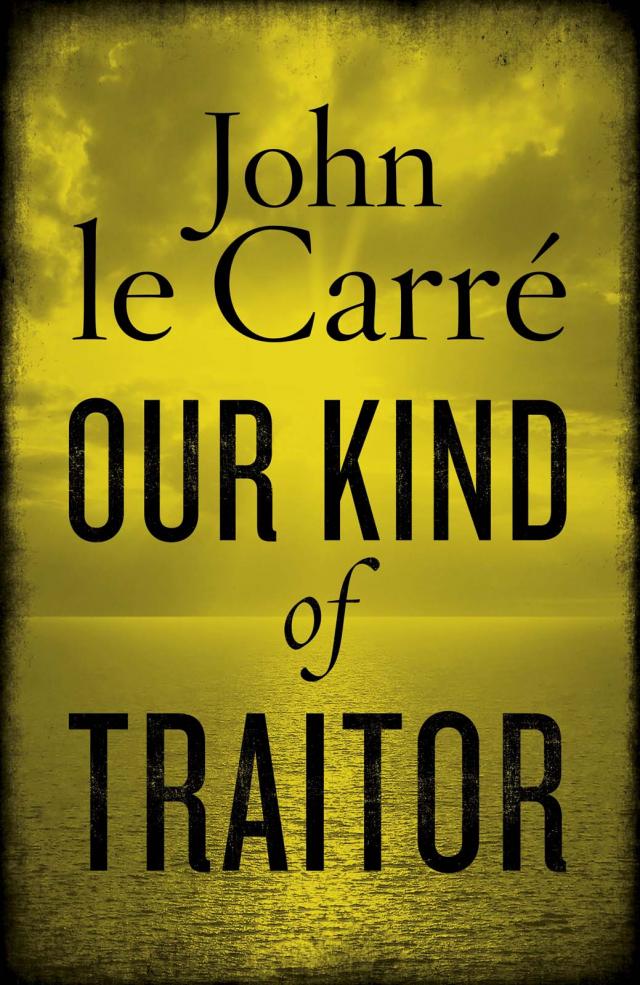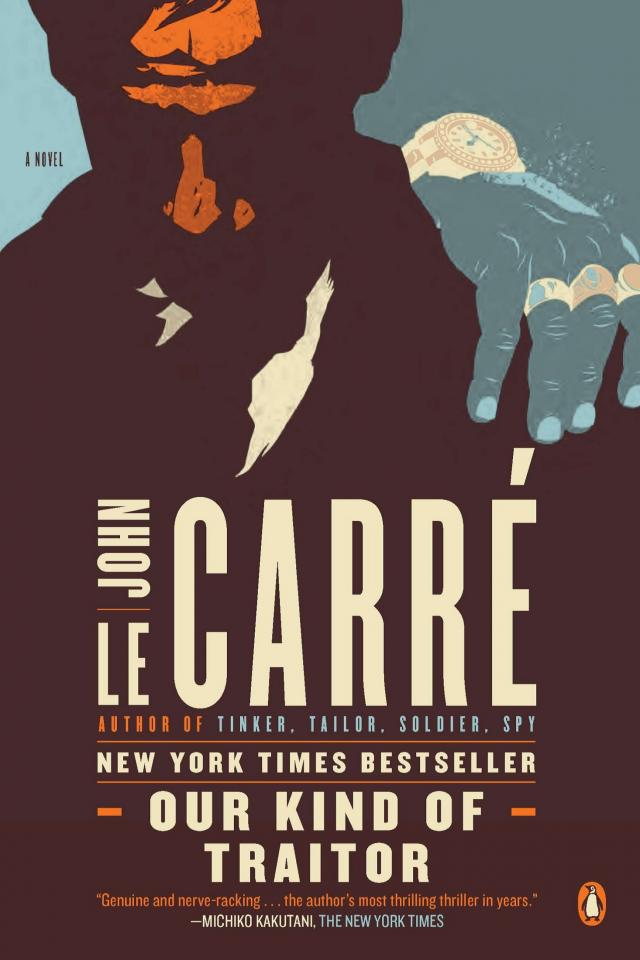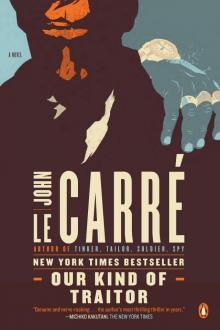
The unrivaled master of spy fiction returns with a taut and suspenseful tale of dirty money and dirtier politics. For nearly half a century, John le Carré's limitless imagination has enthralled millions of readers and moviegoers around the globe. From the cold war to the bitter fruits of colonialism to unrest in the Middle East, he has reinvented the spy novel again and again. Now, le Carré makes his Viking debut with a stunning tour-de-force that only a craftsman of his caliber could pen. As menacing and flawlessly paced as The Little Drummer Girl and as morally complex as The Constant Gardener, Our Kind of Traitor is signature le Carré. Perry and Gail are idealistic and very much in love when they splurge on a tennis vacation at a posh beach resort in Antigua. But the charm begins to pall when a big-time Russian money launderer enlists their help to defect. In exchange for amnesty, Dima is ready to rat out his vory (Russian criminal brotherhood) compatriots and expose corruption throughout the so-called legitimate financial and political worlds. Soon, the guileless couple find themselves pawns in a deadly endgame whose outcome will be determined by the victor of the British Secret Service's ruthless internecine battles.
From Publishers Weekly
Starred Review. Those readers who have found post–cold war le Carré too cerebral will have much to cheer about with this Russian mafia spy thriller. While on holiday in Antigua, former Oxford tutor Perry Makepiece and his lawyer girlfriend, Gail Perkins, meet Dmitri "Dima" Vladimirovich Krasnov, an avuncular Russian businessman who challenges Perry to a tennis match. Even though Perry wins, Dima takes a shine to the couple, and soon they're visiting with his extended family. At Dima's request, Perry conveys a message to MI6 in England that Dima wishes to defect, and on arriving home, Perry and Gail receive a summons from MI6 to a debriefing. Not only is Dima a Russian oligarch, he's also one of the world's biggest money launderers. Le Carré ratchets up the tension step-by-step until the sad, inevitable end. His most accessible work in years, this novel shows once again why his name is the one to which all others in the field are compared. Copyright © Reed Business Information, a division of Reed Elsevier Inc. All rights reserved.
From Bookmarks Magazine
Much to the dismay of many longtime fans, le Carré chose to keep up with the times after the collapse of the Soviet Union. Yet, despite his shift from Cold War-era espionage to more contemporary themes, le Carré's signature stark prose, pitch-perfect dialogue, authentic characters, and moral indignation have stood the test of time. The critics were pleased to see "the master" (Telegraph) back in action, but some had reservations: While the Guardian lamented the "long, fussily narrated opening," the Scotsman praised Traitor's "long and elegantly paced plot." Others quibbled about some dubious plot devices and cartoonish villains, but these complaints paled beside "the old magic" (Telegraph). Intriguing and tense, Traitor shines a blinding, angry, and welcome light on shady international finances and underhanded intelligence agents.
From Booklist
In his last few novels, le Carré has exhibited a remarkable ability to turn multiple forms of international chicanery into gripping, incisive fiction, seemingly before the end of the news cycle. In The Constant Gardener (2001), it was drug testing in Africa by the pharmaceutical industry; in A Most Wanted Man (2008), it was the way the anti-terror industry runs havoc over individual lives. Now, it’s something a little different: international money-laundering. It starts when two idealistic young professionals, one an Oxford professor, the other a lawyer, take a tennis vacation in Antigua, where they meet an unsavory Russian who claims to be “the world’s Number One money-launderer.” Dima wants Perry and Gail to help him defect to the West—not from Russia, in the cold war sense, but from the Russian underworld, whose leaders have decided he knows too much. One of the things Dima knows is which British “vulture capitalists” have used Russian Mob money to survive the collapse of the banking industry. It is a complex but fascinating subject, and le Carré dissects it brilliantly. As usual, though, the real focus isn’t on sorting out good guys from bad; it’s on the somber realization that there are no good guys, that the British Secret Service is no more trustworthy than the Russian Mafia. Perry and Gail, the latest in a long line of le Carré naïfs to learn that institutions prey on individuals, grow up painfully but with considerable grace. In the world as le Carré finds it, grace under pressure is about as good as it gets. --Bill Ott
Review
“One of our great writers of moral ambiguity, a tireless explorer of that darkly contradictory no-man’s land…Our Kind of Traitor brims with deftly drawn characters navigating a treacherously uncertain landscape that seems ripped from yesterday’s papers and re-created with an absolutely certain hand.”—Tim Rutten, Los Angeles Times“Part vintage John le Carré and part Alfred Hitchcock…the suspense in Our Kind of Traitor is genuine and nerve-racking.”—Michiko Kakutani, The New York Times“I would suggest immortality for John le Carré, who I believe one of the most intelligent and entertaining writers working today.”—The Chicago Tribune.
About the Author
New York Times bestselling author John le Carré (A Delicate Truth and Spy Who Came in from the Cold) was born in 1931 and attended the universities of Bern and Oxford. He taught at Eton and served briefly in British Intelligence during the Cold War. For the last fifty years he has lived by his pen. He divides his time between London and Cornwall.
Read online