Consider me gone, p.1
Consider Me Gone, page 1
part #1 of Time Shadows Series


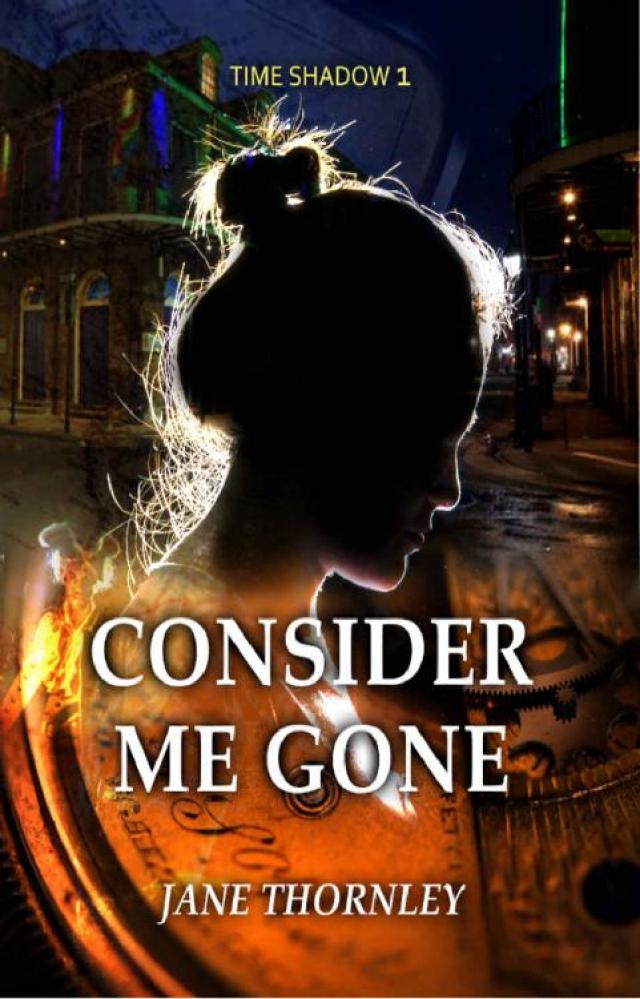
Consider Me Gone
Time Shadows Book 1
JANE THORNLEY
Consider Me Gone
Time Shadows Book 1
JANE THORNLEY
Contents
Chapter 1
Chapter 2
Chapter 3
Chapter 4
Chapter 5
Chapter 6
Chapter 7
Chapter 8
Chapter 9
Chapter 10
Chapter 11
Chapter 12
Chapter 13
Chapter 14
Chapter 15
Chapter 16
Chapter 17
Chapter 18
Chapter 19
Chapter 20
Chapter 21
Chapter 22
Chapter 23
Chapter 24
Chapter 25
Chapter 26
Chapter 27
Chapter 28
Chapter 29
Chapter 30
Chapter 31
Chapter 32
Chapter 33
Chapter 34
Chapter 35
Chapter 36
Epilogue
Join my Newsletter
About the Author
Afterword
Also by JANE THORNLEY
1
The air hung with such humidity in the streets of New Orleans that afternoon, Romy felt coated in syrup. Praline heat, she thought, as she steadied her breathing—sticky and seductive.
The scent of brown sugar wafted from the open windows of the candy shops while rum cocktails flowed in the bars. Everything in the Old Quarter simmered and boiled until it distilled into something rich, intoxicating, and far too addictive for a single taste.
“Is she real, mommy?” Romy heard a little girl ask. From the corner of her eye, she could just see blond curls and big plastic sunglasses.
“She’s a real person, Susie, just not a real angel,” the mother said from somewhere to the right. “She’s only pretending to be made of stone like those angel statues we saw in the big cemetery tour.”
“Like playing make-believe?” the little girl asked.
“Yes, but for money, sweetheart. She’s what is called a ‘performance artist’. Some people do that when they can’t get other kinds of work.”
Irritation stabbed Romy just to the left of one fake wing. Well, what did she expect? It’s not like the truth read any better: a doctoral student dressed like a kneeling angel trying to lure a ghost. No, she corrected, not a ghost, but a past life event. And, in order to recreate exactly the right conditions, she had to stay focused.
People thought she was crazy kneeling as still as death in the summer heat. Surely she had to be mad to pose in these conditions? Traffic noises and conversation wrestled with her concentration. The heat leeched her energy. She’d knelt for nearly an hour with no results until weariness weighed her down and a headache loomed at the edge of her temples.
I’m drunk on this place, she thought. A sober person would have left town at the first sign of trouble. A sober person would never watch her career shatter into a thousand pieces, or push her body to extremes day and night. A sober person would never kneel perfectly still in the burning heat waiting to connect with a man who had been dead for centuries.
But she could not stop herself. She needed answers.
Maybe the migraine threatening like far off thunder destroyed her concentration? Maybe she wasn’t trying hard enough. Or maybe she was trying too hard.
Coins clinked in the little bowl at Romy’s feet but, the moment she dipped her head in thanks, the headache detonated.
Startled by the sudden pain, she instinctively pressed her hands against her forehead and waited for the throb to pass. As she counted the seconds, the child’s chatter receded along with the honking horns and traffic noises of the Old Quarter.
She opened her eyes on a street immersed in a watery light that smeared her vision. Everything became foggy and indistinct. She blinked, stunned. Instead of exhaust fumes, she inhaled the pungent odor of dung. A horse whinnied nearby. Waves washed ashore from somewhere behind her, though she had been standing nowhere near the river.
She had crossed into the past at last. Her heart quickened and she readied herself for the encounter.
A man’s voice speaking French rose out of the background. “Answer me, damn it! Are you a spy, is that it? Speak, why don’t you?”
Dark hair plastered over a bruised forehead above a jaw clenched in pain. Blood soaked the linen of his shirt and she read agony in his eyes.
She tried to speak but couldn’t. A roar of foreign thoughts and emotions whipped through her, none of them hers.
“Why have you done this?” he asked. “Why? Speak!”
Speak? She longed to scream her throat raw, to kick out at the world for the unfairness of everything. She knew that with a desperate certainty but couldn’t fix on the reason why. Something in this long ago lifetime had been lost and something remained in danger still.
“I am a soldier,” she whispered at last, though neither the words nor the voice were hers. “A soldier does what must be done. Love and war should never mix, no?” Her voice rasped. “Is that not the soldier’s creed? For once, it is the woman who is the warrior and the man the pawn.”
She heard the pounding of hooves thundering down the path. They came! She had to escape. Hitching up her skirts, she turned to run but as she did, the world around her burst into noise and motion and she felt herself falling forward. A hand shot out to catch her. Shrugging it away, she stumbled blindly on.
Only when she tripped over her gown and pitched into a skid across the pavement, did reality hit. She had catapulted into the present as suddenly as she had fallen into the past.
“Mommy! Look, the Frozen Angel’s fallen!” a child cried.
The Frozen Angel’s fallen?
“Susie, hold mommy’s bag. Miss, are you all right? We were watching you and you started to run.”
Romy blinked up into the concerned face of the woman—thirtyish with a cap of highlighted gold hair.
“You called out in another language, French I think. I couldn’t understand a word,” the woman said. “You need a doctor.”
“No!” Romy pushed herself up from the ground and gazed around her. “I mean, thank you, but please don’t worry. I’m fine, really. Just a bit dizzy.” Where had she been? She shook her head, trying to dislodge wisps of powerful emotion she didn’t recognize. She gazed around at the busy street, overcome by a sense of terrible loss. “If they hang him, it will be my fault,” she mumbled.
“Who?” The woman's face registered fresh alarm.
Romy paused, staring at the woman. “The man.”
“What man? You called out for someone. Is that who you mean?” The woman's hand remained on Romy’s arm.
“Did I say a name?”
The woman nodded. “Antonio.”
“Antonio,” Romy said with a nod. “His name is Antonio.”
“Your boyfriend?”
“No.” She didn’t have a boyfriend and she didn’t know anybody named Antonio. “You’ll get covered in white,” Romy said, trying to restore normalcy to this ridiculous situation. “From my grease paint.” She pointed to the woman’s hand.
The lady glanced down at the smudge of white on her palms. “Oh, it’ll wash off. Are you sure you don’t want a doctor?”
For the first time, Romy noticed the woman’s t-shirt, the camera, the shopping bag from one of the souvenir shops—a tourist, then. “No, really. Thanks for your help. Now, if you’ll excuse me.”
But the woman wouldn’t leave. “Susie and I must have watched you for, like, ten minutes, and you didn’t even blink,” she said. “A lot of people just kept right on walking, you know, but Susie wanted to stop and watch. There’s got to be an easier way to make a living, if you know what I mean.”
The little girl, no more than six-years-old, stood nearby, gazing up at Romy with an expression of utter wonder. She pointed to the feathered wings Romy wore strapped to her back. “A pretend angel,” she whispered. “Can you fly?”
Romy stifled a laugh. “No, I can’t, sweetie. Believe me, if I could, I would have long ago.” Like on the day her world began to fall apart.
“Stone angels, real or pretend, can’t fly, Susie,” her mother said.
“Bet you could if you tried,” Susie insisted, following along beside her mother as Romy made her way back to her upended milk crate pedestal. “Wanna try now?”
“Hush,” the mother said.
Romy smiled. Pressing her fingers to her forehead, she forced her head to clear. Now she felt drained and empty, almost bereft. The two other times she had experienced the phenomenon, it had been the same—exhausting, baffling, frightening.
Around her, the faces of the watching crowd registered a mix of concern and curiosity. Most had dispersed, probably disappointed that the amazing Frozen Angel—the performance artist who could make like a statue for nearly an hour—had confirmed her humanity in such a pathetic way. Romy sighed. Yes, she was a mere mortal and today especially she felt the weight of years bearing down.
She watched the last of her audience trail away, heading for their chicory coffees and beignets along Decatur Street. How many customers had she attracted this time—twenty, twenty-five, thirty?
Peering into the imitation marble dish she used as a till, she took a mental count of the contents—maybe twenty-five dollars, much less than usual, but she ha d gained in other ways. At least she now had a name. Antonio.
“Are you sure you’ll be okay?” the woman asked again, still hovering.
Romy nodded. “I’m fine, really. I’m not used to the heat. Thanks anyways.”
Maybe the temperatures had impacted the force of this encounter. Either that or she could be losing her mind but, deep down, she didn’t believe her sanity at issue. Frazzled, yes, more than a little lost, and sometimes desperate after everything that had happened, but definitely not crazy. Yet.
“I know I couldn’t do what you do in these temperatures,” the woman continued. “I almost hate to leave the air conditioning to go outside. How do you southerners stand it?”
“Actually, I’m from the north,” Romy told her. “I’ve been here on a study visa for three years.”
“Really?”
“Really.” A pang of regret hit as she thought how her doctoral prospects had taken an even bigger tumble than her frozen angel but thinking of Adrian only intensified the pain. Some things were too hard to explain, even to herself.
She attempted to straighten her wings with a shrug. Those heavily feathered monstrosities, bought from a lady who made Mardi Gras floats, drooped over her shoulders on a broad elastic harness. After securing the fastenings, she stooped to pick up the crate and bowl, nesting one inside the other and covering both with the white canvas cloth. Now she could use her free hand to lift the long starched gown to keep from tripping.
Turning, she dropped a practiced bow to the woman and her daughter and prepared to make her way home. Pulling herself upright, she took a deep breath and walked down St.Philip Street with slow, measured steps, masking her fall with some semblance of dignity. She’d remain in character all the way home. Part theatrics, part good business, she fixed a glazed stare on the path ahead and walked as if with unseeing eyes.
People did a double-take and moved from her path. In New Orleans, where dressing up was part of the culture, the sight of a stone angel walking the streets in her own solitary procession still had an unsettling effect. Old Mr. Benjamin, who took visitors for rides in his mule-drawn wagon, always crossed himself when he saw her coming. Cindy Murphy, who took the tourists for walking tours through the French Quarter, as did Romy twice a week, addressed her clients in hushed tones when the Frozen Angel walked by. At dusk, like now, when her costume took on a ghostly sheen, people scattered from her path.
Amazing to have such power through illusion. Respect, she decided, as she crossed Royal Street. They respected what she represented—one of those strong, dignified guardians of forever that perched atop the cities of the dead. But today, as she walked home slightly weak and uncommonly weary, her angel stumbling, she felt the presence of another weighing her down. Whoever or whatever the identity of that woman who spoke to Antonio, the one who spoke through her, Romy sensed their fates were inextricably connected. They shared something with that man, something that could survive time itself, something that kept calling her back to the past.
A glimpse of her reflection in the shop windows showed a tipsy-looking angel with one wing askew. How fitting.
She took a deep breath and carried on, trying to fortify herself while blocking away the memory of an unknown man accusing her of treachery.
2
Dusk seeped an ultramarine into the sky over Governor Nicholls Street. Romy trudged up the steps to the tiny house she shared with her friend. A grey half-shotgun cottage tucked deep into the back of the French Quarter, it had a long, narrow shape, tall shuttered windows, and belonged to Joquita’s aunt, who rented it to the two women for half the going rate.
Few such cottages that had survived hurricane Katrina. Most of the others on the street had been reconstructed or demolished, which made seeing this one with its windows aglow even more welcoming. Living here was an honor Romy never took for granted.
She shoved open the door and stepped into the kitchen, calling out. “I’m getting too old for this!”
“Hell, girlfriend,” Joquita swung around. “Would you honk twice before barreling in like that? You scare the bejesus out of me in that get-up.”
Joquita, stood bare-foot in the middle of their cramped galley kitchen wearing a red cotton shift and a pair of oven mitts, her large brown eyes wide. A lean, sinewy beauty with hair in cornrows and skin the color of polished walnut, she always took Romy’s breath away.
Tonight, one hand grasped the aluminum tray of a steaming diet frozen dinner and the other held an open book. Joquita had been studying.
Romy pushed away a pang of regret at the thought of her own lost studies as she unfastened her wings and let them drop into a heap on the floor. “Are your nerves shot or something?”
“Maybe, but every time I see the Frozen Angel, something kicks in and my teeth start chattering,” Jo said, watching her. “I guess that says something about your acting. Either that or your skill in the greasepaint division has reached new heights.” She hesitated, peering into Romy’s face. “You all right, girl?”
Romy rubbed her eyes and gazed at her friend, unable to contain herself a moment longer. “It happened again, only much stronger this time. It was like I was sucked into a time vortex powerless to stop the trajectory, just falling, falling. I know I’m onto something here, Jo, I just know it!”
“Oh, hell.”
“Hell—yes, it feels a bit like that. I mean, who am I when I go there, who am I speaking to? This time, I found myself in somebody else’s head again while they used my lips to speak to this man. This time he accused of treachery, treachery! I don’t think I’m going crazy but I know it sure sounds that way.”
“Sit.” Joquita pointed towards a chair at their linoleum-topped table and slid into the place opposite. Romy collapsed on the seat and watched Joquita pop the plastic cover from the dinner tray and shove it towards her. Sometimes the five year difference in their age seemed enormous. At thirty, Romy felt old.
“Here, you need this more than I do: glazed chicken and rice, food of Diana, Goddess of the Hunt.”
Romy wrinkled her nose as she gazed down at the packaged food. “Is the goddess still trying to squeeze into a size six toga?”
“Very funny. Haha. Eat.”
“No thanks. I think I’ll finish off the rest of Aunt Loo’s gumbo and leave the toga fodder to you.” But she made no move to the fridge. All she had the energy to do was sit, hands in her lap, and stare at the grey and pink flecks in the table top. “Why aren’t you asking me for the details?”
“I’m waiting until you recover, girl. Look at you, you’re all done in. Why do you keep doing this frozen angel shit, anyway? That piddly amount of money can’t make up for what working two jobs is doing to your body.”
“Even a little money helps right now but you know I’m not doing the angel freeze for that.” It had started as a lark, a kind of bet with her thesis advisor, and had quickly evolved into something extraordinary. And dangerous.
“Oh right, I forgot: you have a gift for playing dead for fifteen minute stretches.” Jo made a play of slapping her forehead.
Romy laughed. “It’s not that, either—not all of it, anyway. I only care about the phenomena, you know that. I have to figure out what’s going on and get some answers. Consider it research, if you must.”
“So, instead of finishing your thesis, which I remind you is proper research, you can play dressup and hunt for ghosts every night?”
“You think I’m crazy.”
“I think you’re stressed. Isn’t that what the doctor said?”
Romy shook her head. “Dr. Wilkins hasn’t a clue about this stuff and you know it. What medical practitioner can diagnose what doesn’t show up as a tumor or a rash? If it’s not physical, it doesn’t exist. The truth is that I’m seeing things, experiencing genuine encounters with the past. What student of history can let something that significant pass?”