The dark issue 7, p.1
The Dark Issue 7, page 1
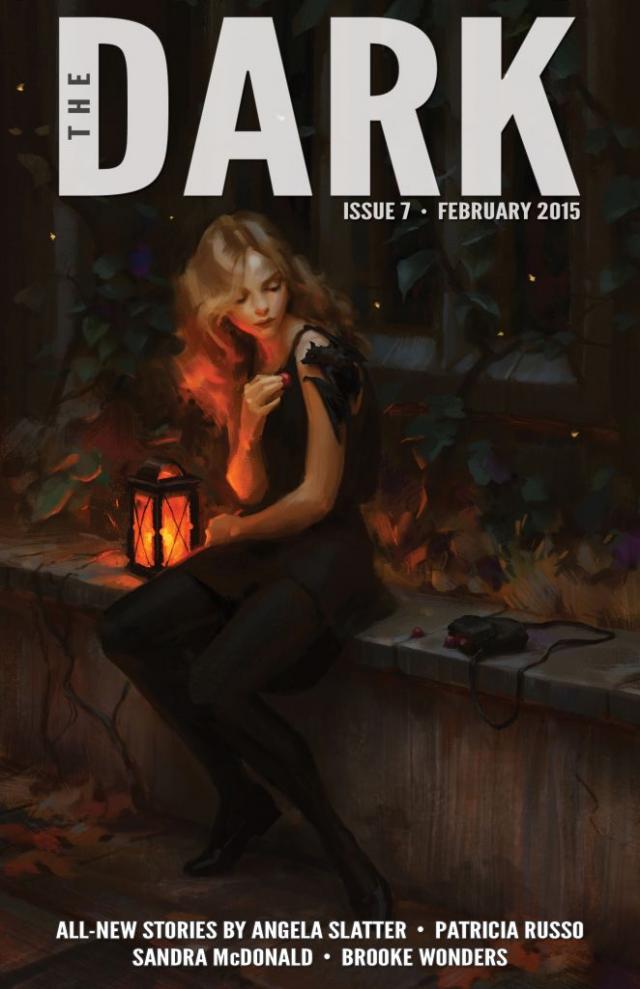


THE DARK
Issue 7, February 2015
“Bearskin” by Angela Slatter
“In the Dreams Full of Sleep, Beakless Birds Can Fly” by Patricia Russo
“Welcome to Argentia” by Sandra McDonald
“A Spoke in Fortune’s Wheel” by Brooke Wonders
Cover Art: “Communion” by Lane Brown
ISSN 2332-4392.
Edited by Jack Fisher & Sean Wallace.
Cover design by Garry Nurrish.
Ebook design by Neil Clarke.
Copyright © 2015 by TDM Press.
www.thedarkmagazine.com
Bearskin
by Angela Slatter
Torben knows he has only one shot. The crossbow shakes in his grip. There is a single bolt and even if there were more he has not the strength to reload for the weapon belongs to Uther, the woodsman, who has left the boy to wait in the small, smelly blind set between the trunks of three ailing alders. The walls are of woven rushes and withy. The flimsy roof fell in who knows when and Torben feels the drip-drip-drip of snow-melt from above—not that the weather’s warming up, but it seems the unhealthy branches won’t allow the ice to remain on their limbs much past daybreak.
The boy is cold in his pale wolf furs, despite their thickness. He never had a taste for hunting though Edvard, his father, tried to teach him. Henry, his brother, took to it like a duck to water, but Torben refused to attend what Edvard patiently told him. He has never learned the knack of willing himself warm, of wiggling his fingers and toes to keep the blood moving. Uther does not bother to instruct, or even to try, he simply slaps the boy about the ears each and every time he fails at one rough task or another. Torben suspects the man rather enjoys it and encourages missteps whenever he can. Edvard was always kind and tolerant, going over the same lesson time upon time, never punishing his youngest child’s inattention. Perhaps that’s why the lad suffers so now.
Thoughts of his father bring, as usual, hot tears which the boy wipes away—he does not want them to freeze on his face. He has learned that much. He bites his lip and steadies his aching heart. He dare not think of his mother.
Torben presses an eye against the matting, but there is nothing beyond but a vastness of white broken only by thin naked trees. There is no canopy above of evergreens to offer any cover. He squints, trying to see if Uther is returning, slinky through the forest, quiet despite his hulking size. Yet no, there is not even the icy comfort of Torben’s gaoler on offer.
Gaoler. Not the word Aunt Bethany had used. Guardian. Teacher. Master to Torben’s apprentice. He’d asked over and again why? Why did he need an apprenticeship when Henry had been allowed to go to University. There was plenty of money—all the problems his parents had caused were sorted—why was he not to be given the same chance? Wasn’t that why they’d moved to Whitebarrow? So Henry could study medicine as he’d desired? It was a few more years, certainly, before Torben would be old enough, but his tutor said he was terribly bright for a twelve year old, that he had great prospects, great possibilities. It hadn’t occurred to Torben then, though it had many times since, that his repeated interrogations were the reason he now found himself huddled in Edmea’s Wood in the depths of winter, yearning for the company of a man he couldn’t stand. A man whose face wore the scars of a bear attack. A man who’d grown so tired of Torben’s stumbling and tripping, his barely swallowed whimpers, that he’d left the boy alone in the decaying blind with instructions to Fecking wait while he went and checked the traps on his own.
Torben sits back, tries to get comfortable; he can barely feel his feet and his backside has gone to sleep. Everything will hurt when he stands, when the blood flows back into his flesh and muscles—oh yes, he has muscles now, not big ones, but they’ve replaced the baby fat he’d had in copious store before. The physical labour, the sparse diet, have stripped the excess from his bones. He is constantly hungry, a gnawing in his belly day and night, but he doesn’t dare steal. Uther is keenly aware of the quantity of provisions in the larder, and Torben is certain that the quiet, scrawny girl who keeps house for Uther would be unwilling to risk her master’s wrath all for the sake of the plump little rich boy who came to them weeping eight months ago.
He listens carefully in case Uther is sneaking up behind to scare him so he pees his pants again. Torben would have thought that trick one to grow old quickly, but apparently not. All he can distinguish is the wind rattling branches, the creak of frozen wood, the whoosh of his own breath as it makes dragon’s mist in front of his face. Put him in a library and he can identify the title of a book by the sound of its fall, but here . . . here he is lost. He clears his throat; it seems terribly loud in the sighing of the snow. A bird calls overhead, a melodic thing, and he thinks of Victoria, his sister, gone before him. That should have been a warning, he thinks, a sign that Aunt Bethany would brook no dissent no matter how much she professed to love them. Henry will be safe, Torben thinks, Henry has the habit of obedience and Aunt cares for him more, differently, strangely.
There is a noise outside, closer than it should be. Something has stalked him, gotten into proximity, and he all oblivious. To one side it shuffles and snuffles . . . his finger tightens on the trigger of the crossbow . . . whoever or whatever is there moves nearer . . . Torben’s finger twitches and the bolt is released, punching through the withy screen. A thud, then a brief sigh-sob, then the sound of a small body falling to the snowy ground.
Heart in mouth, Torben scrambles up, fighting his way out of the blind; unable to find where the door latches, he tears it in panic. He falls through the rip and discovers that he has murdered a bear cub.
The cub is not especially large and his brown pelt is thick and matted. He should not have been out, thinks Torben in distress, he should have been sleeping the deep winter’s slumber, not wandering about—Torben assumes it’s a ‘he’. He kneels and feels for a pulse, however, there is nothing. The barb is embedded right where the creature’s heart should be. Blood has dripped, making crimson blossoms on the white carpet. The fur and flesh beneath Torben’s hand are warm, so warm, but he knows the heat will flee soon enough. Copper eyes glazed over, bewildered, snout damp, teeth sharp beneath the sweet upper lip. The boy begins to weep and does not try to stop; tears drop like liquid stars onto the dark coat and stay there, held on the tips of the bristles.
He cries until he hears a new noise, a crashing and a thrashing somewhere amongst the trees of Edmea’s Wood. Not Uther; the woodsman would never make such a racket. That is when Torben flees; he doesn’t see anything but his imagination has always been worse than what might be real. He struggles through drifts, uncertain if he is heading in the right direction, driven only by the desire to escape whatever is behind. He doesn’t care what punishment Uther will inflict on him for not staying put. He only knows he must run.
It is almost an hour later when he stumbles, more by luck than design, into the white-swept courtyard of the small stone house in the woods to which the woodsman lays claim.
Tove took pity on him when he threw open the door and staggered over to the roaring fire in the large front room. She handed him a mug of heated winter-plum brandy. It was liberally sweetened with molasses and made smooth by a knob of butter, and took away what little breath he had left. But it warmed him and quickly, pressing life back into his extremities, even those he was sure had been frozen forever.
“Thank you,” he croaks to the girl. She doesn’t speak and he wonders, not for the first time, if she cannot or simply won’t. He’s never heard her answer Uther, nor have a conversation, not that their master was much of a one for such pleasantries. She watches everything though, he’s noticed that. Her dark blue eyes seem everywhere at once, as if taking in all possible threats, all available exits and places to hide. Torben feels for the first time, as she refills his mug, that he may stare openly at her, at the fine dark blonde hair, and the small stubs of antlers that poke through it on each side of her head. They are not fully formed and have not changed in the time he has been here. Tawny velvet covers them and he wants to run his fingers over it.
“I killed a bear cub,” he says as she stirs the stew pot on the fire. She pauses, shoulders tensing, goes back to it, then speaks the first words he’s ever heard from her.
“What sort of bear?”
“Brown. A brown bear.”
“No, idiot. Was it a true bear or a one that’s a bear only some of the time?”
“Is there a difference?” he asks, then wilts beneath her gaze, is burned by the contempt he sees there. His world is cracked open, his firmly held idea of who and how she is shatters. He wonders if this is why Uther does not touch the girl, does not abuse her. She’s not his daughter, Torben knows that much for so the woodsman told him, said No, she goes with the house. But Torben thinks she doesn’t go with the house at all, that she belongs somewhere else entirely and is just here for a while. He says, “I’m sorry.”
She stills again, then relaxes, seeming to shrug away the tension. Her lips are no longer set in a sharp line and her eyes soften. “You’re not to know, I suppose. City folk are ignorant.”
That stings from this strange girl with her barely-born antlers, her silence. He blurts, “At least I’m not some stupid superstitious country clod. Bears are just bears, all the time. My parents−”
“Your parents?” she sneers. “What about them?”
He stops, wonders what she knows. Wonders what she’s been told and by whom. Wonders if she knows how Edvard ends his life in gaol, and that his mot her . . . oh, his mother. They stare at each other for long moments while the drink in his hand goes cold, and the stew on the hob, unstirred, becomes agitated, bubbles up and spatters on the flags. It breaks the spell, and he says softly, “What are you?”
But their brief connection is lost. She turns away and does not answer.
When Uther finally comes home a few hours later, a brace of fat bone-coloured coneys slung over his shoulder, he doesn’t yell as Torben expected. Isn’t angry at all, just curious. Strangely proud. He hands the catch to Tove, then eyes the boy.
“You kill tha’ cub?” His voice is deep and raw, rough as elm bark looks.
Torben cannot find a reply so he merely nods from where he sits by the hearth, the aching cold almost out of his bones.
“Should ha’ lugged it home,” the man says, seating himself across from the boy. The fire plays shadow and light over his face, making the scars seem to dance. “Not much you can do with th’ hide, but meat’s sweet so young.”
“I . . . ” Torben croaks. “I heard something else after it, coming for me. I thought it might be the mother.”
Uther nods. “Might ha’ been. Mayhap she woke early too, found him missing.” He leans forward to unlace his boots. “I’d ha’ run too. You did th’ smart thing.”
Torben is surprised and disturbed, that the man has addressed unnecessary words to him, words of comfort and approval. Torben is distressed that the worst thing he has ever done, though it was an accident, is the one thing this man approves of, is the one thing that might make his life here easier if only for a little while. He cannot find it within himself to be glad, even a little. He swallows hard, nods so Uther will think they are in harmony however briefly, and will not suspect that the boy is so sickened by himself he’s thrown up three times in the privy out back. That every time he closes his lids he sees those copper eyes staring at nothing at all.
“Ne’er fear. I brought it back. Skinned it afore I came in, meat’s in th’ smoking hut. He’ll no go to waste.” Uther rises, leaves his boots to dry by the flames, lands a heavy hand on the top of Torben’s head, not in violence, but a kind of rough pat as he stomps to the washroom where Tove has heated water in the tub. Good lad, it says and Torben wants to weep again. His stomach rebels at the idea of eating such flesh, or indeed anything. The winter-plum brandy is long gone. His skin crawls to think of the hide made into shoes or a hood. He refuses the bowl of stew Tove wordlessly offers and makes his way upstairs to his small room under the eaves.
He was not allowed to bring any books, though he managed to smuggle a copy of Murcianus’ Mythical Creatures, and it lies beneath the mattress. He limits himself to a single page each night to stave off the time when he must either beg Uther for a new volume or begin again. The lack still claws at him. He does not read this eve; he is exhausted. Sleep comes weirdly quickly, with dreams chasing its tail like nipping pups. His mother, Cordelia, sits at his bedside. Cordelia as he last saw her, not as Aunt Bethany said she’d become. Cordelia loving and laughing, telling him he was her sweetest, her best darling, her last child, and her only light. That he was special.
It’s so long since Torben felt special.
He wakes himself before the dreams turns to nightmares, almost throwing himself from his mattress.
He stares out the tiny window into the darkness where nothing can be discerned until the full moon rises over the reaching fingers of skeletal treetops. Everything is bathed in silvered indigo. Torben looks down at the lean-to; he can just see the edge of the cub’s skin stretched over the tanning rack. In the moonlight it’s paler than he recalled, and it appears as if there are stars at the end of each bristle.
The stone house sits in a small clearing. To the left is a frozen rill, where Torben and Tove must hack at the ice to melt it for drinking and cooking and bathing. To the right is the lean-to and the outdoor privy. Behind is a barn-cum-stable where the jersey cow and two Clydesdale horses share straw with chickens, ducks and geese. The front garden is dotted with rose-beds, the plants blooming all year round due to Uther’s strangely green thumb. The coloured blossoms look like jewels against the moonlight-blue snow.
Torben’s attention is caught by a hesitant movement at the edge of the clearing. A shape materialises, taking slow steps. At first he thinks it a bear, but the size is too small, the gait too elegant, and the owner walks on two feet, not four. The smudge resolves itself into a woman, her skin dark olive, her hair a blackish-brown running down her back, past her waist, to her ankles where it drags in the deep powder. She is tall, very tall, and heavy-boned, large around breasts and hips. Her face is gentle, her eyes flash amber. She raises her head and Torben sees how she sniffs at the air.
She drifts towards the lean-to, her hands reaching out to the cub’s hide. Just before she touches it, she looks up as if sensing Torben’s gaze. His tears have started again and course down his cheeks. He wonders if the woman can see them glinting. Her expression does not change, she merely stares at him for long moments, then helps herself to the fur, carefully unhitching it from the frame. She cradles it in her arms and returns to the forest.
For a long time Torben watches the space where she no longer is. When he’s half-frozen again, he crawls back into the bed with its goose-down quilt and pillows, the only luxuries Aunt Bethany sent with him. He trembles with fear that the nightmares might overwhelm him, but his dreams when sleeps will no longer be denied are empty, and he is safe.
In the morning Uther finds bear tracks outside, where Torben had watched the woman walk.
“Did you see ought?” he asks, scars twitching, and the boy swears he did not.
Uther grunts and strides towards the barn.
Torben knows the woodsman keeps his great crossbow there, one Torben has no hope of lifting left alone arming, and the bear traps, cruel things with steel teeth. He shivers in the cold as he looks down. The prints are huge, almost three times as long as his own foot. He cannot reconcile the woman he saw with the traces she left behind.
No, perhaps not her. Perhaps a bear came after he slept. Perhaps a bear followed the scent, hers or the cub’s, and obliterated the woman’s footprints. His heart constricts, then: what if the bear stalked the woman? What if it found her with her gentle face and wondering eyes? Neither woman nor bear deserve Uther’s attentions, he decides.
He looks to the house and finds Tove regarding him from the back door. She stares, then retreats inside.
The girl’s barely paid him any attention in almost a year, yet here is the second day in a row that she’s met his gaze. That she’s let him know again she disapproves. She sleeps on a pallet in the kitchen. He wonders what she saw through the window there, and if she’d even tell him if he asked. Torben opens his mouth but the only thing that comes is heated mist before Uther’s shouts from the barn: “Hurry up, boy. We’re hunting bigger game today.”
He envies Tove that she gets to hide even as he is afraid of what she might say if he spoke to her again.
It is late in the day when Torben catches the trail. The light is beginning to fade and they are deep in Edmea’s Wood, where the trees though leafless, grow oh-so tightly together, and the shadows are lengthening. Torben has thrice been lost, but managed to right himself again before Uther realised and had to come and find him, swearing as he went.
The prints are strange, sometimes they disappear for large spans, with nothing to show how the creature got from one spot to another. Torben hoped every moment that the woodsman would not pick up the spoor again, but the man is tenacious, bloody-minded. The scars on his face, the memory of the claws that put them there, drive him. But this time . . . oh, this time, it’s Torben who has found the tracks. He looks at the direction they lead, peers amongst the close trunks but sees no hint of the creature that left them. He spins on his heel as well as he can in the sluggish white and tramps back towards where he last saw Uther.
Breaking from a stand of singing winter grass that croons as he passes, he spies Uther on the other side of a clearing, heading straight towards him. The boy increases his pace, almost jogs, trying to ensure the man stays as far away from the evidence as possible. He is breathing hard when he reaches the woodsman, but it covers his nervousness about lying.