

Stop ollinger, p.1
Stop Ollinger, page 1


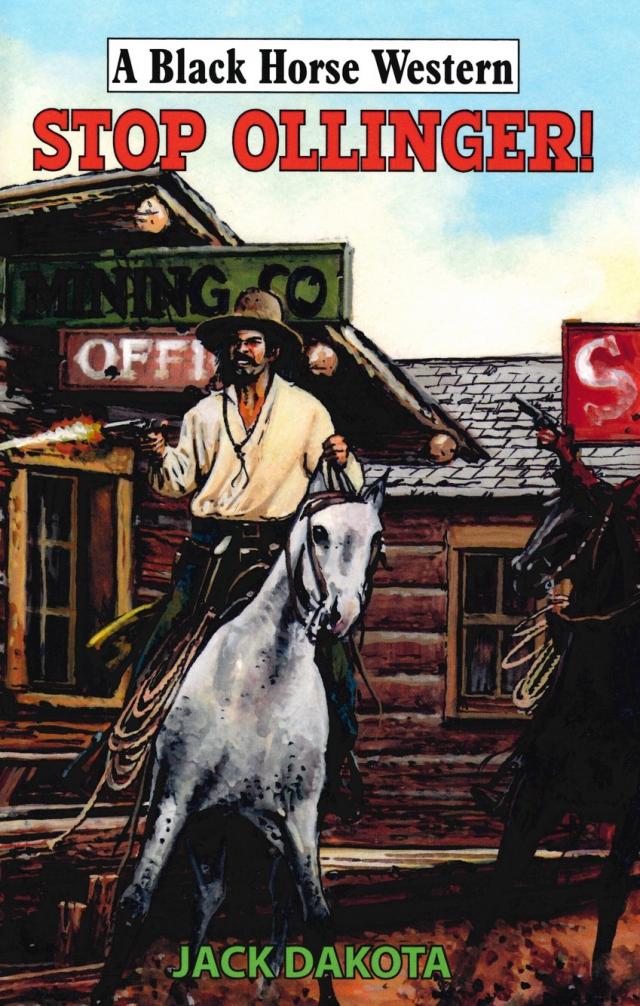
Stop Ollinger!
When the town of Mud Wagon Creek is destroyed by desperadoes it is just the start of a twisted trail of revenge for outlaw-boss, Bass Ollinger. He has sworn to make society pay for the time he spent in the Oregon State Penitentiary, shackled by the infamous Oregon Boot, and he intends blazing a trail of death and destruction clear from Texas to the Beaver State.
Riding the border country, Brant Forrest unwittingly rides into Ollinger’s path and with others also in the renegade’s line of fire, comes to the inevitable conclusion: stop Ollinger!
By the same author
Showdown at Dirt Crossing
Comanchero Trail
Hell Stage to Lone Pine
Stop Ollinger!
Jack Dakota
ROBERT HALE
Jack Dakota 2011
First published in Great Britain 2012
ISBN 978-0-7198-2305-3
The Crowood Press
The Stable Block
Crowood Lane
Ramsbury
Marlborough
Wiltshire SN8 2HR
www.bhwesterns.com
This e-book first published in 2017
Robert Hale is an imprint of The Crowood Press
The right of Jack Dakota to be identified as author of this work has been asserted by him
in accordance with the Copyright, Designs and Patents Act 1988
Chapter One
The town of Mud Wagon Creek lay basking in the sun. A few people were about but generally things were quiet. Marshal Lou Burden sat on a chair outside his office with his hat brim pulled low and his feet on the rail in front of him. He was beginning to doze when suddenly he was roused by a distant rumble. Thunder, he thought; not surprising in view of the type of weather we’ve been having. He closed his eyes again. The thunder seemed to have rolled away into the distance when his ears picked up the noise again. Thunder, like the beating of many hoofs. Suddenly he jerked upright. It wasn’t thunder he could hear; it was the sound of approaching horsemen, and lots of them. In an instant he had sprung to his feet and run inside his office.
‘Hedley!’ he shouted. ‘Hedley!’ His deputy appeared from a back room. ‘Get your guns!’ He stepped quickly to a gun rack and took down a Winchester ’73 rifle which he snapped open and filled with shells from a drawer in his desk. Hedley came back with his own rifle held under his arm. ‘Come with me,’ Burden said.
They ran out into the street. Some of the passers-by had picked up the sound and stood in various postures with puzzled expressions on their faces. One young woman gathered up her child and ushered it along the boardwalk away from the ever growing volume of noise. A dog ran into the street and began to bark. Burden and the deputy marshal started to run and carried on till they reached the end of the street where the clapboards gave way to a few scattered adobes. Burden stationed himself in the middle of the road and gestured to Hedley to stand slightly behind him and to his left. He heard the sound of boots and looked round to see a couple of the townsmen running up carrying rifles.
‘Go back!’ Burden barked, but they shook their heads and took their stand beside him.
‘Whoever those riders are,’ one of them said, ‘I reckon they sure as hell mean trouble.’ He couldn’t know the gang was led by Oregon Boot Bass Ollinger and he couldn’t know how much trouble they were in.
A dense cloud of dust hung in the air as the ground began to shake with the thud of horses’ hoofs. Then the riders came into view, galloping fast and whooping as they came. Some of them began to fire into the air, adding to the cacophony of noise which hurt the listeners’ ears. They showed no sign of slowing and it seemed they must carry on and trample over the four men standing in front of them, when the leader held up his arm and they slowed. They were bunched but as they got close they began to spread out. The leader was almost up to Burden when he brought his horse to a rearing halt.
‘Well now, if it ain’t the town marshal,’ he shouted. His words were greeted with sounds of laughter and hooting. A few more shots were loosed into the air.
‘I don’t know what this is about,’ the marshal said, ‘but I reckon you boys had best just turn right around and ride back where you came from.’
There was a moment’s pause and then the leader, leaning over his horse’s head, broke into a harsh laugh before replying. ‘You hear, boys! The marshal would like us to turn round and go back where we come from.’ There was further laughter and someone shouted: ‘Better not mess with the marshal, Mr Ollinger.’ Ollinger spat into the dust.
‘You can see how it is, Marshal. My boys have ridden a long way and they were lookin’ forward to a better reception. I don’t think they’re too impressed with the welcome.’
‘This is a peaceful town. We don’t want no trouble.’
Ollinger turned his head to his men. ‘You heard the marshal. Now what do you think we ought to do?’
As his men responded with jeers and shouts a shot suddenly rang out and the marshal went spinning backwards. In the same instant, Ollinger spurred his horse and jerked forward, knocking the two townsmen aside. More shots rang out as the whole troupe of horsemen surged forward. The deputy marshal had his rifle in his hands and managed to squeeze off a couple of shots before he went down under the flying hoofs of the owlhoots’ horses. The marshal rolled to one side, wincing with pain from a bullet to his shoulder, then began pumping lead into the galloping horde. Another bullet smashed into his leg. One of the townsmen was firing his rifle but the other lay in a crumpled heap.
The riders were now galloping down the main street of town, whooping and firing at anything that caught their attention. Windows shattered and bullets thudded into wood. Ricochets whined into the air and the whole scene was obscured by billowing dust and gunsmoke. The townsfolk who had been caught in the mayhem were running and screaming but there was nowhere for them to go. One of the owlhoots drew out his lariat and threw it in the general direction of the general store. It caught round a stanchion and, fastening the other end round the pommel of his saddle, he dug in his spurs. The horse pulled hard and the stanchion creaked and snapped. For a moment nothing happened but then one side of the building began to sag. A cloud of smoke billowed from one of the buildings and then a garland of flame rose into the air, crackling and hissing like a devil. The flames started to spread, slowly at first, but soon gaining in speed and intensity. Bodies were lying in the dirt. From the roof of the Bucking Horse saloon someone began to fire down on the gunslicks milling in the street below and soon shots could be heard issuing from some of the other buildings. The gunslicks began to spread out, some of them moving down the side streets and alleys, others dismounting, smashing down doors and entering buildings where people were hiding in terror. The woman who had ushered her child along the boardwalk was seized by a couple of the gunnies and carried kicking and screaming into the back of the millinery store. A group of gunnies burst through the batwings of the Bucking Horse saloon and began to fire at random.
Flames were spreading rapidly and most of the town was ablaze. The gunslicks threw blazing torches into the few buildings that remained unscathed as they ran along the street in a wanton rage of violence and destruction. A man burst from the saloon and began to run down the street but he didn’t get far. Before he had managed a dozen yards he was run down by two horsemen and then seized by a group of the gunnies. It was a lynch mob now; they carried him through the open doorway of the livery stable and, fastening a lasso around his neck, hanged him from the ceiling. Groups of townsfolk were fleeing into the fields surrounding the town and seeking whatever shelter they could among the trees. For most of them it was to no avail: Ollinger’s gunslicks had a killing fever on them and pursued their quarry relentlessly. Most of the town centre was ablaze and buildings were collapsing in huge showers of sparks. A dense cloud hung over the place and through the swirling smoke Ollinger and his men flitted like devils, firing their guns randomly and destroying everything in sight. Ollinger sat astride his horse and observed the proceedings with a broad, ugly grin on his face. Mud Wagon Creek was just the first. There would be plenty of others. He was going to have a good time making people pay for what they had done to him.
When Marshal Burden came round from his faint, the first thing he was aware of was the pain in his leg and shoulder. An acrid smell filled his lungs and a sound like a multitude of snakes filled his ears. Slowly raising himself so he was lying on one shoulder, he turned his head to see the still burning ruins of the town. He tried to stand but fell back grimacing with pain. He looked around for Hedley and saw him lying a short distance away in the dirt by the side of the road. Dragging himself along, he reached the deputy but it was immediately obvious that he was dead. He thought of the two townsmen who had come to their assistance. One of them lay mangled where the horses had trampled him into the dirt. He could not see the other one. He listened for sounds of shooting but they had ceased. Looking up at the sky, he realized that a considerable time must have passed since his initial confrontation with the gunslicks. His shoulder was hurting but his right leg was worse, although, as far as he could make out, it was not broken. But he had lost a lot of blood and needed help quickly if he was to have any chance of surviving. He began to pull himself along but every inch of progress seemed to cost an infinitude of pain; he had no idea how far he had slithered and crawled before darkness descended and he passed out once again.
It was a few days before the destruction of Mud Wagon Creek when Brant Forrest drew his buckskin gelding to a stop. It had been some hours s ince he had crossed the border and there couldn’t be much further to go. He raised himself in the stirrups to take a good look around. The sun was going down but it was still hot and the air shimmered. The country was arid with just a few twisted cactus plants and yucca to relieve the harsh landscape. He took his bandanna and wiped the dust and sweat from his eyes, having to think for a moment before he remembered the name of the town he was looking for: Caldera. He had been south of the border before but hadn’t come across it, not so far as he knew. It would probably prove to be just another anonymous fly-blown collection of wood and adobe shacks. There must be a church; he knew that because without a church there would be no icon and no reason for him to be there. He was getting tired and so was the horse. After thinking for a few more minutes he resolved to carry on a little further; if he didn’t find the town then he would make camp for the night and carry on in the morning.
Darkness descended and he had not reached the village. Finding a suitable spot, he built a fire and made a meal of bacon and beans. When he had finished, he rolled a cigarette and reclined with his back propped against his saddle. The sky was filled with stars. By contrast with the heat of the day, the night was cold; when the fire had died down he wrapped himself in a blanket before stretching out with his rifle close at hand. Out in the darkness the buckskin snorted. He sat up and listened but his ears could detect nothing except the gentle soughing of the breeze. After a time he settled down to sleep but could not relax. Just beyond range of the firelight his horse stamped and blew. Something was making it restless. Abandoning his attempt to sleep, Forrest got to his feet and, taking his rifle, positioned himself in the shelter of some bushes from which he had a good view of the camp. He strained his ears in an effort to detect the slightest sound. His horse snorted once again and then quietness descended, a quiet deeper, it seemed, than what had preceded it. The tortured landscape glimmered in the moonlight; the raised arms of the saguaro cactus were transformed into the likeness of a man pleading his cause to the heavens but the only response was the unseeing eyes of a thousand stars. Forrest was still feeling twitchy but it seemed he had no cause. He was just about to step out of cover when the night’s intense silence was shattered by the loud boom of rifle shots. Dust flew into the air as bullets bit into the earth and fluttered the blanket in which he had been wrapped. Forrest swung his rifle in the direction in which he thought the shots had come and watched closely for any sign of his attacker. Nothing moved. He slipped back into the bushes and waited, hoping that whoever had fired the shots would turn up to check on the outcome, but no one appeared. When he felt certain that there was to be no follow-up and no repetition, he slid from cover and walked quickly to where he had been lying. There were several holes in his blanket. If he had stayed where he was he would almost certainly have been killed. He sat down out of the fire’s glow and pondered the situation. Who could be responsible? And what reason could he have for wanting him dead? He could not come up with any answers. Maybe it was just some lone renegade; a bandit, a robber. But in that case, why hadn’t he appeared to take his reward? He puzzled about it for a long time till, confident that his attacker had gone and of his own ability to waken at the presence of danger, he fell into a fitful doze.
He set off early the next morning and reached the village shortly before noon. He hadn’t been wrong in his expectations. What passed as the main street was nothing but a dirt track on either side of which straggled a few roughly framed huts. Pigs wandered about and chickens flew up as his horse walked by, while a straggle of dirty children looked up at him with wondering eyes. At the end of the street a dusty plaza was surrounded on four sides by a motley collection of adobe buildings. On the fourth side stood the church, the only building in the whole place to show signs of care and attention. Its whitewashed walls were surmounted by a square tower. As he swung down from the buckskin a bell began to peal. He looked about him. Some of the children had approached but still stood at a safe distance. A few older people had come out of their doorways and were also watching him. He became aware of an intermittent murmur from inside the church. He turned and, taking off his hat, walked through the door.
The interior was dark but illuminated in various places by candles. His nostrils picked up the smell of incense and as his eyes grew used to the dimness he could see several people kneeling in the pews. Some of them were mumbling words while their fingers picked at rosary beads. He suddenly felt conspicuous. It was a long time since he had been in church and he wasn’t sure how to behave. He dipped his finger in the holy water and crossed himself before genuflecting awkwardly and taking a seat at the back. He sat quietly for a few moments before he remembered what he had come for and began to look around for the icon. Although he had been given a description, he wasn’t altogether sure what he was looking for. He assumed it must be somewhere near the altar. His eyes swept the interior of the church, taking in the Stations of the Cross along the walls and the altar table with its silver monstrance. Beneath the mumble of voices at prayer, the church was filled with a deep silence. He became aware of someone watching him and glanced to his left. An old lady with a mantilla was looking towards him with a downward glance; he suddenly realized that he was wearing his six-guns. He made a move as if to unbuckle his belt but stopped and rose to his feet instead. Keeping to the shadows, he slipped back out of the door. After the gloom of the church, the sun struck him like a physical blow. He walked forward and, seeing a cantina more or less opposite, made his way across the plaza.
There was no door. He sat down at a rickety table on which stood a candle in a bottle. There was no one else in the cantina but after a moment a woman appeared from an opening leading to another room at the back. ‘Sí señor,’ she said. ‘What can I get you?’
‘Copa of pulque,’ he replied. The woman turned away and came back a few moments later with a jug and a green glass. She poured from one to the other. Forrest raised the glass. ‘A su salud, señora,’ he said. She smiled.
‘Would you like something to eat with it?’
‘Enchiladas?’
She nodded and withdrew. Forrest swallowed the drink; it was thick but refreshing. He poured himself another and then sat back and stretched his legs. The woman came back with a plate of enchiladas. For a moment she hesitated, as if she was about to say something, but seemed to think better of it and walked away. While he ate he was thinking of what his next move should be when the doorway darkened and another person entered the cantina. Glancing at Forrest, he approached his table. ‘Mind if I join you?’ he said. Forrest pointed at a seat opposite him.
‘My name is Father Dowd,’ he continued. ‘I am the village priest.’
Forrest looked closely at the newcomer. He wasn’t dressed like a priest. He was small in stature and his cadaverous face was pock-marked and pitted with scars. ‘I saw you enter and leave the church. If you don’t mind my saying so, you look rather different from most of the people round here.’
‘Most?’ Forrest queried.
‘I would have said all but for the fact that someone of a very similar type was here just a couple of days go.’
‘So you would say that people fall into types?’ Forrest said.
‘I think you know what I mean. Another American, and carrying guns.’ Forrest was interested but wasn’t giving anything away.
‘I saw you genuflect. Are you a Catholic?’
‘Was once,’ Forrest replied. ‘A long time ago.’ The woman had appeared from the back room and the priest looked up.
‘Could I have some coffee?’ he said. He turned back to Forrest. ‘Maybe you would like some too?’
‘Sure,’ Forrest replied.
When he had finished eating, Forrest drew a pouch of Bull Durham from his shirt pocket. He took out some tobacco and a paper and handed the pouch to the priest. When he had built a cigarette Forrest held a match to it. The priest inhaled. ‘Thank you Mr Forrest,’ he said. Forrest looked at him.






