Untenable, p.1
Untenable, page 1


Advance Praise for Untenable
“A startlingly honest and poignant look at ‘white flight’ from the white perspective. A necessary and overdue corrective.”
— Brent Bozell III, founder and president of the Media Research Center
Also by Jack Cashill
The Hunt
Unmasking Obama: The Fight to Tell the True Story of a Failed Presidency
Barack Obama’s Promised Land: Deplorables Need Not Apply
A POST HILL PRESS BOOK
ISBN: 978-1-63758-646-4
ISBN (eBook): 978-1-63758-647-1
Untenable:
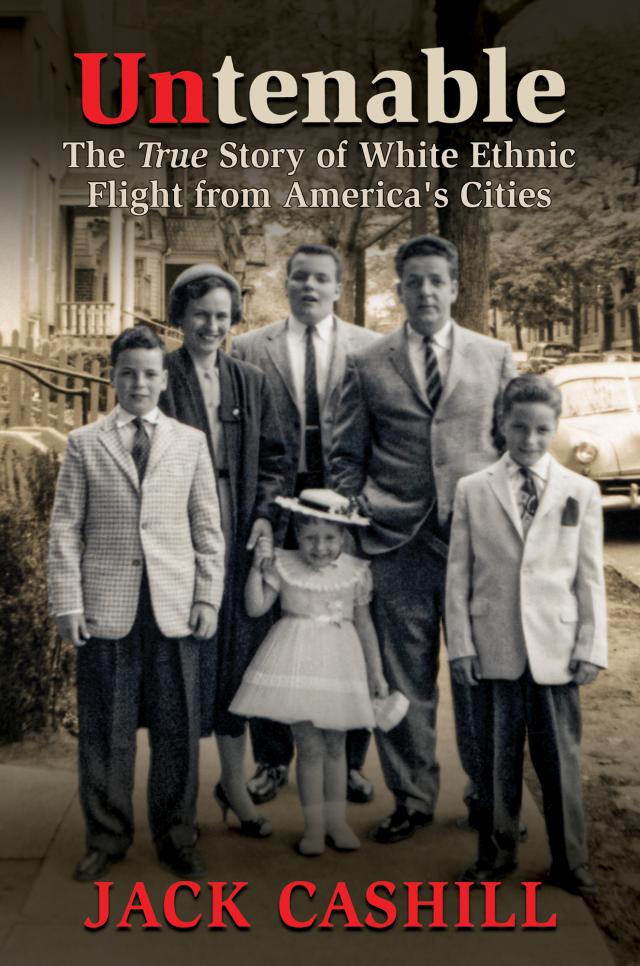
The True Story of White Ethnic Flight from America’s Cities
© 2023 by Jack Cashill
All Rights Reserved
Cover design by Joel Gilbert
This is a work of nonfiction. All people, locations, events, and situation are portrayed to the best of the author’s memory.
No part of this book may be reproduced, stored in a retrieval system, or transmitted by any means without the written permission of the author and publisher.
Post Hill Press
New York • Nashville
posthillpress.com
Published in the United States of America
Dedicated to Newark Police Detective William F. Cashill
Table of Contents
Snow Falls on Pigs
Untenable
Working Girls
Ethnic Cleansing
Georgia Tech
Straight and Narrow
Janitress
Trail of Tears
Free Range
Tabachnik’s Pickle Barrels
Homesteading
None of Our Boys
Endangered Species
Divided Highways
Fall of Rome
Ambush at the New York Times
The Last Hurrah
Political Considerations
Below Grade
Victimhood
Payback Time
Assisted Suicide
Willful Blindness
Over the Bridge
Rumbles
Rebellion
The Riots
After the Fall
Let’m Row
Goodbye, Columbus
Epiphany
Notes
Acknowledgments
Snow Falls on Pigs
The call came to my house in Kansas City on December 15, 1981. I remember the date well. It was my birthday. That night my wife, Joan, and I had tickets to see the Rolling Stones. We thought we might not get the chance again. After all, Mick Jagger was nearing forty.
I did not expect the call. The employer in question had turned me down months earlier for “political” reasons. Complicating matters, I had another offer pending, this one in Berkeley. I had good friends who lived there. They lobbied hard for their once charmed city. The restaurants are fabulous, they told me, so, too, the wineries, the scenery, and, of course, the weather. They were disappointed when I told them I wasn’t coming. They were shocked when I told them where I was going.
“Newark,” I said, rhyming it with “pork” as God intended.
“As in New Jersey?”
“The one and the same.”
“But why?”
“Simple,” I said. “It’s home.”
At its purest, home was a night like that of March 19, 1958, when snow, loads of it, all the more welcome for its late arrival, fell on Pigs. Pigs was shorthand for Pigtails Alley, the magical stretch of broken asphalt and ground glass that ran unseen by adult eyes down the length of our block before doglegging to the west just short of block’s end.
With the snow falling so abundantly, no one needed prompting. We all came out. From the Myrtle Avenue side, it was me and my brother Bob, Irish twins, born within a year of each other, he the older, a fact he never let me forget. From down Myrtle a few houses came broken-home Bobby. From the Roseville Avenue side, directly across Pigs, came Richie, our leader, and his wild little brother Ronnie. From farther down Roseville were Roger and his pesky little brother Norman, Sean and his wee little brother Brendan, and Earl, my fellow Dodger fan. From Orange Street, the commercial corridor at block’s end, came Bobby and his older, slightly “touched” brother George, and Artie, a little scrapper we had captured not long before. From farther up Roseville came Paul, the rarest of all local fauna, an only child, and Donato, new not just to the block but to the country.
In a way, we were all new to the country. Nearly every one of us had living relatives who had been born elsewhere—Ireland, Italy, Germany, Hungary. Earl was the exception. His family had been in America since at least 1808, the year the Constitution banned the importation of slaves. We were “diverse” then without knowing or caring that we were. According to the 1950 census, immigrants from fourteen different countries, including outliers like Finland and Turkey, lived on just the Myrtle side of the block.
In Pigs, none of that mattered. All that did matter was if you could run fast enough and dive hard enough on your Flexible Flyer to sled headfirst down to the dogleg. The slope in Pigs was lively enough to keep us flying all night. With the alley’s sole streetlight already lit, we had no natural signal to call the evening over. We did have, however, my father, a police officer and the most authoritative presence on the block. At some point, he would sense the time was right for his signature whistle, a beckoning homeward as final and plaintive as “Taps”—a long low note, a short high note, a long low note. Upon hearing it, we all knew the sledding was done and God was nigh.
That wintry night in March, the snow was general all over the northeast. Kids like us in cities big and small, from Camden to Chicago, from Buffalo to Baltimore, were out sledding on their slopes, many likely steeper than ours, but none as special. In Pigs, as elsewhere, we knew these moments would not last forever, but we had no idea how short-lived they would be. Within a dozen years, give or take, our families, thousands of them, hundreds of thousands, millions, would be coldly uprooted and randomly dispersed.
In our case, the removal would be swift and brutal. By the end of the 1960s, the state had razed many of our homes, mine included. A lethal riot had scorched the neighborhood. My friends and their families had scattered to the winds, and a twenty-foot-deep trench as wide as a tennis court forever severed the north end of Pigs from the south. To the degree anyone beyond our world noticed, it was to scold us for our very displacement.
Within five years of that snowy March night, some of the same forces that scattered us led to the sudden and shocking death of my father, a gentleman from sole to crown. It is for his sake, and the sake of all the dispossessed, that I share the saga of our unwelcome diaspora. “Tell the story of your village,” said Dostoevsky. “If you tell it well, you will have told the story of the world.”1
Untenable
In her massive 2018 bestseller, Becoming, and on the arena tour that followed, Michelle Obama laid out for the world her version of “White flight.” Michelle was at her harshest and most specific at a 2019 Obama Foundation forum. “As families like ours, upstanding families like ours, who were doing everything we were supposed to do and better, as we moved in, White folks moved out,” she told the moderator, adding, “They were afraid of what our families represented.”
To drive the injustice home, Michelle, pointing to herself and to her mild-mannered brother Craig, continued, “I wanna remind White folks that y’all were running from us, and y’all still runnin’.” Among the things that unnerved White people, said Michelle, were “the color of our skin” and the “texture of our hair.”2
My friends from Pigs have a slightly different take on White flight. I asked one lifelong friend, a loyal Democrat, why he and his widowed mother finally left our block in the early 1970s, twenty years after the first African American families moved in. He searched a minute for the right set of words and then simply said, “It became untenable.” When I asked what “untenable” meant,” he answered, “When your mother gets mugged for the second time, that’s untenable. When your home gets broken into for the second time, that’s untenable.”
There is no understanding what really happened to Newark and other troubled cities without knowing a little about the White ethnics who inhabited those cities and their attachment to the neighborhoods they lived in. Almost to a person, they or their kin came to America for the very qualities now sadly absent in too many cities: freedom, security, the rule of law, opportunity. For the first Cashill to come to America, that opportunity was a lifeline.
Not until I came back to Newark in 1982 did I discover who that first Cashill was. With little to guide me, I stumbled upon his grave on a spooky summer eve in St. Paul’s Cemetery on Nassau Street in Princeton. After much wandering about, I found my great-great-grandfather, John Cashell, from County Waterford in Ireland. His American-born son, John D. Cashill, was buried nearby. So, too, was John D.’s wife, Catherine Kane Cashill, and her father—an unexpected find—great-great-granddad Patrick Kane from County Cavan.
Names changed frequently in those days. The original John Cashell’s descendants went by either “Cashill” or “Cashel,” but not “Cashell,” the name on the elder John’s tombstone. As a brief aside, while still in academia, I attended a presentation by two Rutgers professors who had an insight on name changes. The two made a film starring themselves ca noeing up New Jersey’s Raritan River and embarking at Ellis Island. There they inflicted on each other the kind of indignities they imagined the new arrivals suffered, none more heartrending than the butchering of the newcomers’ names. So traumatic was the experience that the profs thought it fair to compare Ellis Island to—hang on here—Auschwitz. During the Q & A, I suggested that since the average immigrant spent only an hour or two on Ellis Island, might not the local DMV be a more apt point of comparison than a Nazi crematorium? As the reader might suspect, I was not long for academe.
John and his wife, Ann, set out from Waterford for America in 1847—Black ’47, as the Irish call it—the darkest year of that country’s horrific potato famine. Reading about the famine makes one realize how relative, when used in a contemporary American context, are words like “poverty,” “hunger,” or “hard times.” The blight hit the potato-rich County Waterford particularly hard. A local reporter shared his observations: “The poor are dying like rotten sheep, in fact they are melting down into the clay by the sides of the ditches…. The bodies remain for whole weeks in those places unburied. In a corner of the vegetable shambles, a man was dead for five days.”3 In a word, Ireland had become untenable.
Those who could get out got out. Those who could not, many of them at least, died—more than a million dead and another million departed during the four famine years, 1845–49. Another million would leave in the next decade, nearly halving the country’s population. John’s landlord in Ireland, either out of charity or greed, may have paid his passage to America. This happened often. Whatever his motive, the landlord could then rededicate the vacated property to more productive purposes than, say, growing rotten potatoes. It is possible, too, that John and Ann had their passage paid by an American farmer in exchange for a period of indentured servitude. That happened as well. In any case, John first shows up on the census as a laborer living in rural New Jersey.
I do not know the details of John and Ann’s departure, but an estimated 20 percent of those who left Ireland for North America in 1847 did not reach our shores alive. There were many ways to die en route, none of them pretty. John and Ann were among the blessed. By extension, so too was I. Their exodus enabled me to come of age in the most bountiful nation in the most bountiful time in the history of the world. The Irish are legendary for their grudges, but I have not earned the right to bear one against whoever sent John and Ann packing.
If “poverty” can only be understood as a relative term in an American context, the same holds true for “diaspora,” a word derived from the Greek for “disperse.” In the nineteenth century, when Irish emigrants approached their departure date, friends and family would stage an “American wake,” less in their honor than in their memory. These were melancholy affairs. The folks left behind did not expect to see the departed ever again. By contrast, when ethnic neighborhoods emptied in America, those leaving had at least the hope of maintaining contact with their old friends and neighbors, even if they rarely did.
The one burden we had to bear that our ancestors did not was the contempt of our betters for “fleeing.” Here is how Robin DiAngelo, among the most influential “antiracists,” sums up our collective plight: “White families fled from cities to the suburbs to escape the influx of people of color, a process socialogists [sic] term White flight. They wrote covenants to keep schools and neighborhoods segregated and forbade cross-racial dating.”4 DiAngelo’s analysis of “White flight” is no more accurate than her spelling of “sociologist.” Nonetheless, she makes more than $700,000 a year reminding smug White people of the “fragility” of their less enlightened peers. Were DiAngelo—born Robin Taylor—to tell the true story of America’s Great Ethnic Diaspora, her speaking fees would shrivel to nothing.
Unlike DiAngelo, Amiri Baraka expressed at least an interest in the fate of the displaced. Born Leroy Jones, later changed to LeRoi Jones, Baraka grew up in an integrated neighborhood less than a mile from where I did and attended our local high school, Barringer. After speaking of his White acquaintances, Baraka writes in his useful memoir, The Autobiography of LeRoi Jones, “I often wonder what those guys and girls carried away from that experience with us and what they make of it.”5 Unfortunately, Baraka never got around to asking. Then again, if he had asked, and had listened, he might never have been named New Jersey poet laureate. He got that title by neither knowing nor caring.
It is remarkable, given the social and political consequences of their exodus, that no one of note has asked “those guys and girls” what they made of their experience in America’s collapsing cities. If writers had asked, they would have learned quickly just how fruitless it is to find meaning in the collective “whiteness” of the urban dispossessed. In Newark, as elsewhere, each ethnic group reacted differently to the pressures brought to bear on its neighborhood. Of course, too, White ethnics were not the only ones to “flee.” Blacks, Hispanics, and Asians left the cities for much the same reasons urban Whites did, but only Whites were shamed for leaving, thus the word “White” in the book’s title.
In February 2009, weeks after Barack Obama’s inauguration, Attorney General Eric Holder caught heat for saying what is obviously true: “Though this nation has proudly thought of itself as an ethnic melting pot, in things racial we have always been and continue to be, in too many ways, essentially a nation of cowards.” Holder elaborated, again accurately, “Certain subjects are off limits and that to explore them risks at best embarrassment and at worst the questioning of one’s character.” Unfortunately, Holder’s observation is more true now than then—in no small part due to the ready use of racial slander by Holder and his allies. Given the precarious racial zeitgeist, I will use just the first names of those who spoke with me about our shared experience. As to my childhood friends, I will use the names I knew you by then. Sorry, guys.
This shared experience enables me to write with some confidence about Newark in general and “White flight” writ large. About the collapse of Roseville, my own neighborhood, it enables me to write authoritatively. We were there. We saw it. We know what we saw. In 1975, Time magazine would call Newark “the worst city in America.” Those of us who lived there know why. Our city suffered every form of governmental abuse, local and national, a modern democracy can dish out. Newark’s shellacking was extreme but not exceptional. A half-dozen other New Jersey cities—and scores more throughout the Northeast and Midwest—suffered similar abuse.
As the Department of Justice reminds us, it is important to know the impact—“emotional, physical, and financial”—a crime has had on its victims.6 Consider what follows a victim impact statement. Those eager to “blame the victim” are reading the wrong book.
Working Girls
Given that no adult ever visited Pigtails Alley—save for the occasional rummy—the alley’s original purpose was lost to history. When I posted a photo of Pigs on a neighborhood Facebook page, a local real estate reporter asked about the name. Richie, from across the alley, posted, “The story is that years and years ago they raised pigs in that area, that’s the only story I ever heard.”
I chimed in, “That is basically the same story I heard.”
Other than in my own postings, “Pigtails Alley” shows up absolutely nowhere on Google. Neighborhood history, however, suggests a rationale for the alley’s name and function. Until about 1850, the area had been farmland. The first street opened was Myrtle Avenue, just a block long. Roseville Avenue was likely the second north-south street. Orange Street meanwhile was emerging as the dominant east-west commercial corridor. If a farmer wanted to bring his pigs to market on Orange Street, local developers would not want him to drive those noisome little porkers down their newly platted streets. Just as Pigs sheltered us kids from querulous neighbors, Pigs likely did much the same for the pigs. The dogleg on to Myrtle would allow the farmer to muster his charges before releasing them into the traffic on Orange. Or so I imagine.