

All up, p.1
All Up, page 1
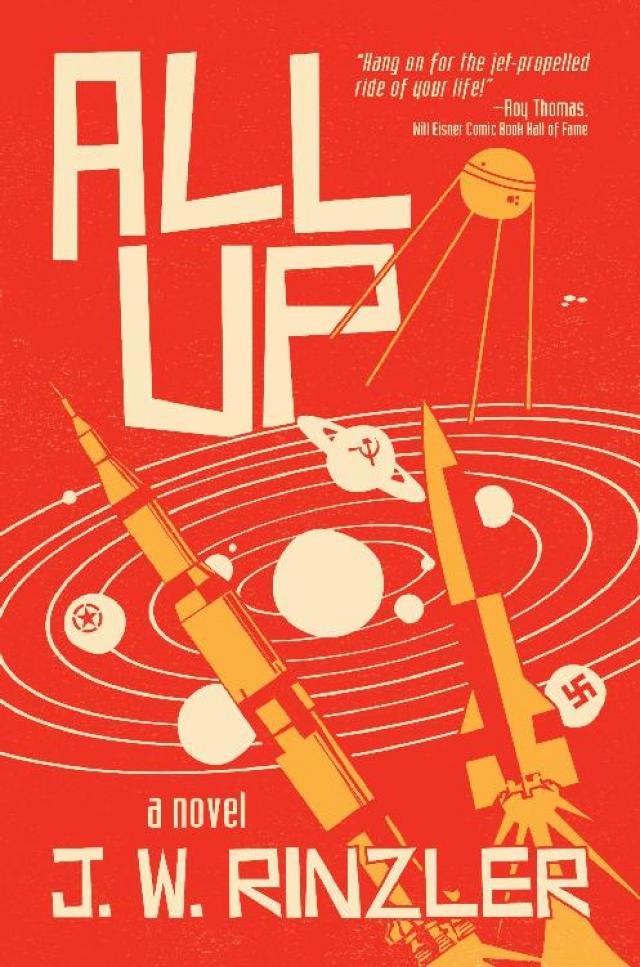


Advance Praise for
All Up
“All Up takes the reader beyond the usual descriptions of the challenges and achievements of the technical teams by describing the human reality behind the extraordinary efforts of intelligence and will that made it all possible. Imagine if we could meet von Braun and Korolev, and hear them speak about their lives, their failures and hopes, and their eventual successes. That is the story told in this exceptional book, a timely contribution and a valuable guide to the stunning voyages to come.”
—DR. JACQUES F. VALLÉE, computer scientist,
winner of the Jules Verne Award for science fiction
“All Up takes us behind the scenes of the Space Race—but with a fictional twist. With its fascinating personalities that only Rinzler could describe, All Up can’t be put down.”
—DAVID MANDEL, executive producer of Veep
“All Up ingeniously weaves together the stuff of history and science fiction…of what really happened, and what seems both fantastic and yet almost possible, where fiction lifts off from fact like a rocket achieving escape velocity… So just hang on for the jet-propelled ride of your life. You won’t want to stop till you discover how it all comes out!”
—ROY THOMAS, author/editor, member of the
Will Eisner Comic Book Hall of Fame
“All Up reminds me in some ways of the great novels by James Michener and Leon Uris that teach us history in a fictional manner.”
—DAVID CHUDWIN, author of I Was a Teenage Space Reporter:
From Apollo 11 to Our Future in Space
“All Up… What a space journey from planet Earth to the Moon! If Stanley Kubrick wove his Odyssey into the music of Richard Strauss, Rinzler’s has the Faustian spirit of Wagnerian opera in it. I can see dozens of academic research articles growing out of such fertile soil.”
—DR. HANS VOLKER WOLF, former director of
Goethe Institute Malaysia, Senior Lecturer at University of Malaya
A PERMUTED PRESS BOOK
All Up
© 2020 by J. W. Rinzler
All Rights Reserved
ISBN: 978-1-68261-901-8
ISBN (eBook): 978-1-68261-902-5
Cover art by Cody Corcoran
Interior design and composition by Greg Johnson, Textbook Perfect
This book is a work of alternative historical fiction. All incidents, dialogue, and characters aside from the actual historical figures are products of the author’s imagination. While they are based around real people, any incidents or dialogue involving the historical figures are fictional and are not intended to depict actual events or commentary. In all other respects, any resemblance to actual persons, living or dead, events, or locales is purely coincidental.
No part of this book may be reproduced, stored in a retrieval system, or transmitted by any means without the written permission of the author and publisher.
Permuted Press, LLC
New York • Nashville
permutedpress.com
Published in the United States of America
To the writers, illustrators, filmmakers, and visionaries who imagined space voyages long before they took place, and to the men and women (and unwitting animals) who took those space voyages, whose work, dedication, engineering, constructions, theories, and rockets made them possible, past, present, and future.
CONTENTS
Prelude
ACT I
Chapter 1
Chapter 2
Chapter 3
Chapter 4
Chapter 5
Chapter 6
Chapter 7
Chapter 8
ACT II
Chapter 9
Chapter 10
Chapter 11
Chapter 12
Chapter 13
Chapter 14
Chapter 15
Chapter 16
Chapter 17
Chapter 18
Chapter 19
Chapter 20
Chapter 21
Chapter 22
Chapter 23
Chapter 24
Chapter 25
Chapter 26
Chapter 27
Chapter 28
Chapter 29
Chapter 30
Chapter 31
Chapter 32
Chapter 33
Chapter 34
Chapter 35
Chapter 36
Chapter 37
Chapter 38
Chapter 39
Chapter 40
Chapter 41
Chapter 42
Chapter 43
Chapter 44
Chapter 45
Chapter 46
Chapter 47
Chapter 48
Chapter 49
Chapter 50
Chapter 51
Chapter 52
Chapter 53
Chapter 54
Chapter 55
Chapter 56
Chapter 57
Chapter 58
Chapter 59
Chapter 60
ACT III
Chapter 61
Chapter 62
Chapter 63
Chapter 64
Chapter 65
Chapter 66
Chapter 67
Chapter 68
Chapter 69
Chapter 70
Chapter 71
ACT IV
Chapter 72
Chapter 73
Chapter 74
Chapter 75
Chapter 76
Chapter 77
Chapter 78
Chapter 79
Chapter 80
Chapter 81
Chapter 82
Chapter 83
ACT V
Chapter 84
Chapter 85
Chapter 86
Chapter 87
Chapter 88
Chapter 89
Chapter 90
Chapter 91
Chapter 92
Chapter 93
Chapter 94
Chapter 95
Chapter 96
Chapter 97
Chapter 98
Chapter 99
Chapter 100
Chapter 101
Chapter 102
Chapter 103
Chapter 104
Chapter 105
Chapter 106
Chapter 107
Chapter 108
Chapter 109
Chapter 110
Chapter 111
Chapter 112
Chapter 113
Chapter 114
Chapter 115
Chapter 116
Chapter 117
Chapter 118
Chapter 119
Chapter 120
Chapter 121
Chapter 122
Chapter 123
Chapter 124
Chapter 125
Chapter 126
Chapter 127
Epilogue
End Quote
Acknowledgments
PRINCIPAL PLAYERS
(In alphabetical order; title, rank, or affiliation usually corresponds to the player’s first appearance)
The Americans
Quincy Adams, agent, Central Intelligence Agency (CIA)
Buzz Aldrin, astronaut, National Aeronautics and Space Administration (NASA)
James Jesus Angleton, Associate Deputy Director of Operations for Counterintelligence, CIA
Neil Armstrong, test pilot, National Advisory Committee for Aeronautics (NACA)
Henry Harley “Hap” Arnold, General, Chief of the Air Corps
Frank Borman, astronaut, NASA
Vannevar Bush, Chairman of the Joint Research and Development Board of the Army and Navy
Michael Collins, astronaut, NASA
Calvin Cory, Major, Army Ordnance
Walt Disney, cofounder of the Walt Disney Studio
Allen Dulles, Director, CIA
John Foster Dulles, Secretary of State
Frederick Durant III, President of the International Astronautical Federation
Dwight D. Eisenhower, Supreme Commander of the Allied Forces
James Forrestal, Secretary of the Navy
Robert Gilruth, Director, Space Task Group
Robert Goddard, professor, physicist, and inventor/rocketeer
Lyndon B. Johnson, Senator
Theodore von Kármán, aerospace engineer, professor, Director of the California Institute of Technology, cofounder of the Jet Propulsion Laboratory (JPL)
John F. Kennedy, Congressman
Robert F. Kennedy, Attorney General
Chris Kraft, Flight Director, Space Task Group
George Mueller, Director, Apollo Program, NASA
Marvel Whiteside “Jack” Parsons, explosives expert, cofounder of JPL
Al Shepard, astronaut, NASA
Bruce Staftoy, Major, Army Ordnance
Harry S. Truman, President
James Webb, Chief Administrator, NASA
The British
Winston Churchill, Prime Minister
Reginald V. Jones, Assistant Director of Intelligence, Chief of Air Scientific Intelligence, MI6
Frederick “the Prof” Lindemann, Lord Cherwell, physicist, head of S Branch, science advisor to Winston Churchill
Cornelius “Connie” Ryan, journalist
Duncan “Sands” Sandys, Chairman of the War Cabinet Committee for Defense, Churchill’s son-in-law
The Germans and Austrians
Karl Heinrich Emil Becker, Lieutenant Colonel, Head of the Ballistics and Munitions Section of the HWA Weapons Testing Division
Magnus von Braun, chemical engineer, Wernher von Braun’s younger brother
Maria von Braun, Wernher von Braun’s wife
Sigismund von Braun, diplomat, Wernher von Braun’s older brother
Wernher von Braun, engineer/rocketeer
Kurt Debus, Flight Test Director/rocketeer
Arthur Dieter, Electrical and Guidance Systems/rocketeer
Walter Dornberger, Captain, Germany Army, rocketeer
Helmut Gröttrup, electrical engineer/rocketeer
Irmgard Gröttrup, Helmut Gröttrup’s wife
Heinrich Himmler, Reichsführer-SS
Adolf Hitler, Führer
Hans Kammler, Brigadeführer-SS
Fritz Lang, film director
Willy Ley, rocket and space travel enthusiast/writer
Hermann Oberth, physicist, engineer/rocketeer
Ernst Rees, Electrical and Engines, Fabrication and Assembly/rocketeer
Viktor Schomberger, inventor
Albert Speer, Minister of Armaments
Johannes Winkler, member of the Verein für Raumschiffahrt (early German rocket club)
The Russians
Boris Evseyevich Chertok, communications expert/rocketeer
Yuri Gagarin, cosmonaut
Mikhail Klavdievich Glushko, Engine Designer/rocketeer
Nikita Sergeyevich Khrushchev, Soviet Union Premier
Kseniya Maximilianovna Vincentini Korolev (Lyalya), doctor, Korolev’s first wife, Natasha’s mother
Natasha Korolev, daughter of Sergei Pavlovich and Kseniya Maximilianovna
Sergei Pavlovich Korolev, Chief Designer/rocketeer
Nina Ivanovna Kotenkova, translator, mistress to Korolev, his second wife
Vasily Pavlovich Mishin, engineer/rocketeer
Joseph Stalin, Soviet Union Premier
Dmitriy Fyodorovich Ustinov, People’s Commissar of Armaments
Leonid Alexandrovich Voskresenskiy, engineer
A note to readers of All Up: Newspaper headlines preceding each chapter did not occur on the exact date of the chapter’s events (except for a few instances); the headlines usually occurred days, weeks, or, more rarely, months before the chapter date. However, in all cases the headlines were taken from the newspapers as indicated.
Prelude
The Free Imperial City of Nuremberg
Friday, April 4, 1561
The little boy backed away from his mother, but she jabbed him in the stomach with a thick wooden cane and he doubled over.
With both hands she swung her heavy stick onto the boy’s back and flattened him to the threshing-room floor.
“Do not smile at him, do not relent,” growled the boy’s uncle from a stool not far from them. “If you are weak in little things, you will suffer in great ones.”
The mother screwed up her face in righteous anger and, stained gown fluttering, booted her son in the ribs. The seven-year-old rolled over and blinked at the wooden rafters in the farmhouse ceiling. He gasped for air. In the hazy morning light, he saw dancing dust motes.
“You dare not spare your child this beating.” His uncle shoved a poker at red coals in a brazier. He was shaping a metal lamp, and his other hand clenched a small hammer. “The rod will not kill him but will do him good.”
The boy tried to rise to his knees, so she smacked him on the side of his head and he tottered over again.
“When you strike the sinful body, you save the soul,” his uncle declared, bloodshot eyes rolling upward in a disfigured face. “You must raise your child in fear if you wish to find a blessing in him. You must crush his ribs before he is grown, or he will cease to obey.”
The mother grabbed her son by his short brown hair, she yanked and shook him—“Runt!” she shrieked—and flung him into a side stall usually reserved for cattle.
She slammed the wooden door and clapped down its bar.
Inside the dark pen, the boy put three fingers to his head and touched blood. He crawled deep into a corner, accustomed to the odor of piss and manure, and curled up in a pile of hay. His rags couldn’t keep him warm, so he held his bent legs close. He lay that way for long minutes, whimpering softly. His body shook with a jolt—his crying might be heard—and a wall shot up in his mind to cut off the pain.
He closed his eyes.
It was quiet when the little boy opened them and he was hungry. He stared at the intricate coiled patterns in the wood slats for a long while, until shafts of light shot through the seams, sheets of orange, yellow, and red. Strange sounds seeped in from the outside—deep rumblings, then a high-pitched whine.
He sat up, wild and desperate.
The Last Judgment?
Curiosity replaced misery.
He recalled that the stall had been left empty because it wasn’t sound. He burrowed through the straw and found a small hole. He kicked at the rotting boards to loosen them, then rammed through with his good shoulder. Once through the opening, he ran in the direction of the flashes and booms.
At the top of a neighboring hill, he gazed above him in astonishment.
On the same mound of the Reichsstadt Nürnberg, merchants and farmers had already assembled, and a number of wealthy men and women dismounted from horses held by liveried servants. Behind them the walled city with its many towers straddled the river. From its eastern gate, others hurried to join them. They, too, looked up at the sky. Their place afforded an unblocked view of the extraordinary sight: white lights and large globes as big as a rich man’s house. The undersides of the globes glowed a dark crimson red, their tops shimmered blue and black. They dived and swooped like falcons before the afternoon sun.
The boy marveled at the appearance of two great silver tubes. Their noise grew louder, more threatening, and he looked to his betters for guidance.
“Tricks and illusions!” murmured a learned craftsman.
“Blood-colored crosses,” said a lean candlemaker.
“Like floating cannons,” another remarked. “They come arrayed for battle.”
The boy glanced back at his thatched farmhouse, afraid he might be missed and pursued, but no one stirred.
He moved closer to one of the finely dressed gentry, who had a black stiletto beard and a twisted stance. He’d never come so close to a rich man, and admired the man’s clothes nearly as much as the strange objects cartwheeling above. Surely the aristocrat descended from the ancient nobility, with his crimson cloak, black vest, and puffed sleeves. A gold band hung around his neck, with a circular gem, a crooked golden spiral set in red clay.
Feeling the boy’s eyes, the bearded man cocked his head sideways. “Perhaps I’ve arranged this whole theater,” he said.
The boy’s blue eyes widened, but a bright yellow flash made him look to the west.
“One of the globes disappeared!” someone shouted.
Seven more pale-blue orbs sprinkled the sky, darting in and out of long white clouds. The bright lights of the strange objects reflected orange in the alabaster faces of the wealthier men and women. At least a hundred people had gathered.
“It is a dreadful apparition!” a peasant exclaimed.
“It is a sign of rods and whips,” moaned the candlemaker. “The Last Judgment is upon us.”
The candlemaker scurried off. Yet his words confirmed the boy’s secret desire, so he stayed and summoned the courage to request of the bearded man, “If you arranged it, tell me what is happening.”
“Is it not a cavalry battle, or are you stupid?” he answered. “A skirmish between demons of warring factions,” he sniffed. “I smell yellow crystals…”
“Are we in danger?”
The aristocrat didn’t say. He strutted away and took the reins from his groom, who inclined his head in deference. The rich man mounted his black steed and rode off. His retinue followed, and the child noted their foreign manner of dress, with knee-length heavy skirts of salmon and lemon. They, too, wore strange jewels.
When one of the globes split into flames, three women wailed. It dived silent and low over their heads, so closely pursued by a spear-like silver tube that the remaining men cowered. The boy stood fast and even reached up to try to touch its underbelly.






