

Iron maiden, p.1
Iron Maiden, page 1


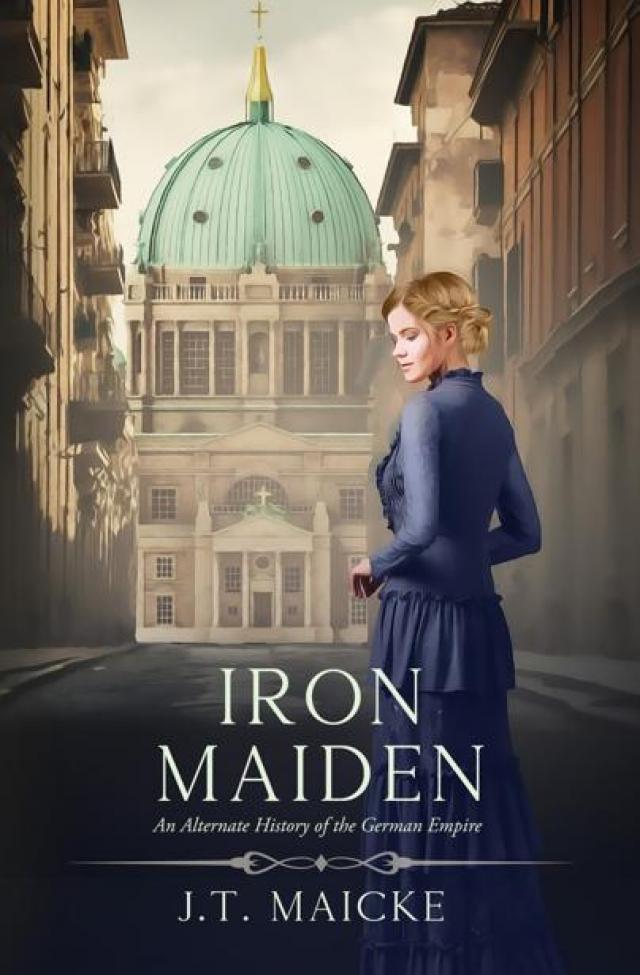
Iron Maiden
J.T. Maicke
Copyright © 2023, J. T. Maicke
Published by:
DX Varos Publishing, Inc.
7665 E. Eastman Ave. #B101
Denver, CO 80231
This book contains material protected under International and Federal Copyright Laws and Treaties. Any unauthorized reprint or use of this material is prohibited. No part of this book may be reproduced or transmitted in any form or by any means, electronic or mechanical, including photocopying, recording, or by any information storage and retrieval system without express written permission from the author.
Book cover design and layout by Ellie Bockert Augsburger of Creative Digital Studios.
www.CreativeDigitalStudios.com
Cover design features:
Vintage evening dress. Elegant classic brown gown. Brunette lady posing in studio. Full length outfit in bohemian style with lond sleeves, frills, ruffles and lace inserts. Female glamour look by Stylish_Pics. Old castle in the old town by jang
ISBN: 978-1-955065-91-7 (paperback)
ISBN: 978-1-955065-92-4 (ebook)
Printed in the United States of America
ALL RIGHTS RESERVED
For my princesses, Marisa and Addison.
If history were taught in the form of stories, it would never be forgotten,
--Rudyard Kipling
Table of Contents
Chapter 1: Christa
Chapter 2: Heidelberg
Chapter 3: Bloody Sunday
Chapter 4: The Empty Throne
Chapter 5: The People’s Queen
Chapter 6: New Beginnings
Chapter 7: Departments
Chapter 8: Diplomacy
Chapter 9: Plans
Chapter 10: Lighting the Fuse
Chapter 11: The Iron Dice Roll
Chapter 12: Opening the Gate
Chapter 13: Counterattacks
Chapter 14: Subterfuge
Chapter 15: Last Gasps
Chapter 16: Armistice
Chapter 17: Bloody Tuesday
Chapter 18: Settling Accounts
Chapter 19: Über Alles
Author’s Notes
About the Author
1
Christa
The young rider walked her chestnut gelding over the rolling green hills of her father’s estate. The girl was outfitted in boyish riding attire. No skirts for her! Dressed in tight, dark grey leather riding trousers, a short, quilted black jacket, and shod with highly-polished, black riding boots that reached up to just below her knees, the girl would have looked like a tiny Prussian cavalryman, had she been wearing a saber and the Hussar’s traditional fur shako. As it was, she peered out with crystal blue eyes from beneath the wide brim of a battered, grey slouch hat of the type worn by German soldiers in the Reich’s African colonies. The hat hid part of her face and covered her light blonde hair with the exception of the French braid running down to between her shoulder blades, tied at the end with a black ribbon.
It was a fine day for a ride in late March 1885, the mid-morning sun just beginning to burn through the fog and mist which always seemed to plague Berlin and its environs through the beginning of spring. From her vantage point, the girl could see the light sparkling off the wave tops of the nearby lake as its waters gently churned beneath the Glienicke Bridge. To the left of the bridge, she could see the city of Potsdam and, before it, Babelsberg Palace, with its curious mixture of octagonal, round, and square turrets, one of the residences of the elderly Kaiser Wilhelm I and his wife. Further to the west, she could make out the green-corroded copper dome of the New Palace in Sanssouci Park, the summer residence of the Crown Prince and his family.
Suddenly, the gelding snorted, anxious for exercise and urging his mistress to let him run. The girl reached down and patted the horse’s neck, lovingly.
“Easy, Hektor,” she cooed. “We will go very soon.”
The horse was a Trakehner, a light, warmblood variety originally developed 150 years earlier at an East Prussian stud farm near the town of Trakehnen. The girl’s father and grandfather both had an admiration for the breed and had raised them on their estates for decades. A cross between the powerful, hearty old Prussian Schwaikenpferd ponies dating back to the 13th century Teutonic Knights with Thoroughbred, Arabian, and Hanoverian strains, the Trakehner was both athletic and trainable, combining speed with strength and endurance, and made an excellent medium-build cavalry horse. Hektor, standing at fifteen hands, was on the smaller end in size for his breed and was a gift from the girl’s father for her tenth birthday the previous month. The young mistress and her horse adored one another.
The rider’s head snapped up as she was broken out of her reverie by the wet, clopping sound of galloping hooves over soft turf in the distance accompanied by feminine shrieks. Peering to the northwest, the girl saw a woman on a horse, which clearly was out of control, speeding down the gently sloping field about a half kilometer away. At their present rate of speed and direction, the distressed rider and her berserk horse would pass the girl and Hektor about a quarter kilometer to their left.
“Come on, Hektor!” ordered the girl, biting her lower lip in excitement and anxiety. She flicked the reins, urged her mount forward with a nudge from her heels, and crouched low to her horse’s neck. The rider refused to wear spurs or to use a riding crop. She considered such implements cruel and unnecessary and she refused to hurt her horse who, along with her older brother, was her best friend in the world. Hektor responded gleefully, happy to finally be allowed to blow off some steam. He let out another snort and a loud neigh before jumping forward to cross the field and chase down his target.
The lady’s mount, a beautiful, black Thoroughbred mare, was larger than Hektor but, despite its agitation, appeared to be tiring and was no match for the younger, well-rested, and powerful Trakehner. The girl quickly closed the distance just as the runaway horse was nearing a tree line. Before the young rider could reach out to grab the mare’s bridle, however, the horse stumbled and the woman bounced from the saddle with a squeal and hit the damp ground. The girl managed to halt the mare, turned both horses, and walked them back toward the distressed woman who sat on the grass, clutching her left ankle.
“Oh, dear! Oh my, I’ve done it now. Oh, Martha, you naughty girl!” the lady scolded the mare. To the girl’s surprise, the woman was speaking English! She leapt from Hektor’s saddle, walked the gelding and the mare over to a nearby fallen log at the edge of the tree line, and tied them securely. She quickly congratulated Hektor on a fine race and cooed to and stroked the mare in an effort to further quiet the exhausted horse. Once she was certain the mare was calm, she ran back to the lady and helped pull her up to her feet. The woman, obviously wealthy and well-born, was dressed in the fashion worn by upper class equestriennes of the day, with an olive jacket, black skirts over black riding pants, and deeply polished knee boots, now splattered with mud. Her brown hair, now in a bit of disarray, clearly had been expertly coiffured. The girl picked up the lady’s black top hat and handed it to her.
“Come, Madam,” she said calmly to the lady in English. “Please allow me to assist you.” The girl held out an arm to help the lady hobble over and sit on the log where the horses were tied.
“You speak English!” the lady exclaimed, her eyes widening before she winced and limped with the girl’s help to her seat.
“Yes, Madam,” answered the girl with a nod. She then ran over to Hektor, grabbed a canteen and a scarf from a small saddle bag, and brought them back to the lady. “Here, Madam. Please have a drink while I inspect your injury,” the girl said, handing the woman the canteen. She dropped to her knee and gently palpitated the lady’s ankle.
“Your ankle does not appear to be broken, but you may have a sprain,” the girl stated in a detached, almost professional manner. “It appears to be swelling somewhat. With your permission, I will wrap it with this scarf and then seek assistance.”
“Thank you, young man,” answered the lady. The girl, who had not had an opportunity to remove her slouch hat, was about to correct her when she heard the pounding of hooves from several riders approaching from the same direction the lady and her runaway mare had come. The girl stood, turned, and peered into the distance. The riders wore cavalry uniforms and one was carrying a distinct guidon attached to the end of a lance.
“Cuirassiers!” the girl murmured, squinting her eyes quizzically. “And that is the imperial standard!” she added, now with wonder in her voice. She then spun around and stared at the injured lady with eyes the size of saucers, finally recognizing the woman. “Euere königliche Hoheit!”—Your Royal Highness—she gasped in German, dropping to a knee and bowing her head before the lady.
“Her Royal Highness is over here, sir!” called one of the cuirassiers. Another rider approached behind the cavalrymen. He was also in uniform but dressed more splendidly with loops of gold braid and numerous medals bedecking his tunic. He was also older than the cavalrymen, clearly middle aged, with wavy brown hair and a long, thick brown beard just beginning to turn grey around his mouth and his chin.
He was Crown Prince Friedrich, son of Kaiser Wilhelm I and heir to the thrones of Prussia and of the German Empire. Seated on the log before the girl was his wife, Victoria, the Princess Royal and eldest daughter of the English sovereign Victoria, Queen of Great Britain and Ireland and Empress of India.
“Leaping from his saddle, Prince Friedrich ran to his wife. “Are you a lright, my dear?” he asked in German, his face painted with concern.
“You should ask my rescuer, Fritz,” smiled Princess Victoria, answering her husband in German while glancing down at the kneeling girl. “This young gentleman here is both a brave horseman and a fine physician. Please, stand, my young sir.”
“I beg your pardon, Your Royal Highness” said the girl, coming to her feet and sweeping off her slouch hat. “But I am no gentleman.”
“A girl!” exclaimed Victoria, jolting upright on her log seat. Prince Friedrich gaped but then broke into a wide grin and chuckled while the cavalrymen murmured to one another in surprise.
“What is your name, young lady,” asked Friedrich.
“I am Christiana Maria Louisa von Preussen, if it please Your Royal Highness,” answered the girl, her curtsy to the Crown Prince and his wife looking somewhat comical in her masculine riding attire. “But I am known to my family as Christa.”
“Of course!” answered Prince Friedrich. “You are the youngest daughter of my cousin, Friedrich Karl, are you not? We have not seen you since your baptism, Princess. That must have been…”
“I just turned ten years old, last month, sir,” helped Christa.
“Indeed,” responded the Crown Prince. “And you are staying at Jagdschloss Glienicke?” The Crown Prince was referring to the Berlin estate of Christa’s father, Prince Friedrich Karl of Prussia, nephew to the elderly Kaiser. Although the residence was referred to as a Jagdschloss—a “hunting manor”—it was in truth a small palace situated in the countryside, across Glienicke Lake from Potsdam, approximately 25 kilometers southwest from the heart of Berlin.
“Yes, sir. If I may be so bold, sir, the Crown Princess is in no condition to ride. If you will allow me, I will ride back to the manor and return with a suitable carriage to convey the Princess back to your palace in central Berlin. However, your palace is quite distant and you are most welcome to come to our home. The manor is just over the rise to the south and Dr. Rudolf Virchow is visiting us this week. He would be available to provide a professional diagnosis and treatment of the Crown Princess’ injury. By your leave, I can ride swiftly back to the manor and return with a carriage within minutes.
“Dr. Virchow?” asked Prince Friedrich. “The noted pathologist?” He turned to his wife, “I daresay, my dear, a more eminent physician could not be found in such close proximity at this hour on a Saturday.”
The Crown Princess smiled and nodded. Turning to Christa, she said, “We accept your gracious hospitality, Christa, and we thank you for your kind assistance.” In truth, Victoria’s injury was minor and the royal couple could have easily traveled back to their palace in central Berlin, but both she and Friedrich were absolutely enchanted with Christa and curious to learn more about this precocious girl. Neither had ever met a child—girl or boy—so capable, confident, and well-spoken at such a young age.
Christa beamed, dropped another quick curtsey to the royal couple, turned, ran, and leapt back onto Hektor. She trotted the gelding for several yards before urging him into a gallop so as to avoid spraying the royal party with mud clods from Hektor’s hooves. She quickly shot away and disappeared over the top of the rise.
“What an extraordinary girl,” murmured Prince Friedrich with awe.
***
Christa returned a short time later mounted on Hektor, accompanied by a four-wheeled buggy with driver and two other riders: her father, Prince Friedrich Karl, cousin to the Crown Prince, and Christa’s brother, Leopold, ten years her senior. As soon as the Crown Princess was assisted into the carriage, Friedrich Karl commanded his daughter to return immediately to the manor with a stern order to change into appropriate attire, much to her chagrin. For his part, Friedrich Karl, an army commander and hero of the Franco-Prussian War of 1870-71, was resplendent in his field marshal’s uniform. His tunic was bedecked with various medals including the Pour le Merite and the Orders of the Black and Red Eagles—the highest military honors of the German Empire—and he wore his gleaming, spiked Pickelhaube headgear. Leopold, a senior lieutenant in the 1st Guards Cavalry Brigade, was dressed in his blue cuirassier’s uniform with gleaming helmet.
When the buggy and riders arrived in the cobblestone courtyard in front of the three-story manor, Christa and her mother, Princess Maria Anna of Anhalt-Dessau, dressed in formal, full-length gowns, and Dr. Virchow were already waiting at the main entrance to greet them. Christa’s three older sisters had married and moved away years earlier; a fourth older sister had died in infancy.
With her petite features, flowing brown hair, and angelic smile, Christa’s mother was considered by many social observers to be one of the most beautiful women of her generation. Princess Maria Anna had successfully steered her three older daughters through the upper echelons of Berlin society and had worked to arrange propitious marriages for them within the higher European nobility.
Princess Maria Anna’s marriage to Christa’s father had not been a happy one. Prince Friedrich Karl was a taciturn, bad-tempered man by disposition. Christa had overheard rumors among the servants that her father had beaten her mother after the birth of their fourth daughter for not having produced a son. Middle age, combined with the eventual birth of a son and heir, Leopold, their fifth child, had thawed Prince Friedrich Karl’s icy manner somewhat. Nowadays, he and his wife were civil, if not loving, with one another. While he may not have been a kind and loving husband, Friedrich Karl was a devoted father. He loved Christa more than his older girls and almost as much as his son. Despite his conservative attitudes on all issues, including the role of women in society, Friedrich Karl admired the girl’s spunk and was often entertained by her refusal to accept the societal conventions and boundaries to which her older sisters and other highborn young ladies of this age so easily acquiesced. His gifting of the beautiful gelding, Hektor, was one of the ways he expressed regard for his sixth and youngest child.
After the Crown Princess was moved into a plush, comfortable armchair in the drawing room of the estate, Dr. Virchow unwrapped Christa’s scarf from Victoria’s ankle and examined her injury. After he confirmed Christa’s diagnosis of a sprain, both Victoria and her husband looked over at the young princess and nodded and smiled. Christa blushed in response. A servant was dispatched to fetch cold compresses, which Virchow wrapped around the royal ankle with advice that the Crown Princess remain off her feet for a week. In the meantime, light refreshments were laid out, including sliced cheeses and cold meats, petite mushroom omelets, fresh berries with cream, and champaign. The servants brought a tray table to the Crown Princess’ seat so she could enjoy some of the food. Christa stood next to Victoria and waited on her as if she were the princess’ equerry. Christa’s mother sat nearby in a matching plush armchair with a small bowl of berries and cream.
“You look quite lovely in a formal gown, Christa,” said Victoria. “I am still quite embarrassed that I mistook you for a lad earlier.”
“Oh, Madam,” answered the girl, clasping her hands before her chest. “I am the one who was embarrassed! I should have recognized you immediately and introduced myself.” The Crown Princess went on to explain to Maria Anna the tale of how her horse had suddenly bolted and how Christa had come to her rescue.”
“Yes, cousin,” said Crown Prince Friedrich, turning toward Christa’s father. “Your daughter is quite the equestrienne.”
“Indeed, sir,” acknowledged Friedrich Karl, his voice suggesting a hint of pride. “She also enjoys hunting and is a rather good shot. I draw the line at fencing, however, although I suspect a certain lieutenant has been tutoring her behind my back.” Christa’s father gave his son a sidelong glance. Leopold reddened and the Crown Prince chuckled indulgently in response.
Christa was somewhat perplexed by the entire dialogue. Why was it so strange that she enjoyed riding, hunting, and even fencing? She was very good at all three pastimes. In fact, she honestly believed she was as fine a horseman as most men, including her older brother, and an even better marksman. Christa’s brother, Leopold, whom she simply called “Leo,” secretly had a smaller, lighter version of a cuirassier’s saber crafted for his little sister, and noted in private that her swordsmanship was coming along nicely.






