Omoo, p.1
Omoo, page 1


*This spirituous liquor derives its name from a considerable town in Peru, where it is manufactured in large quantities. It is well known along the whole western coast of South America, whence some of it has been exported to Australia. It is very cheap.
*A corruption of the French word savoir, much in use among sailors of all nations, and hence made familiar to many of the natives of Polynesia.
*For a few years past, more than one hundred and fifty sail have annually touched at Tahiti. They are principally whalemen, whose cruising-grounds lie in the vicinity. The harbor dues—going to the queen—are so high, that they have often been protested against. Jim, I believe, gets five silver dollars for every ship brought in.
*The Newtonian theory concerning the tides does not hold good at Tahiti; where, throughout the year, the waters uniformly commence ebbing at noon and midnight, and flow about sunset and daybreak. Hence the term Tooerar-Po is used alike to express high-water and midnight.
*I do not wish to be understood as applauding the flogging system practiced in men-of-war. As long, however, as navies are needed, there is no substitute for it. War being the greatest of evils, all its accessories necessarily partake of the same character; and this is about all that can be said in defense of flogging.3
*Concerning the singular ignorance of the natives respecting their own country, it may be here observed, that a considerable inland lake—Whaiherea by name—is known to exist, although their accounts of it strangely vary. Some told me it had no bottom, no outlet, and no inlet; others, that it fed all the streams on the island. A sailor of my acquaintance said, that he once visited this marvelous lake, as one of an exploring party from an English sloop-of-war. It was found to be a great curiosity: very small, deep, and green; a choice well of water bottled up among the mountains, and abounding with delicious fish.
*Meaning the showy image of the Virgin in the little Catholic chapel.
† The word “arva,” as here employed, means brandy. Poofai was one of the highest chiefs on the island, and a jolly companion.
‡This word, evidently a corruption of “missionary,” is used under various significations by the natives. Sometimes, it is applied to a communicant of the Church. But, above, it has its original meaning.
*A word generally used by foreigners to designate the natives of Polynesia.
‡At this period, many of the population were upon the verge of starvation.
*The coloring matter is inserted by means of a shark’s tooth attached to the end of a short stick, which is struck upon the other end with a small mallet of wood.
† Pomaree, some time previous, had received a present of a chariot from Queen Victoria. It was afterward sent to Oahu (Sandwich Islands), and there sold to pay her debts.
*Pope. (Epistle to a lady.)
*With abhorrence and disgust the custom is alluded to by a late benevolent visitor at the island. See page 763 of the “Memoirs of the Life and Gospel Labors of the late Daniel Wheeler.”1 A work hereafter to be more particularly alluded to.
*Polynesia: or an Historical Account of the Principal Islands of the South Sea: By the Right Rev. M. Russell, LL.D. (Harpers’ Family Library Edition), p. 96.
*A New Voyage round the World in the years 1823–24–25–26: By Otto Von Kotzebue, Post Captain in the Russian Imperial Service (London, 1830; 2 vols. 8vo.), vol. i., p. 168.
†The author of a Voyage round the World, in the years 1800–1804 (3 vols. 8vo., London, 1805).
‡ Narrative of a Voyage to the Pacific and Bherring’s Straits, under the command of Captain F. W. Beechey, R.N. (London, 1831), vol. i., p. 287.
§ Memoirs of the Life and Gospel Labors of the late Daniel Wheeler, a minister of the Society of Friends (London, 1842, 8vo.), p. 757.
*A Missionary Voyage to the South Pacific Ocean, Appendix, pp. 336, 342.
†See Vancouver’s Voyages, 4to. edition, vol. i., p. 172.
*He was so called from the place of his birth, being a runaway Maryland slave.
‡ Beechey’s Narrative, p. 269.
*“I was convinced,” he adds, “that from the vast swarms that everywhere appeared, this estimate was not at all too great.”
†For an allusion to this census, see one of the chapters on Tahiti, in the volumes of the U. S. Exploring Expedition.
Ruschenberger, 4 an intelligent surgeon in the United States Navy, takes the following instance from the records kept on the islands. The district of Kohala, in Hawaii, at one time numbered 8679 souls: four years after, the population was 6175: decrease, in that time, 2504. No extraordinary cause is assigned for this depopulation. Vide A Voyage round the World, in the years 1835–36–37. By W. S. Ruschenberger, M.D. (Philadelphia, 1838, 8vo.) The chapter on the Sandwich Islands.
*Perhaps the finest sweet potato in the world. It derives its name from a district of Peru, near Cape Blanco, very favorable to its growth; where, also, it is extensively cultivated: the root is very large; sometimes as big as a good-sized melon.
*Perhaps the most remarkable volcanoes in the world. For very interesting accounts of three adventurous expeditions to their summits (seventeen thousand feet above the level of the sea), see Lord Byron’s Voyage of H.B.M. Ship Blonde; Ellis’s Journal of a Visit to the Sandwich Islands; and Wilkes’s Narrative of the U.S. Exploring Expedition.
*This anomaly exists, notwithstanding that, in other respects, the missionaries have endeavored to organize the native courts upon the English model.
*The men were shipped “by the lay;” in other words, they received no wages; but, by the articles, were entitled to a certain portion of the profits of the voyage.
*The above is the popular idea on the subject. But of late, a theory directly the reverse has been started. Instead of regarding the phenomena last described as indicating any thing like an active, creative power now in operation, it is maintained, that, together with the entire group, they are merely the remains of a continent, long ago worn away, and broken up by the action of the sea.
*So called from the place he hailed from; a well known sea-port on the coast of Massachusetts.
*This is a term much in vogue among sailors in the Pacific. It is applied to certain roving characters, who, without attaching themselves permanently to any vessel, ship now and then for a short cruise in a whaler; but upon the condition only of being honorably discharged the very next time the anchor takes hold of the bottom; no matter where. They are, mostly, a reckless, rollicking set, wedded to the Pacific, and never dreaming of ever doubling Cape Horn again on a homeward-bound passage. Hence, their reputation is a bad one.
*Some of the most “promising” convicts in New South Wales are hired out to the citizens as servants; thus being, in some degree, permitted to go at large, government, however, still claiming them as wards. They are provided with tickets, which they are obliged to show to any one who pleases to suspect their being abroad without warrant. Hence the above appellation. This was the doctor’s explanation of the term.
*The most northerly point of the island; and so called from Cook’s observatory being placed there during his first visit.
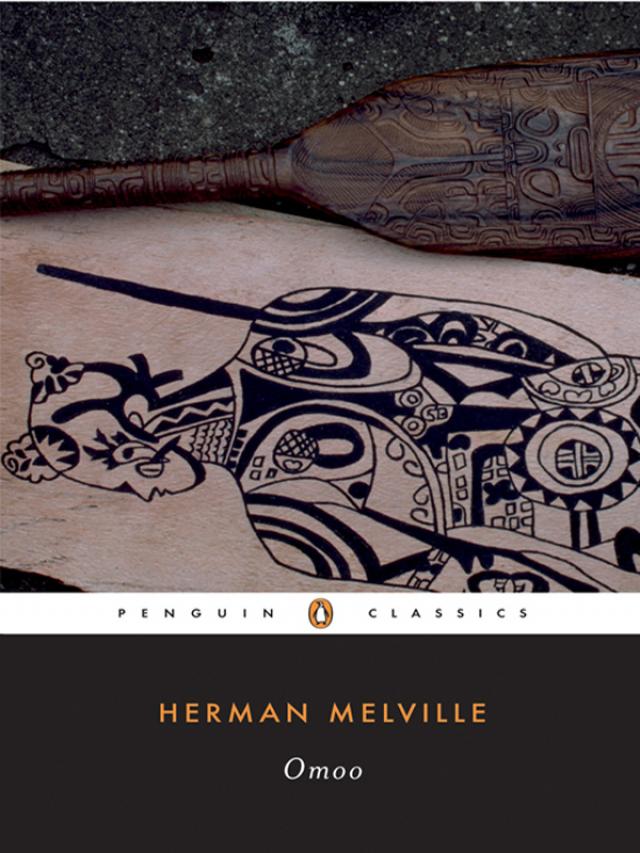
PENGUINCLASSICS
OMOO
HERMAN MELVILLE was born on August 1, 1819, in New York City, the son of a merchant. His father died when he was only twelve, and Herman worked as a bank clerk and later an elementary school teacher before shipping off on a whaling ship bound for the Pacific. Upon his return, he published a number of books based on his experiences at sea, which won him immediate success. By 1850, he was married and had acquired a farm near Pittsfield, Massachusetts, where he wrote Moby-Dick. His later works, including Moby-Dick, became increasingly complex and alienated many of his readers. In 1863, during the Civil War, he moved back to New York City, where he died in 1891.
MARY K. BERCAW EDWARDS is associate professor of English at the University of Connecticut, past president of the Melville Society, and author of Melville’s Sources. As a young woman, she circumnavigated the world aboard a thirty-eight-foot sailing vessel and spent much time in the South Pacific. In addition to teaching and scholarship, she now works high aloft on the only wooden whaleship left in the world, the Charles W. Morgan, berthed at Mystic Seaport in Mystic, Connecticut.
HERMAN MELVILLE
Omoo
A NARRATIVE OF ADVENTURES IN THE SOUTH SEAS
Introduction and Notes by
MARY K. BERCAW EDWARDS
PENGUIN BOOKS
PENGUIN BOOKS
Published by the Penguin Group
Penguin Group (USA) Inc., 375 Hudson Street, New York, New York 10014, U.S.A.
Penguin Group (Canada), 90 Eglinton Avenue East, Suite 700, Toronto, Ontario, Canada M4P 2Y3 (a division of Pearson Penguin Canada Inc.)
Penguin Books Ltd, 80 Strand, London WC2R 0RL, England
Penguin Ireland, 25 St Stephen’s Green, Dublin 2, Ireland (a division of Penguin Books Ltd)
Penguin Group (Australia), 250 Camberwell Road, Camberwell, Victoria 3124, Australia (a division of Pearson Australia Group Pty Ltd)
Penguin Books India Pvt Ltd, 11 Community Centre, Panchsheel Park, New Delhi–110 017, India
Penguin Group (NZ), 67 Apollo Drive, Mairangi Bay, Auckland 1311, New Zealand (a division of Pearson New Zealand Ltd)
Penguin Books (South Africa) (Pty) Ltd, 24 Sturdee Avenue, Rosebank, Johannesburg 2196, South Africa
Penguin Books Ltd, Registered Offices:
80 Strand, London WC2R 0RL, England
First published in the United States of America by Harper & Brothers 1847
This edition with an in
Introduction and notes copyright © Mary K. Bercaw Edwards, 2007
All rights reserved
LIBRARY OF CONGRESS CATALOGING-IN-PUBLICATION DATA
Melville, Herman, 1819–1891.
Omoo: a narrative of adventures in the South Seas / Herman Melville; introduction and notes by Mary K. Bercaw Edwards.
p. cm.—(Penguin Classics)
ISBN: 978-1-1012-0147-3
1. Polynesia—Description and travel—Fiction. I. Edwards, Mary K. Bercaw. II. Title.
PS2384.O6 2007
813'.3—dc22 2006050737
Except in the United States of America, this book is sold subject to the condition that it shall not, by way of trade or otherwise, be lent, resold, hired out, or otherwise circulated without the publisher’s prior consent in any form of binding or cover other than that in which it is published and without a similar condition including this condition being imposed on the subsequent purchaser.
The scanning, uploading, and distribution of this book via the Internet or via any other means without the permission of the publisher is illegal and punishable by law. Please purchase only authorized electronic editions, and do not participate in or encourage electronic piracy of copyrighted materials. Your support of the author’s rights is appreciated.
Contents
Introduction by Mary K. Bercaw Edwards
Works Cited
Preface
Introduction
Chapter 1 My Reception Aboard
Chapter 2 Some Account of the Ship
Chapter 3 Further Account of the Julia
Chapter 4 A Scene in the Forecastle
Chapter 5 What Happened at Hytyhoo
Chapter 6 We Touch at La Dominica
Chapter 7 What Happened at Hannamanoo
Chapter 8 The Tattooers of La Dominica
Chapter 9 We Steer to the Westward State of Affairs
Chapter 10 A Sea-Parlor Described, with Some of Its Tenants
Chapter 11 Doctor Long Ghost a Wag His Capers
Chapter 12 Death and Burial of Two of the Crew
Chapter 13 Our Destination Changed
Chapter 14 Rope Yarn
Chapter 15 Chips and Bungs
Chapter 16 We Encounter a Gale
Chapter 17 The Coral Islands
Chapter 18 Tahiti
Chapter 19 A Surprise More about Bembo
Chapter 20 The Round Robin Visitors from Shore
Chapter 21 Proceedings of the Consul
Chapter 22 The Consul’s Departure
Chapter 23 The Second Night off Papeetee
Chapter 24 Outbreak of the Crew
Chapter 25 Jermin Encounters an Old Shipmate
Chapter 26 We Enter the Harbor Jim the Pilot
Chapter 27 A Glance at Papeetee We Are Sent aboard the Frigate
Chapter 28 Reception from the Frenchman
Chapter 29 The Reine Blanche
Chapter 30 They Take Us Ashore What Happened There
Chapter 31 The Calabooza Beretanee
Chapter 32 Proceedings of the French at Tahiti
Chapter 33 We Receive Calls at the Hotel de Calabooza
Chapter 34 Life at the Calabooza
Chapter 35 Visit from an Old Acquaintance
Chapter 36 We Are Carried before the Consul and Captain
Chapter 37 The French Priests Pay Their Respects
Chapter 38 Little Jule Sails without Us
Chapter 39 Jermin Serves Us a Good Turn Friendships in Polynesia
Chapter 40 We Take unto Ourselves Friends
Chapter 41 We Levy Contributions on the Shipping
Chapter 42 Motoo-Otoo A Tahitian Casuist
Chapter 43 One Is Judged by the Company He Keeps
Chapter 44 Cathedral of Papoar The Church of the Cocoa-Nuts
Chapter 45 A Missionary’s Sermon; with Some Reflections
Chapter 46 Something about the Kannakippers
Chapter 47 How They Dress in Tahiti
Chapter 48 Tahiti As It Is
Chapter 49 Same Subject Continued
Chapter 50 Something Happens to Long Ghost
Chapter 51 Wilson Gives Us the Cut Departure for Imeeo
Chapter 52 The Valley of Martair
Chapter 53 Farming in Polynesia
Chapter 54 Some Account of the Wild Cattle in Polynesia
Chapter 55 A Hunting Ramble with Zeke
Chapter 56 Musquitoes
Chapter 57 The Second Hunt in the Mountains
Chapter 58 The Hunting-Feast; and a Visit to Afrehitoo
Chapter 59 The Murphies
Chapter 60 What They Thought of Us in Martair
Chapter 61 Preparing for the Journey
Chapter 62 Tamai
Chapter 63 A Dance in the Valley
Chapter 64 Mysterious
Chapter 65 The Hegira, or Flight
Chapter 66 How We Were to Get to Taloo
Chapter 67 The Journey Round the Beach
Chapter 68 A Dinner-Party in Imeeo
Chapter 69 The Cocoa-Palm
Chapter 70 Life at Loohooloo
Chapter 71 We Start for Taloo
Chapter 72 A Dealer in the Contraband
Chapter 73 Our Reception in Partoowye
Chapter 74 Retiring for the Night The Doctor Grows Devout
Chapter 75 A Ramble Through the Settlement
Chapter 76 An Island Jilt We Visit the Ship
Chapter 77 A Party of Rovers Little Loo and the Doctor
Chapter 78 Mrs. Bell
Chapter 79 Taloo Chapel Holding Court in Polynesia
Chapter 80 Queen Pomaree
Chapter 81 We Visit the Court
Chapter 82 Which Ends the Book
Notes
Acknowledgments
I wish to thank my research assistant Nathan Adams, my husband, Craig Edwards, and my friend and colleague Peter Sorensen for all their help with the introduction and notes. I also wish to thank my parents, Jay and Gretchen Bercaw, for my initial inspiration to become a Melville scholar. My family spent three and a half years circumnavigating the world in a thirty-eight-foot sailboat, during which we stopped at many of the islands visited by Melville. Just this last winter, my mother took me back to the South Pacific, and I reread Omoo while sailing from Nuku Hiva to Hiva Oa (Melville’s La Dominica) in the Marquesas, on to the Tuamotus (Melville’s Pomotu or Coral Islands), and then to the Society group, just as Melville did in 1842. Thank you all.