

Edenfield, p.1
Edenfield, page 1


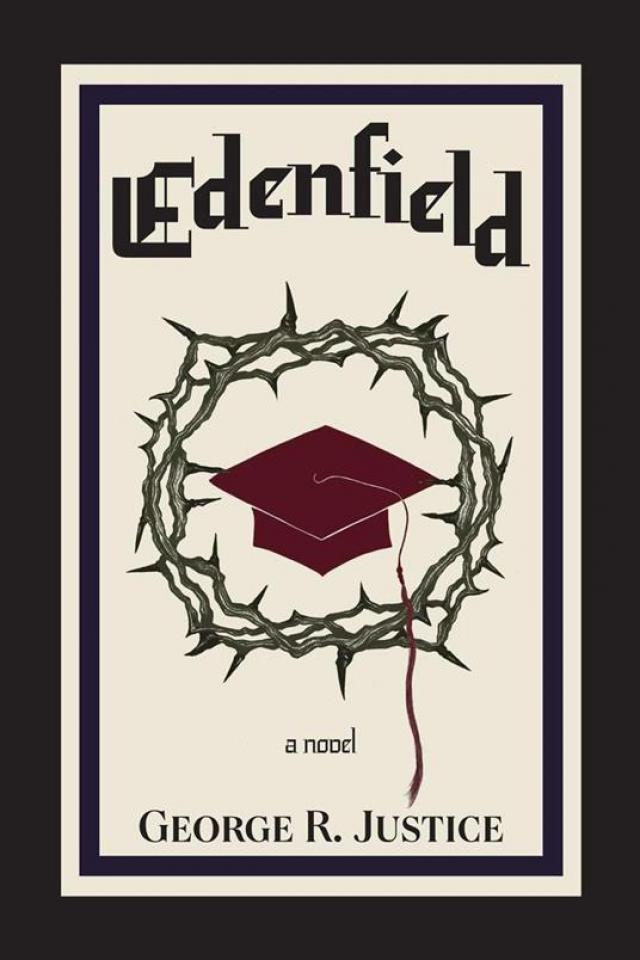
Edenfield
George R. Justice
Legacy Book Press LLC
Camanche, Iowa
Copyright © 2024 Geroge Justice
Cover design by Kaitlea Toohey (kaitleatoohey.com)
Cover art by Elle Reid
This is a work of fiction. Names, characters, business, events and incidents are the products of the author’s imagination. Any resemblance to actual persons, living or dead, or actual events is purely coincidental.
All rights reserved. No part of this book may be used or reproduced by any means, graphic, electronic, or mechanical, including photocopying, recording, taping or by any information storage retrieval system without the written permission of the publisher except in the case of brief quotations embodied in critical articles and reviews.
ISBN: 979-8-9874823-8-4
Library of Congress Case Number: 979-8-9874823-8-4
To my son, Rob: once our warrior...now our angel.
Train up a child in the ways of the Lord,
and when he is old he will not depart from it.
Proverbs 22:6
Table of Contents
Like Sackcloth on a Sunburn 3
Under the Bleachers 5
Carol and Cheryl and Bonitasue 14
Your Sins Will Find You Out 18
Never Forget Rule Number One 25
The Mill 32
An L.L.Bean Catalog Cover Come to Life 38
Fishes and Loaves 43
La’Randa and Lo’Randa 45
Harmon and Harmony 55
To the Right of John Birch 60
Rising Up Out of the Heat 62
Finesse and Know-How 70
Muted in Amber Hues 75
A Hothouse Flower in the Middle of the Desert 79
So Far It’s Worked Pretty Good 84
War Was Always Imminent 86
Airy, Sexy, and Fraught with Impulse 96
Fall Revival 100
Fugitive Status 114
Mister-Granddaddy-Bull-Moose-of-All-Time 124
Against the Backdrop of a Steel-Gray Sky 128
Beyond the Complexity and the Pain 134
Catch Me If You Can, I’m Dying 140
No Cadillac, No Light 149
Within the Flock 152
In a Rage of Silence 157
Catherine Ivy 160
Duncan, Mother, and the Big Silver Quonset Hut 171
Gold Leaf Envelope 176
Billy Screws 181
Becky and the Beanstalk 184
O’ Shock of Silver 187
Stone and Judi Remington 191
Unrequited Affection 193
Dr. De (Lizzy) 195
The Ultimate Means to the Ultimate End 203
The Paradisiacal Latch 207
I’ll Repent Tomorrow 215
Bent Like a Willow 218
A Slagheap of Forfeiture 220
Plateaus 222
The Last Goodbye 225
Dr. Cannon 233
The Prophet Jeremiah 239
Do Tell 246
After All These Years 257
Reaching in Our Own Way for What We Longed For 268
Thrown Open to the Wind 274
Whose Hands We Would Hold 279
A Place I Once Called Home 288
Part I
Prologue
Like Sackcloth on a Sunburn
I left home in the summer of 1962, two weeks before my eighteenth birthday and just after Mother’s desperate last-minute maneuverings saved us from a troop-train goodbye. At the time, it never occurred to me that my leaving would be for good, but that’s the way it turned out…circumstances and a stronger-than-expected need for independence being the occasions of my fate.
It was a Greyhound bus that Mom and Dad put me on, right there in the heart of Chicago, right after Mother cried hard and openly, and after Dad squeezed a twenty-dollar bill into the palm of my hand. Four hours and twenty minutes later, I stepped out of that bus into Edenfield, a reverent little town nestled in the miles-from-nowhere countryside of southern Minnesota.
The plan was for me to work at Edenfield’s sawmill during the summer, then attend Edenfield College in the fall. It was a plan born out of good intention and heaped with possibility, but, in the end, one that wore like sackcloth on a sunburn.
I’d never had any intentions of college. The Army had been all I wanted, but the crafted and skilled manipulations of my mother and the very Reverend Burton Mayfield had etched a place for me on Edenfield’s fall roster.
The town of Edenfield was intimate, devoutly Protestant, and straightaway paranoid about influences from the outside world. The college was its mirror image. “Perfect” was how Mother described it. But it was there, amidst an ultraconservative fundamentalism, that I came to learn about such things as friendship and love and betrayal, sex and death and God…things that just seemed to surface from my own directionless curiosity and the misgivings of carnal malfeasance.
Outside of a suitcase and a string-tied cardboard box, the only things I knowingly took with me were the incidentals of adolescent mischievousness and the compliance that comes from a childhood of perfect Sunday school attendance. What I was unaware of taking was my father’s blue-collar work ethic and my mother’s neurotic fear of those with religion stronger than it ought to be. What I left with, though, was a profound sense of my own naivety and that there is no natural rhythm or order for anything that happens, only an abiding sense that it all happens for a reason.
Chapter One
Under the Bleachers
We left home before dawn and drove south to Edenfield. My wife, Holly, slept in the front seat next to me with her face buried in a pillow and her breathing in perfect harmony with the drone of our aging Volvo. It was nothing new that she was so mollified. She had always been a model of quiescence, even from the beginning. It had been her strong suit, and the thing that had attracted me to her in the first place. We were quite the contrast. Then and now. Our son, Harris, despite his six-foot frame, lay in the backseat, silent as a babe-in-arms. Harris was our only child, and the excitement of his going off to college had given Holly and me reason to feel united despite our multitude of petty differences. Their combined slumber was a welcomed solitude, one that gave me a chance to further ponder my return. It had been thirty years since I last set foot in Edenfield, since I walked away in the middle of my sophomore year. Still, to this day, I’ve never quite been able to clear my mind of that time, to allow myself the peace that comes from forgetting. Time and again I’m drawn back there, to the events of my carnality and the things surrounding my betrayal. Returning is what remains of my hope to lay at least some of it to rest. The irony, though, is that I’m less and less sure of myself the closer Edenfield gets. There’s a part of me that wants to stop the car and tell Holly she’ll have to go on without me, be both parents today, but each time I somehow manage to talk myself out of it, my responsibility to Harris being stronger than any need of my own. Then, too, it was the hope of coming to grips with the past, or maybe just knowing that it was time to try, that kept me on course. Edenfield was, after all, a place I once called home.
I’d watched the sun climb in a slow steady arc all morning, first from the car, then from the bleachers bordering the soccer field. It wasn’t typical for the sun to be so brutal above the forty-fourth parallel, to be so torrid. Still, it hadn’t slowed the number of families from packing the blue plank bleachers thigh to thigh.
In the middle of the field a huge purple banner emblazoned with gold block letters was stretched banjo-tight across the front of the speaker’s stand: WELCOME, PARENTS AND FRESHMAN CLASS OF 1993. Its satiny brilliance glistened in the sun. I wasn’t much for ceremony, yet I waited patiently. The fact that I waited at all was uncharacteristic. I was never very good at it, but today seemed appropriate that I should at least make the effort. This was our son, after all, opening a new chapter on his life, and I was determined to be a part of it. The sun, though, seemed determined to challenge my resolve in much the same way Edenfield had three decades ago.
Every so often a stray cloud offered an umbrella of relief and allowed me to scan the crowd without shading my eyes. Despite an added thirty years, there were faces almost familiar; brief eye contact, but no names. Did they recognize me? I almost feared they would.
Between the un-breathability of my polyester suit and the bunching of my boxer shorts, I was uncertain how long I could feign a pretext of wellbeing. All around me, others seemed so collected, so unbothered, including Holly. She sat undaunted on my right, not bothering to notice my anguish.
“Aren’t you HOT?” I asked. She turned her face toward mine and examined me as though I was some sad little thing in need of a hug. It was a look I had become familiar with over the years, one that she woke with most mornings and one she embraced as the antecedent of who she was.
As a last resort, I rose and excused myself with only a faint look of apology. I could think of little beyond the cool shade beneath the bleachers. Holly watched after me without the slightest change in expression. She had no idea where I was going, only that I had reached my limit.
The underbelly of the bleachers was far from an oasis, but it was the canopy I longed for. Apart from the girders interlocking in a geom etric zigzag, it was uncluttered, and except for the four-foot cyclone fence surrounding the field, offered an unobstructed view. I wasted little time in loosening my tie and perching myself on a concrete block supporting one of the steel uprights. I had found the one vantage point that afforded me the medicine of solitude and the place where I could dispose myself, without the worry of heat stroke, to the fullness of the day.
The students had been herded to sit together in the middle of the field. I spotted Harris right off, his hair as long and straight as his stature. He looked eager, ready for the likes of Freud, Blake, and Pythagorean theorem. I tried to imagine the magnitude and complexity of his ancestral pool, and the centuries of peasants and paupers, princes and princesses, it took to get him here. He gave me every reason to want to sing his praises. The only way I could have felt prouder was to have been by his side. In concept, I was. It was as though we were, at that very moment, connected, one and the same. I couldn’t help but wonder what thoughts were going through his mind, and if I, even remotely, was a part of them. I couldn’t be sure how much of me he carried with him today, because in some unspecific way he was somebody brand new, like someone I was seeing for the first time. I tried to liken him to me and the path I had chosen, but I knew we were too diverse, two separate entities in search of two different worlds.
I watched as he searched the bleachers and a throng of waving arms, trying to find the faces most familiar. But we were too many. His searching reminded me of his years in Little League and the times he stood alone on the pitcher’s mound searching for my face in the stands, for its assurance and approval.
Harris had never given me a satisfactory answer as to why he chose Edenfield. I never thought his choice had anything to do with my having once attended. I didn’t think what I did thirty years ago would be of any consequence, and that my skewed campus legacy would amount to little more than a few laughs for him and his friends. I figured that the accounts of my life during those times would have, if anything, worked to deter him. But it wasn’t until he said, “You know, Dad, I’m looking forward to finding you at Edenfield ... I mean that part you said you left behind,” that I realized my influence, whether I intended it or not, had been substantive, and that his decision had more to do with me than I really wanted.
Above me, applause was sudden and thunderous, echoing through the bleachers with the potency of cannon-fire for someone bedecked in a floral sport coat and edging his way across the speaker’s platform. He was Dr. R. D. Yoglir, Exalted Deacon from The Church’s World Conference and a magnate among God’s chosen. Despite his strong Christian presence, the sun still made no concessions. Dr. Yoglir seemed oblivious to the quiet suffering of his audience and spread his papers with deliberate care on the podium before him. He then surveyed them with a scrunched look and gave the microphone an annoying little knock.
“As we find ourselves,” he began, “at yet another crossroad ...”
The loudspeakers sent R. D.’s greeting well into the surrounding alfalfa fields, and I would guess as far south as Elwin Cotter’s where his moon-eyed quarter horses lazed in the shade of sourwoods. Straight ahead, the crown of the field swelled before me, a formidable reminder of Carol and Cheryl and Bonitasue. The three of them cheerleading on the sidelines. Three gyroscopes: oscillating, pom-pomming, the hems of their skirts higher than their eyes. Only their images were dull now, faded like sepia photos left too long in the sun.
“... we need pause to reevaluate who we’ve become and the influences that have shaped our lives...”
R. D. droned on, decisive and full of purpose, reading word for word what he so painstakingly prepared in what I imagined to have been the cool comfort of an air-conditioned room. I listened, hoping for something new, but then after a time realized his message was like so many others offering the same tired traditions, those of hope and renewal, much like the ones I so often delivered. But I was elsewhere today, unfocused, and before long his message was reduced to only a word here and there, then faded altogether.
For the moment, I returned to Harris, studied him and his assurances of youth. Mine were behind me now, taken up in memories. It was as if time had passed me by without warning, then flooded me with remembrances. For the most part, they were innocent enough, just flashes and glimpses of things I thought were long forgotten. But then there were those that refused to be overlooked, coming like uninvited guests demanding attention. Such was the case today. Only today they were not bits and pieces, but total ensembles. Nothing for me to sift through or decipher. Nothing fragmented or incomplete. Only the purest of images anxious to wash me in recollections. There, beneath the bleachers, they were as clear as day:
June 1:
“Mom.”
“Not now, please. I’m trying to juggle too many things at once here.”
“I just want you to know that I’ve signed up for the Army.”
“Fine. Now take out this trash and make sure the lid is on tight. I’m tired of the squirrels ripping open the bags.”
June 14:
“Well, son, now that you’re about to graduate, have you given any thought to what you’ll be doing?” Dad was never heady or lofty with his speech, but he did like to think of himself as the consummate authority on anything having to do with making a living. This was not always without its irritability. The fact that we never knew from one minute to the next what posture he might assume or what tack he might take, kept us more than just a little off balance most of our lives. One simply had to stay focused in order to stay in the game.
“You mean after the Army?”
“You know you can’t just lay around and dream.”
“You don’t have to worry about that.”
“You gotta make some kind of move.”
“I have. I’ve decided to join the Ar-”
“Trade school or college. Anything. You might try junior college like your Cousin A.J. You remember your cousin, A.J., don’t you? Aunt Alice’s son? Down there in Dayton? Hell, he owns his own furniture store now. Drives a Cadillac everywhere he goes. Peaked though. Sickly looking, like he never had a bite of greens. Jesus. Been like that his whole life. No telling what’s wrong with him. No sense in worrying about it, though. Anybody who’s too cheap to go to the doctor when he needs to deserves what he gets. Whole family’s the same way. Got every dime they ever made. God knows we’ll never see any of it.”
“Dad!”
“Listen, maybe you could go to one of them community colleges. Live right here at home. Learn a trade on the side. Matter of fact, Charlie Bevins is looking for a couple of roofers right now. Can pick up some good money roofing. Look at your Uncle Leonard. Roofed all his life. Stronger than a horse. Why I’ve seen him take--”
“DAD!”
“What?”
“I’ll give it some thought … college and all.”
“Yeah, well, Okay. I’m going to bed. One thing for sure though: you can’t just lay around and dream. You gotta make a move. Oh, and listen, before you turn out the lights, take out the trash. And make sure the lid is on tight. I’m tired of the squirrels ripping open the bags.”
June 25:
Induction day. I was up at four thirty, convinced that this was a day I would want to remember. It was a chance to be alone for a while and prepare myself for what lay ahead, a chance to ponder life and what roles providence and destiny might play. But other than a light-to-medium nosebleed, the morning passed without incident or revelation.
Dawn was like an inevitable messenger. Its pale lemon light bathed everything in a soft patina, including my dad’s sleeping face. I woke him with a nudge. He looked up at me in a stupor, checked the time, and asked in a half-whisper if this was really what I wanted. My heart softened to his words. I was elated that he cared enough to ask but was somehow unable to separate my joy from my sadness. Why had he waited so long to ask? Why, after I had been saying goodbye for nearly a month, had he only now seen fit to offer consolation? Yet I knew this was him and took comfort from his having asked at all.
After dressing slower than usual, and without saying a word, Dad led the way to the car. Once there, we sat in near-perfect silence, staring straight ahead and searching for impossible words before he finally backed us down the driveway and into the street. It was then that Mother, in a nightgown torn under one arm and bleached beyond color, came running at us from across the lawn. She was crying, but through her tears she somehow managed to tell me that Reverend Mayfield was on the phone and was wondering if I had a minute to say goodbye. A phone call from Reverend Mayfield at six o’clock in the morning was a little obvious, but it was so like Mother to know when to sic God on me. It wasn’t her first time, nor was I under the illusion that it would be her last.






