Complete works of edgar.., p.1
Complete Works of Edgar Allan Poe, page 1
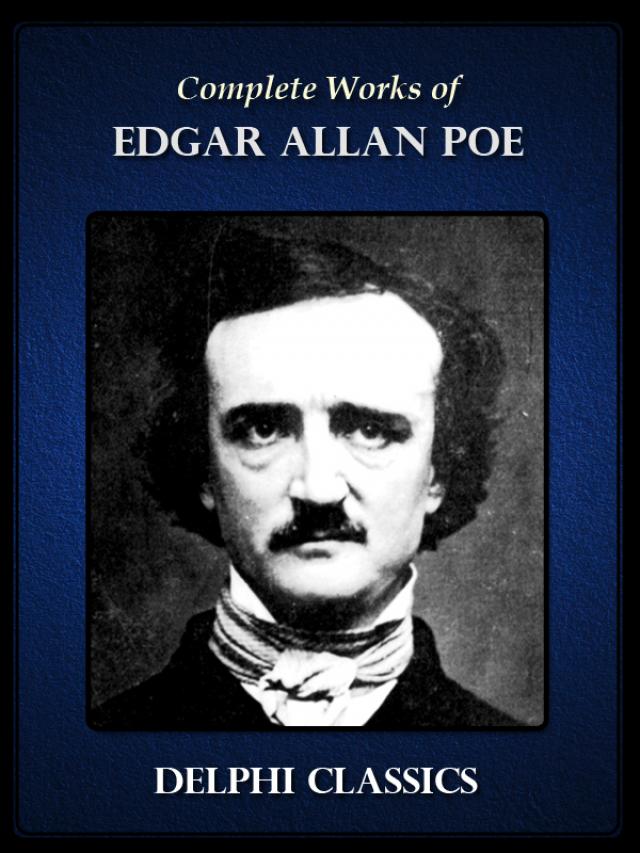


THE COMPLETE WORKS OF
EDGAR ALLAN POE
(1809-1849)
Contents
The Poetry Collections
TAMERLANE AND OTHER POEMS
AL AARAAF, TAMERLANE AND MINOR POEMS
POEMS, 1831
THE RAVEN AND OTHER POEMS
UNCOLLECTED POEMS
The Poems
LIST OF POEMS IN CHRONOLOGICAL ORDER
LIST OF POEMS IN ALPHABETICAL ORDER
The Tales
THE COMPLETE TALES IN CHRONOLOGICAL ORDER
THE COMPLETE TALES IN ALPHABETICAL ORDER
The Novels
THE NARRATIVE OF ARTHUR GORDON PYM OF NANTUCKET
THE JOURNAL OF JULIUS RODMAN
The Play
POLITIAN
The Essays
INDEX OF THE COMPLETE ESSAYS
The Non-Fiction
THE CONCHOLOGIST’S FIRST BOOK
THE LITERATI
MARGINALIA
FIFTY SUGGESTIONS
A CHAPTER ON AUTOGRAPHY
The Letters
INDEX OF CORRESPONDENTS
INDEX OF CORRESPONDENTS, LETTERS AND DATES
The Criticism
EDGAR A. POE by James Russell Lowell.
AN EXTRACT FROM ‘FIGURES OF SEVERAL CENTURIES’ by Arthur Symons
AN EXTRACT FROM ‘LETTERS TO DEAD AUTHORS’ by Andrew Lang
THE CENTENARY OF EDGAR ALLAN POE by Edmund Gosse
FROM POE TO VALÉRY by T.S. Eliot
The Biographies
THE STORY OF EDGAR ALLAN POE by Sherwin Cody
THE DREAMER by Mary Newton Stanard
MEMOIR OF THE AUTHOR by Rufus Wilmot Griswold
DEATH OF EDGAR A. POE. by N. P. Willis
© Delphi Classics 2012
Version 6
THE COMPLETE WORKS OF
EDGAR ALLAN POE
By Delphi Classics, 2012
Interested in Gothic literature?
Then you’ll love these eBooks:
The Poetry Collections
Edgar Allan Poe’s birthplace, Carver Street, Boston
The plaque that marks where Poe was born
Eliza Poe, the author’s mother, who was actress.
Very little is known of the author’s father David, an actor who abandoned his family shortly after Edgar’s birth. This play bill contains both of Poe’s parents’ names.
TAMERLANE AND OTHER POEMS
Poe’s first published work was a short collection of poems, which appeared in 1827 under the title Tamerlane and Other Poems. At the time, Poe had abandoned his foster family and moved to Boston to seek work. Unsuccessful in finding suitable employment, the poet enlisted in the United States Army. He brought with him several manuscripts, which he paid a printer named Calvin F. S. Thomas to publish. The 40 page collection did not include Poe’s name and there were only 50 copies printed, 12 of which still survive. The collection received no critical attention.
The poems were largely inspired by Lord Byron, including the long title poem Tamerlane, which portrays an historical conqueror that laments the loss of his first romance. Like much of Poe’s future work, the poems in Tamerlane and Other Poems include themes of love, death, and pride.
John and Frances Allan — Poe’s wealthy foster parents, who provided for him after his mother’s early death from tuberculosis
The first edition cover of Poe’s first book of poetry
CONTENTS
TAMERLANE (1827)
FUGITIVE PIECES.
TO — —
DREAMS.
VISIT OF THE DEAD.
EVENING STAR.
IMITATION.
COMMUNION WITH NATURE
A WILDER’D BEING FROM MY BIRTH
THE HAPPIEST DAY — THE HAPPIEST HOUR
THE LAKE.
This advertisement was printed on the back cover of the booklet
PREFACE BY THE EDITOR.
THE same year that witnessed the publication, at Louth in Lincolnshire, of Alfred Tennyson’s first schoolboy volume of verse also gave birth, at that literary capital of the United States of America which takes its name from another Lincolnshire town, to Edgar Poe’s maiden book. Unlike the sumptuous and elegant “Poems by Two Brothers,” however, which the adventurous publishers actually had the temerity to issue in large-paper form as well as in the ordinary size, Edgar Poe’s volume (if it can be dignified with that designation) is the tiniest of tomes, numbering, inclusive of title and half-titles, only forty pages, and measuring 6⅜ by 4⅛ inches. Its diminutiveness, probably quite as much as the fact that it was “suppressed through circumstances of a private nature,” accounts for its almost entire disappearance. The motto on the title-page purports to be from Cowper: that from Martial, which closes the Preface (Nos hæc novimus esse nihil), was, by a curious coincidence, the very same that figured on the title-page of Alfred and Charles Tennyson’s Louth volume.
In 1827, when the little “Tamerlane” booklet was thus modestly ushered into the world, Poe had not yet attained his nineteenth year. Both in promise and in actual performance, it may claim to rank as the most remarkable production that any English-speaking and English-writing poet of this century has published in his teens.
In this earliest form of it the poem which gives its chief title to the little volume is divided into seventeen sections, of irregular length, containing a total of 406 lines. “Tamerlane” was afterwards remodelled and rewritten, from beginning to end, and in its final form, as it appeared in the author’s
edition of 1845, is divided into twenty-three sections, containing a total of 243 lines. Eleven explanatory prose notes are added, which disappear in all subsequent editions. A critic whose familiar acquaintance with the text of Poe gives weight to his verdict, declares that although “different in structure, and explaining some things which, in later copies, are left to the imagination, the Tamerlane of 1827 is in many parts quite equal to the present poem.”
Of the nine “Fugitive Pieces” which follow only three, and these in a somewhat altered form, were included by the author in his later collection. The remaining six have never been reprinted in book form, although they were, together with a few extracts from the earliest version of “Tamerlane,” printed (so incorrectly, however, as to be practically valueless,) in a magazine article on “The Unknown Poetry of Edgar Poe,” contributed by Mr. John H. Ingram to Belgravia for June 1876.
I have no desire to disparage or underrate, and have already taken occasion to render tribute to, the worthy and loyal service and labour of love performed by Mr. Ingram, with zeal if not always with discretion, on the text of Poe, and still more notably in clearing his life and memory from the aspersions of contemporary calumniators. But, in justice both to myself and to others, I am compelled to repudiate and refute the untenable and, as it seems to me, preposterous claim recently put forward by him in the columns of a leading literary journal, to be the discoverer of the first edition of Poe’s Tamerlane, and to possess a sort of moral right of monopoly over it.
The facts are simply these, and had I been allowed, as in all fairness I ought to have been, to disclose them in the columns of the journal which gave insertion to Mr. Ingram’s ex parte statement, I need not have troubled the reader with them here. First as to discovery. The only copy of Edgar Poe’s 1827 volume at present known to have escaped destruction, came into the possession of the British Museum on the 10th October 1867, which date is (according to custom) officially impressed in red, at the end of the volume, i.e., at the bottom of page 40, under the last note. I believe I am correct in stating that Mr. Ingram did not commence his work on the text of Poe until several years after this: it was certainly not until nearly nine years after that he communicated to the public his account of the “Tamerlane” volume, with extracts, first to Belgravia for June, 1876, and afterwards to the Athenæum for July 29, 1876. The extracts in the Athenæum were limited to four lines of verse, and an imperfect transcript of the title; but the paper in Belgravia contained copious extracts from the longer poem of “Tamerlane,” and of the nine “fugitive pieces,” the six suppressed ones were given in extenso. In the “Tamerlane” extracts, as thus printed by Mr. Ingram, there were two textual misprints in the Preface, and five in the text; in the “Fugitive Pieces” there were at least five misprints, seriously affecting the sense. This assertion can easily be proved and cannot possibly be refuted. And now as to the claim to monopoly. Since the publication of his Belgravian article, shown to be valueless on account of its inaccuracy, nearly eight more years have elapsed, and until the announcement of the present venture, Mr. Ingram had made no attempt, and given no sign of his intention, to reissue the contents of Poe’s 1827 booklet, either separately or in any other shape. His claim to monopoly, therefore, is just as unreasonable and absurd as I have already proved his claim to discovery to be.
“There are several palpable errata,” as Mr. Ingram has remarked, “in Edgar Poe’s first book” (and which therefore all the more should have had no fresh ones superadded). These I have thought it best to correct, wherever they are perfectly obvious (a list of them and of proposed conjectural emendations is appended), and I have also reduced the orthography and punctuation to a uniform standard. The present case was not one where a facsimile reprint was desirable, — the typography, arrangement, size, and general appearance of the original edition being unsatisfactory in the extreme.
Should this attempt to perpetuate an
Richard Herne Shepherd.
P.S. — Mr. George Edward Woodberry, of Beverly, Mass., the author of an excellent “History of Wood-Engraving,” who is preparing a biography of Poe for the series of “American Men of Letters,” now publishing by Messrs. Houghton and Co., of Boston, writes to me (under date Jan. 1, 1884) as follows: —
“Of the original edition Mr. Ingram states that he has a copy, and thinks it unique because Poe stated that the edition was suppressed. I do not think it was suppressed, however, and as you may be interested in the matter I extend this note. The printer, Mr. Calvin F. S. Thomas, was a very obscure man, who had a printer’s shop at Boston only in that year; I have sought through all the Thomas families of Mass., Maine, Rhode Island, Maryland, Ohio, etc., to which he was likely to belong, and there is no trace of him. I can find no other book with his imprint. Consequently I suppose the edition to have been small and obscure. It was published between June and October, 1827, probably in June. It was not noticed or advertised, apparently, but it occurs in the North American Review’s quarterly list of new publications, in the October number, 1827 [vol. xxv. p. 471]. How Poe, a youth of eighteen, in a strange city, friendless and penniless as he was, persuaded this unknown printer to issue his volume, is a mystery to me. I have talked with old men, and had the printers and publishers who survive from that time interrogated, but though Boston was a small town, no one knew Thomas or ever heard of him. You may be sure, however, that the Mr. Ingram who seems to own Poe, is wrong in believing that the volume was only printed, and not published. Poe left Boston in October of that year.”
AUTHOR’S PREFACE.
THE greater part of the Poems which compose this little volume were written in the year 1821-2, when the author had not completed his fourteenth year. They were of course not intended for publication; why they are now published concerns no one but himself. Of the smaller pieces very little need be said: they perhaps savour too much of egotism; but they were written by one too young to have any knowledge of the world but from his own breast.
In “Tamerlane” he has endeavoured to expose the folly of even risking the best feelings of the heart at the shrine of Ambition. He is conscious that in this there are many faults (besides that of the general character of the poem), which he flatters himself he could, with little trouble, have corrected, but unlike many of his predecessors, has been too fond of his early productions to amend them in his old age.
He will not say that he is indifferent as to the success of these Poems — it might stimulate him to other attempts — but he can safely assert that failure will not at all influence him in a resolution already adopted. This is challenging criticism — let it be so. Nos hæc novimus esse nihil.
TAMERLANE (1827)
I.
I HAVE sent for thee, holy friar;
But ‘twas not with the drunken hope,
Which is but agony of desire
To shun the fate, with which to cope
Is more than crime may dare to dream,
That I have call’d thee at this hour:
Such, father, is not my theme —
Nor am I mad, to deem that power
Of earth may shrive me of the sin
Unearthly pride hath revelled in —
I would not call thee fool, old man.
But hope is not a gift of thine;
If I can hope (O God! I can)
It falls from an eternal shrine.
II.
The gay wall of this gaudy tower
Grows dim around me — death is near.
I had not thought, until this hour
When passing from the earth, that ear
Of any, were it not the shade
Of one whom in life I made
All mystery but a simple name,
Might know the secret of a spirit
Bow’d down in sorrow, and in shame. —
Shame, said’st thou?
Ay, I did inherit
That hated portion, with the fame,
The worldly glory, which has shown
A demon-light around my throne,
Scorching my sear’d heart with a pain
Not Hell shall make me fear again.
III.
I have not always been as now —
The fever’d diadem on my brow
I claim’d and won usurpingly —
Ay — the same heritage hath given
Rome to the Cæsar — this to me;
The heirdom of a kingly mind —
And a proud spirit, which hath striven
Triumphantly with human kind.
In mountain air I first drew life;
The mists of the Taglay have shed
Nightly their dews on my young head;
And my brain drank their venom then,
When after day of perilous strife
With chamois, I would seize his den
And slumber, in my pride of power,
The infant monarch of the hour —
For, with the mountain dew by night,
My soul imbibed unhallow’d feeling;
And I would feel its essence stealing
In dreams upon me — while the light
Flashing from cloud that hover’d o’er,
Would seem to my half closing eye
The pageantry of monarchy!
And the deep thunder’s echoing roar
Came hurriedly upon me, telling
Of war, and tumult, where my voice,
My own voice, silly child! was swelling
(O how would my wild heart rejoice
And leap within me at the cry)
The battle cry of victory!
*****
IV.
The rain came down upon my head
But barely shelter’d — and the wind
Pass’d quickly o’er me — but my mind
Was maddening — for ‘twas man that shed
Laurels upon me — and the rush,
The torrent of the chilly air
Gurgled in my pleased ear the crush
Of empires, with the captive’s prayer,
The hum of suitors, the mix’d tone
Of flattery round a sovereign’s throne.
The storm had ceased — and I awoke —
Its spirit cradled me to sleep,
And as it pass’d me by, there broke
Strange light upon me, tho’ it were
My soul in mystery to steep:
For I was not as I had been;
The child of Nature, without care,
Or thought, save of the passing scene. —
V.
My passions, from that hapless hour,
Usurp’d a tyranny, which men
Have deem’d, since I have reach’d to power,
My innate nature — be it so:
But, father, there lived one who, then —
Then, in my boyhood, when their fire
Burn’d with a still intenser glow;
(For passion must with youth expire)
Even then, who deem’d this iron heart
In woman’s weakness had a part.
I have no words, alas! to tell
The loveliness of loving well!
Nor would I dare attempt to trace
The breathing beauty of a face,
Which even to my impassion’d mind,
Leaves not its memory behind.
In spring of life have ye ne’er dwelt
Some object of delight upon,
With steadfast eye, till ye have felt
The earth reel — and the vision gone?
And I have held to memory’s eye
One object — and but one — until
Its very form hath pass’d me by,
But left its influence with me stilL
VI.
’Tis not to thee that I should name —
Thou canst not — wouldst not dare to think