

Visible light, p.1
Visible Light, page 1


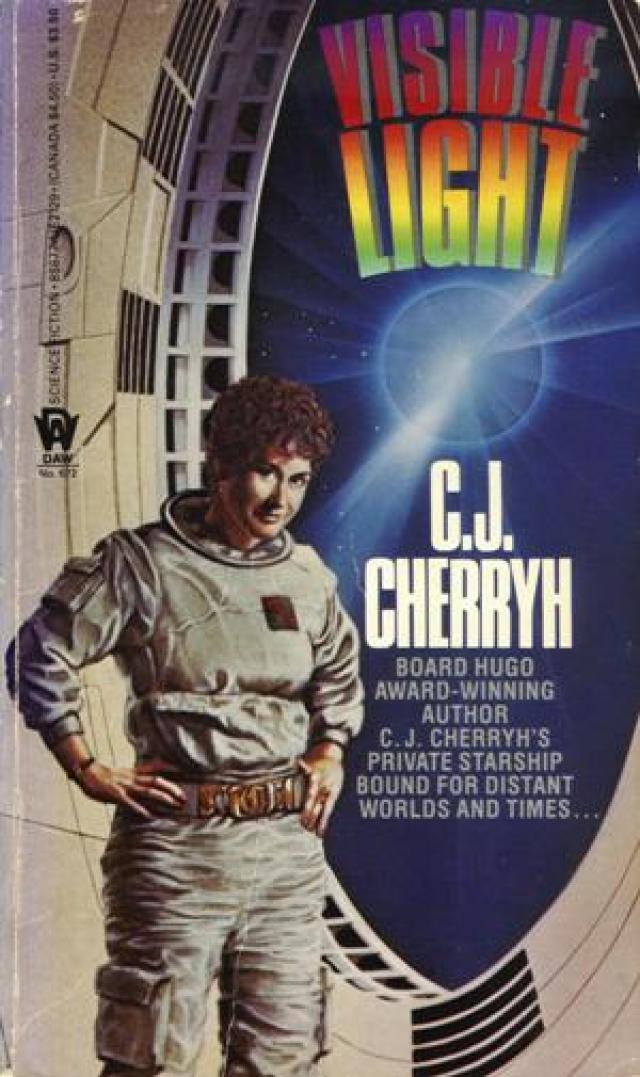
VISIBLE LIGHT
By
C. J. Cherryh
Dedication
the credit for this collection plainly goes to Don Wollheim, who came up with the idea back in 1979. It took me a few more years, to be sure, to have written a body of short fiction; and for a few years after that what I had written was scattered here and there and some of it too currently in print. So I put the project off. And put it off.
Then I thought of it several times and put it off againuntil in 1984 Don inquired not once but a second time where that collection was.
To answer the question, here it is, Don; and this one is dedicated to you.
Introduction
In a collection like this the writer has the rare chance to do a very old-fashioned thing: to speak to the audience, like the herald coming out before the ancient play to explain briefly what the audience is about to seeand perhaps to let the audience peek behind the scenesDown this street, mark you, lies the house of the Old Man, and here the wineseller Well, on this street lives a bit of fantasy and a bit of science fiction, here reside stories from my first years and some from not so long ago I introduce one brand new tale, because that's only fair.
I have gathered the rest by no particular logic except the desire to present some balance of early and later material, some mixture of science fiction and fantasy, and in a couple of instances to preserve work that has never appeared in any anthology.
One of the additional benefits of walking onto the stage like this is the chance to lower the mask and give the audience an insight into the mind behind the creation. So stop here, ignore all the intervening passages, and go straight to the stories if you simply enjoy my craft and care nothing for the creator being creator, I am no less pleased by that. Go, sample, enjoy.
For those who want to know something of me, myself, and what I amwell, let me couch this introduction in a mode more familiar to me: let me set a scene for you. I sit on a crate on a dockside well, let's make it a lot of baggage, a battered suitcase and a lot of other crates round about, with tags and stickers abundant. See earth first, one sticker says, quite antique and scratched. And this is a metal place full of coolant fumes and fuel smells. Gears clash, hydraulics wheeze, and fans hum away overhead while our ship is loading its heavier cargo.
You sit there on your suitcase just the same as I, and I suppose our boarding call is what we're waiting for. Passers-by may stop. But it's mainly you and me.
"What do you do?" You ask, curious about this woman, myself, who am the ancient mariner of this dockside: I have that looka little elsewhere, a little preoccupied, baggage all scarred with travels. I rarely give the real answer to that question of yours. "I'm a writer," I usually say. But the clock sweeps into the small hoursstarships have no respect for planet timeand we talk together the way travelers will who meet for a few hours and speak with absolute honesty precisely because they are absolute strangers. I am moved by some such thing, and I take a sip of what I have gotten from the counter yonder and you take a sip of yours and we are instantly philosophers.
"Call me a storyteller," I say, recalling another mariner. "That's at least one of the world's oldest professions, if not the oldest."
"You write books?" You ask. "Are you in the magazines?"
"Oh," say I, "yes. But that's not the important part. I tell stories, that's what I do. Tonight in New Guinea in New Hampshire, in Tehuantepec and Ulaanbaatar, quite probably someone is telling a story: we still build campfires, we still watch the embers and imagine castles, don't wedown there? They weave stories down there, the same as they did around the first campfire in the world; they still do. Someone asks for the story of the big snow or the wonderful shipthere's very little difference in what we do. You just have to have a hearer." : "Do you have to?"
"I'm not sure about that. I wrote about something like thatpeople called the elee who knew their world was dying. And they had rather make statues than spaceships, though they knew no eye would ever see them."
"It would last."
"On a dead world. Under a cinder of a sun. It's an old question, isn't it, whether art created for the void has meaningwhether the tree falling in solitude makes a sound or not. What's a word without a hearer?
Without that contact, spark flying from point to point across space and time, art is voidlike the art of the elee, made for the dark and the silence."
"Then it matters what somebody else thinks of it?"
"It matters to somebody else. It matters to me. But that it matters to him hardly matters to me the way it does to him."
"That's crazy."
"I don't live his life. But I'm glad if he likes what I do. I'm sorry if he doesn't. I hope he finds someone who can talk to him. Everyone needs that. I do all I can. Perhaps the elee have a point."
"You mean you don't write for the critics?
"Only so far as they're human. And I am. Let me tell you, I don't believe in systems. I only use them."
"You mean all critics are crooked?"
"Oh, no. It's only a system. There are good critics. The best ones can point out the deep things in a book or a painting: they can see things you and I might miss. They have an insight like a writer's or an artist's.
But their skill isn't so much adding to a book as helping a reader see ideas in it he might have missed. But there are various sorts of critics. And some of them do very dangerous things."
"Like?"
"Let me tell you: there's criticism and there's faultfinding. A tale is made for a hearer, to touch a heart. To criticize the quality of the heart it touchesthat's a perilously self-loving act, isn't it? Criticizing the message itself, well, that might be useful. But the critic properly needs as much space to do it in as the writer took to develop it. And then the critic's a novelist, isn't he? Or a painter. He's one of us. And many of us are, you know. The best of us are. But criticism as a science" I take here another sip. Thoughts like this require it. "Criticism is always in danger of becoming a system. Or of submitting to one."
"You said you don't believe in systems."
"Oh, I believe they exist. They exist everywhere. And more and more of them exist. The use of art, the manipulation of art and science by committees and governments, by demographics analysts and sales organizations, by social engineers, oh, yesand by academeall of thisIt's happening at a greater pace and with more calculation than it ever has in all of history."
"And that worries you."
"Profoundly. I wrote a book about it. About art and the state. Art is a very powerful force. And the state would inevitably like to wield the wielder. It wants its posterity. Most of all it wants its safety."
"You write a lot about that?"
"That I write is about that. Do you see? It isn't fiction. It isn't illusion. That I write is a reality. Life is art and science. Look at your hand. What do you see? Flesh? Bone? Atoms? It's all moving. Electrons and quarks exist in constant motion. You think you know what reality is? Reality is an artifact of our senses."
"Artifact? Like old arrowheads?"
"A thing made. Your reality is an artifact of your senses. Your mind assembles the data you perceive in an acceptable order. Do you think this floor is real? But what is it, really? A whirl of particles. Matter and energy. We can't see the atoms dance: we can scarcely see the stars. We're suspended between these two abysses of the infinitely small and the infinitely vast, and we deceive ourselves if we believe too much in the blue sky and the green earth. Even color, you know, is simply wavelength. And solidity is the attraction of particles."
"Then it's another system."
"You've got it. Another system. Here we sit, an intersection of particles in the vast now. Past and future are equally illusory."
"We know what happened in the past."
"Not really."
"You mean you don't believe in books either."
"I don't believe in history."
"Then what's it all worth?"
"A great deal. As much as my own books are worth. They're equally true."
"You said it was false!"
"Oh, generally history is fiction. I taught history. I know some facts of history as well as they can be known. I've read original documents in the original languages. I've been where the battles were fought.
And every year history gets condensed a little more and a little more, simplified, do you see? You've heard of Thermopylae. But what you've heard happened there, is likely the average of the effect it had not the meticulous truth of what went on. And remember that the winners write the histories. The events were far more yea and nay and zig and zag than you believe: a newspaper of the day would have deluged you with contradictory reports and subjective analyses, so that you would be quite bewildered and confounded by what history records as a simple situationthree hundred Spartans standing off the Persians. But were there three hundred? It wasn't that simple. It was far more interesting. The behind-the- scenes was as complicated as things are in real life: more complicated than today's news ever reports anything, with treacheries and feuds going back hundreds of years into incidents and personalities many of the men on that field would have been amazed to know about. Even they didn't see everything. And they died for it."
"Anyone who tried to learn history the way it was he'd go crazy."
"He'd spend a billion lifetimes. But it doesn't matter. The past is as true as my books. Fiction and history are equivalent."
"And today? You don't think we see what's going on today either."
"We see less than we ought. We depend on eyes and ears an d memory. And memory's very treacherous.
Perception itself is subjective, and memory's a timetrip, far trickier than the human eye."
"It all sounds crazy."
"The totality of what's going on would be too much. It would make you crazy. So a human being selects what he'll see and remember and forms a logical framework to help him systematize the few things he keeps."
"Systems again."
"I say that I distrust them. That's what makes me an artist. Consider: if it's so very difficult to behold a mote of dust on your fingertip, to behold the sun itself for what it truly is, how do we exist from day to day? By filtering out what confuses us. My stories do the opposite. Like the practice of science, do you see? A story is a moment of profound examination of things in greater reality and sharper focus than we usually see them. It's a sharing of perception in this dynamic, motile universe, in which two human minds can momentarily orbit the same focus, like a pair of vastly complex planets, each with its own civilization, orbiting a star that they strive to comprehend, each in its own way. And when you talk about analyzing governments and not single individuals: as well proceed from the dustmote to the wide galaxy.
Think of the filters and perceptual screens governments and social systems erect to protect themselves."
"You distrust governments?"
"I find them fascinating. There was an old Roman, Vergilius Maro"
"Vergil."
"Just so. He said government itself was an artform, the same as great sculpture and great books, and practiced in similar modeemotionally. I think I agree with the Roman."
"Isn't that a system?"
"Of course it's a system. The trick is to make the system as wide as possible. Everything I think is just that: thinking; it's in constant motion. It, like all my component parts, changes. It has to. The universe is a place too wonderful to ignore."
"You think most of us live in ignorance?"
"Most of us are busy. Most of us are too busy about things that give us too little time to think. I write about people who See, who See things differently and who find the Systems stripped away, or exchanged for other Systems, so that they pass from world to world in some lightning-stroke of an understanding, or the slow erosion and reconstruction of things they thought they knew."
"But does one man matter?"
"I think two kinds of humanity create events: fools and visionaries. Chaos itself may be illusion. Perhaps what we do does matter. I think it's a chance worth taking. I hate to leave it all to the fools."
"But who's a fool?"
"Any of us. Mostly those who never wonder if they're fools."
"That's arrogance."
"Of course it is. But the fools aren't listening. We can never insult them."
"You think what you write matters?"
"Let me tell you: for me the purest and truest art in the world is science fiction."
"It's escapist."
"It's romance. It's the world as it can be, ought to bemust someday, somewhere be, if we can only find enough of the component parts and shove them together. Science fiction is the oldest sort of tale-telling you know. Homer; Sinbad's story; Gilgamesh; Beowulf; and up and up the line of history wherever mankind's scouts encounter the unknown. Not a military metaphor. It's a peaceful progress. Like the whales in their migrations. Tale-telling is the most peaceful thing we do. It's investigatory. The best tale- telling always has been full of what-if. The old Greek peasant who laid down the tools of a hard day's labor to hear about Odysseus's trip beyond the rim of his worldhe wasn't an escapist. He was dreaming.
Mind stretching at the end of a stultifying day. He might not go. But his children's children might.
Someone would. And that makes his day's hard work worth something to the future; it makes this farmer and his well-tilled field participant in the progress of his world, and his cabbages have then a cosmic importance."
"Is he worth something?"
"Maybe he was your ancestor. Maybe he fed the ancestor of the designer who made this ship."
"What's that worth? What's anything worth, if you don't believe in systems?"
"Ah. You still misunderstand me. Anything is worth everything. Everything is important. It's all one system, from the dustmote to the star. It's only that our systems are too small."
"So you give this world up? You're leaving it?"
"Aren't you?"
"I've got business out there."
"Good. That's very fine. Remember the cabbages."
"What's your business out there?"
"History."
"You don't believe in it!"
"And stories. They're equal. Fusing the past with now and tomorrow. That's what's in the crates. History.
Stories."
"Where are you taking them?"
"As far as I can. You know what I'll do when I get there? I'll sit down with you and your kids born somewhere far from Earth and I'll say: listen, youngest, I've got a story to tell you, about where you came from and why you're going, and what it all means anyway. It's a story about you, and about me, and a time very much like this one& a dangerous time. But all times are dangerous.
"Once upon a time, I'll say. Once upon a time is the only true enchantment the elves left to us, the gift of truthful lies and travel in time and space.
"Once upon a time there were listeners round a fire; once upon a time there will be a microfiche orvastly to be treasureda real paper book aboard a ship named Argo (like the one ages past) in quest of things we haven't dreamed of. But they'll dream of something more than that." Youngest, I'll say, when I fly I always look out the windowI do it as a ritual when I remember it. I look for myself. But I also look for the sake of all the dreamers in all the ages of this world who would have given their very lives to catch one glimpse of the world and the stars the way I can see them for hour upon hour out that window.
"Someday, youngest, someone will take that look for meoh, at Beta Lyrae; or at huge Aldebaran; or Tau Ceti, which I've named Pell's Star"
I pause. I sip my drink, almost the last, and look at the clock, where the time runs close to boarding. It's time to think about the baggage. We have, perhaps, amazed each other. Travelers often do.
We send our baggage off with the handlers. We exchange pleasantries about the trip, about the schedule.
We retreat to those banalities better-mannered strangers use to fill the time.
Words and words. A story teller isn't concerned with words.
The boarding call goes out. We form our mundane line and search after tickets and visas. The dock resounds with foreign names and the clank of machinery.
It is of course, always an age of wonders. The true gift is remembering to look out the windows, and to let the thoughts run backward and forward and wide to the breadth and height of all that's ever been and might yet be Once upon a time, I tell you.
I
I sit in the observation lounge. Window-staring. The moon is long behind us, and Earth is farther still. And a step sounds near enough to tell me someone is interested in me or the window.
"Ah," I say, and smile. We've met before.
"What do you see out there?" You ask. It sounds like challenge.
"Look for yourself," I say. It's a double-edged invitation. And for a time, you do.
"I've been thinking about history," you say at last.
"Oh?"
"About what good it is. People fight wars over it. They get their prejudices from it; and maybe what they think they remember wasn't even true in the first place."
"It's very unlikely that it is true, since history isn't."
"But if we didn't have all those books we'd have to make all those mistakes again. Wouldn't we?
Whatever they were."
"Probably we'd make different ones. Maybe we'd do much worse."
"Maybe we ought to make up a better past. Maybe if all the writers in the world sat down and came up with a better history, and we could just sort of lie to everyoneI mean, where we're going, who'd know?
Maybe if you just shot those history books out the airlock, maybe if you wrote us a new history, we could save us a war or two."
"That's what fantasy does, you know. It's making things over the way it should have been."
"But you can't go around believing in elves and dragons."






