Whats left us, p.1
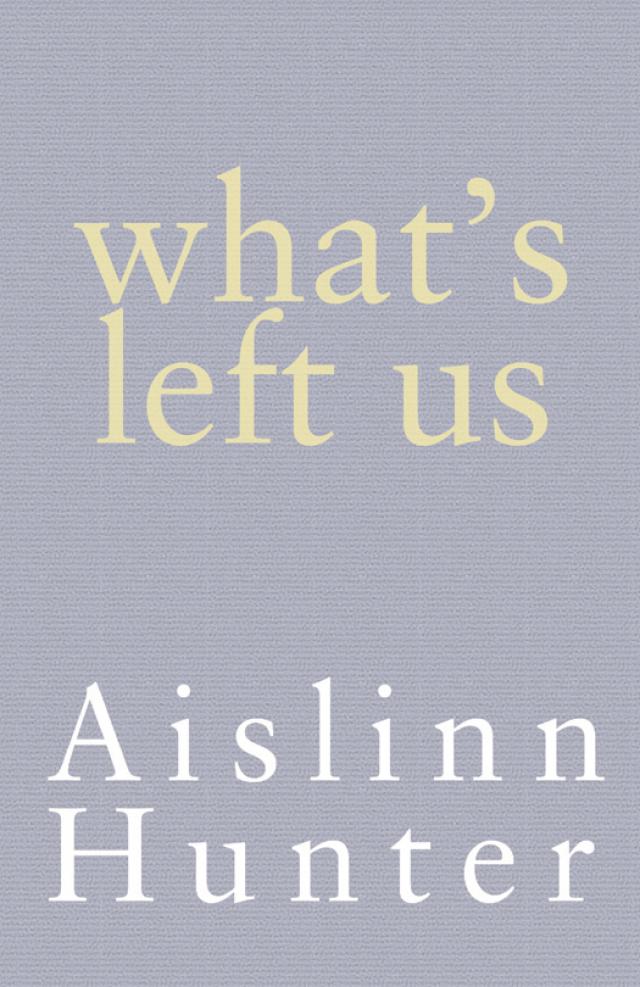
What's Left Us, page 1


Copyright © 2001 Aislinn Hunter
Anchor Canada e-book published 2013
All rights reserved. The use of any part of this publication, reproduced, transmitted in any form or by any means electronic, mechanical, photocopying, recording or otherwise, or stored in a retrieval system without the prior written consent of the publisher—or in the case of photocopying or other reprographic copying, license from the Canadian Copyright Licensing agency—is an infringement of the copyright law.
Anchor Canada is a registered trademark.
eISBN: 978-0-385-68090-5
This book is a work of fiction. Names, characters, places and incidents are products of the author’s imagination or are used fictitiously. Any resemblance to actual events or locales or persons, living or dead, is entirely coincidental.
Published in Canada by Doubleday Canada,
a division of Random House of Canada Limited
Visit Random House of Canada Limited’s website: www.randomhouse.ca
v3.1
For my mother
Contents
Cover
Title Page
Copyright
Dedication
Epigraph
THE STORIES
Hagiography
We Live in this World
Unto Herself
The Last of It
At the Bus Stop in Love with the Idea
The Caoin Funeral
THE NOVELLA
What’s Left Us
Acknowledgments
About the Author
“To dare to be born.
To bare love.”
— Elizabeth Smart, The Assumption of Rogues and Rascals
THE STORIES
Hagiography
SOPHIE BELIEVED SHE HAD been called by the Divine to work at the Ormand Quay Triple X Cinema. First of all, she was good with numbers.
“Four pounds a ticket, times two shows, equals eight pounds. Add popcorn” (stale and overly salted) “at fifty-five pence—equals eight pounds fifty-five pence total.”
She smiled brightly and put the gentleman’s money in the old tin cash box.
“Next?”
Second, she was a devout and God-fearing Catholic girl who at twenty-one was at her peak of sexual repression. Divinity, Sophie and her mother decided, had called her to test herself. Besides, the only other places that were hiring in all of Dublin were the pubs, and Sophie’s mother didn’t care for the drink at all.
Sophie liked candy-apple red lip colour and short skirts that swirled around her ordinary thighs as she walked down O’Connell Street to work. She had learned to think of herself as plain and had given up all hope of ever being beautiful. It was, she reasoned, her individual features that never quite seemed pulled together. Often she caught sight of her reflection in shop windows: nose too long for her face, lipstick on her teeth, frizzy brown hair popping out of her barrettes. Behind the Plexiglas in the ticket booth, however, she felt desirable. She ignored the water stains marking the peeled yellow wallpaper and the cigarette burns along the counter. She sat up straight and focused on the task at hand.
The flicks at the Triple X ran at nine and eleven. There was always a fair enough crowd, especially for the American imports. “The Irish like nothing better,” Peter the projectionist liked to remark, “than American smut. Reminds us of our blessed sanctity.” He said this every time an American film was showing, chuckling more to himself than to anyone else. Sophie knew the Western pornos were Peter’s favourites, better than the British films they usually showed. The American films were said to be the most outrageous. Films like Way Down South and Cowboy Riders were considered classics.
“Four pounds please,” Sophie says to the next man in the queue. Tonight she is feeling kind of pretty in her mother’s light blue summer dress and knitted shawl. She leans towards the cut oval in the Plexiglas, slipping her hand underneath it to take the fellow’s fiver. “Grand,” she smiles widely, “one pound’s yer change.” She gives him back his coin, lets her fingers rest on his hand momentarily.
This is not about him. There are many men, mostly in their forties, whose hands Sophie brushes from the comfort of her red vinyl stool. This is not about numbers, unless numerology dictates fate and every cash transaction in the ticket booth or in Dublin leads to it. This is not about sex, although eventually we’ll get to that. There is a young seminarian at Saint Patrick’s College. His name is James, after the biblical James; we are, after all, in Ireland. Young James loves God, also feels compelled by Grace, Divinity, his ma, what have you, to his vocation. The Lord, he believes, is his shepherd, there is nothing he should want. He will come to want Sophie.
James first meets Sophie on an April day, halfway down Grafton Street. He’s bent over the cobblestones, tapping his finger on the ground.
“All right there?”
First he sees her ankles, sloppy flats, and then his head follows his eyes up her bare and goose-pimpled leg to her thick waist, round breasts and finally her face. It’s pinched.
“All right or not? Are you daft?”
People pass by them. James clears his throat, shifts so Sophie’s blocking the sun again.
“Sorry?”
“Did you lose something?”
He looks at the cobblestones in front of where he’s kneeling.
“Ah, no.”
Sophie, puckering her lips, surveys the street. People come and go from shops and offices.
“So?” she folds her arms. “Do you need a hand or not?”
“Something’s written here,” he says.
“Oh.” She leans over and her blouse and cardigan open a bit. Sure enough there are illegible scribbles over three of the stones.
“I can’t read it,” he sighs.
Standing up next to her James feels tall and lanky. His dark fringe flops in front of his eyes and he brushes it aside impatiently. Sophie looks at him for a moment as if he is familiar, but not quite.
“All right,” she sighs, “good enough then.” And she strides away.
James and Sophie both love God. And they both love their respective parents who love God more than Sophie and James ever could. Both families share a number of traditions: confession and communion, charity work with those less fortunate, and the quiet kind of self-flagellation that comes from wondering if you love God enough. James is ready to give himself to God. But something about Sophie has bowled him over. There is, in truth, a lot of love going around—mostly, but not entirely, of the holy kind.
Later that week Sophie locks the ticket booth and sneaks up to the projection room for the first time in the seven months she’s worked at the Triple X. She can’t quite put her finger on it but she’s feeling a little unsettled. Maybe, she reasons, it was not being able to read that scrawl on the stones on Grafton Street. As if she’s missing a sign.
Two light knocks on the projection room door get no response so Sophie lets herself in. Peter’s mangy head is pressed close to the projector and he’s looking through the hole around the lens. He’s got his hand around his penis, which surprises Sophie because she’d never really considered the possibility of it before. Averting her eyes, she takes in the nudie pin-ups tacked over the wood panelling.
“Humph.” She clears her throat loudly. “Peter?”
“Yeah?” He barely turns towards her.
She’s curious about the film but doesn’t want to actually look at it. That, she figures, would be a sin.
“What?” He’s impatient.
“Is it any good?”
James is good. Clean undies every day, never curses, respects his mother, does up the dishes after dinner, helps old ladies and so on. He makes the long trek from his flat in Parnell Square to Saint Patrick’s College in Maynooth every day. He speaks both Irish and Latin. Coming home he recites the Bible under his breath, crossing in front of the pawnshops and military surplus stores that blanket Capel Street. He has memorized Genesis and the Revelations, the Psalms, Matthew and Mark. Today, a Sunday, he peers through the window of a sun-filled bakery and, seeing the scones, decides to indulge.
“Two please.”
“One pound sixty.”
Through the shop window, between shelves loaded with sourdough and rye, he spies Sophie.
“Keep it,” he says and leaves without his change, without his scones.
She would be perfect, he thinks, his pace quickening to catch up to Sophie, perfect on a carousel, sitting sidesaddle on a creamy palomino, her halo of hair catching the sunlight, her arm swinging open to him as she kicks off her loafers. She would be perfect if he could place her there in real life, at the carnival that came to Bray every summer when he was growing up. It was the most complete part of his childhood, the most freedom he’d ever felt. Flickering lights strung up like stars from Bray Head to the causeway and dozens of rides, side shows. Going round on the carousel, you could sometimes get a glimpse into the fat lady’s tent, catch sight of her large drooping breasts before the tent flap closed behind another customer. At the carnival, whole worlds that James had never considered were revealed. On top of the ferris wheel, James, only twelve, looked down at the smallness of the people below. He raised his arms to the sky, knowing there was nothing left between him and heaven. It was then, on that ferris wheel, that James first knew God.
At Ha’penny Bridge he is almost beside her. Unsure if he should actually touch this woman, he simply lopes along at a distance, thinking of ferris wheels and cotton candy, the pink of her cardigan. The more he muses the more he wants to tou
“Ms.—” His hand—long, clean fingers—reaches out to her shoulder as she turns onto the sidewalk, but she picks up her pace before he can reach her. Sophie, oblivious to James’ presence, looks both ways then trots across the street and enters a narrow utility doorway. “No Entrance” is written boldly above the door handle in black spray paint. Above his head to the left James sees the marquee.
Triple X.
Water Orgy and All Wet. Double bill.
Flummoxed, James takes a step back, rereads the sign. He decides he’ll wait.
These are the options that are open to him: James can leave and pretend he didn’t see Sophie. He can retrace his steps, go back to the bakery and then enter in under the ringing bells above the door. Embarrassed, he can ask the counter girl if she remembers him, and if so, could he still take the scones. Or, James could go in through the No Entrance doorway and seek out Sophie. He could put his hand out to her and bring her out of the Triple X and into the bright cast of the day. But it is a foreboding door and the fear of being seen stops him.
“Peter?” Sophie sees the projectionist down the faintly lit hallway.
“Over here darlin’.”
“Cheques?”
“Sam’s got ’em.” He jabs his thumb towards the office.
Sophie moves to squeeze by Peter, who is reclining against the wall outside the office doorway. He takes a deep drag of his cigarette then flicks the ashes over the carpet, running his hand up Sophie’s leg when she makes her way past him.
“Really?” she smiles, jabs him hard with her knuckle.
“All’s fair,” he mumbles, “all’s fair.”
Outside, Sophie hustles towards home, opening her envelope to check her wage card. James is following her. She adds up the figures in her head, mumbles little bits, “times eight …, for taxes.” Stuffing the envelope into her handbag, Sophie misses the light and steps out off the curb. It is mid-morning now and the traffic is thin. Nonetheless a lorry is barreling towards her and, of course, the driver has his mind on other things.
The predicament is this: Sophie is still oblivious to her calling. James, however, is not. He loves Sophie more than he loves God and they’ve only just met. The lorry is barreling down.
The lorry is barreling down. The lorry driver has six children and a wife who cross-stitches and embroiders beautifully. It is not a happy home, but it is typical, and “typical” is well-documented and quite routine in this country. Sophie steps out, typically. The driver has just noticed a spot on his trousers and is looking at it, wondering how it got there and if his wife can get it out.
Sophie steps off the curb.
James, as we have noted, is a bit too far behind.
There is the sound of brakes, there is a fantastic pause, there is a “No!” from the depths of James’ soul, which is quite deep. “No!” again. The lorry driver swerves. Sophie is pulled off the road by a strong ruddy hand. It is not James’ hand.
Sophie marries Eamon, who is a friend of the fellow who saves her life, the fellow with the strong ruddy hand. They date for two years and have sex on their wedding night and once a week after. It is blasé at the best of times. Sophie leaves her job, foregoing her calling, her Plexiglas shrine. She is no longer a virgin, so the temptation, the test the Triple X represents, no longer seems necessary. She starts going to the pubs, although her mother threatens to disown her. In her spare time Sophie gives cooking classes at the local Catholic Woman’s Association.
On a Tuesday, some four years into their marriage, Eamon is at the garage working late. That night Sophie is at home rifling through donations for the CWA’s annual book sale. She happens upon a story in an American fashion magazine in which the heroine is bedded by a Montana plains man. Sophie discovers masturbation. Her happiness lasts close to six months.
But this is not about Sophie and Eamon. This is about James. Let’s say the man with the ruddy hand was preoccupied, thinking about his pal Eamon who owns a garage.
The man with the ruddy hand is preoccupied, thinking about his pal Eamon who owns a garage. Eamon is fixing the ruddy-handed man’s Austin. Thinking about where the money will come from, the man with the ruddy hand scuffs his toe on the pavement while he waits for the light to change. The lorry driver is looking at his pants.
Sophie steps out.
A “No!” rips through the skies and meets with the small slender hand of one James MacNeill as he pulls on the shoulder of a woman in a pink cardigan. He loves her, but he doesn’t even know her name.
Over scones with jam and tea at Bewley’s (coming to a perfect four pound total), the conversation centres around not the almost accident, not numerology or Water Orgy but on having a calling. Sophie leans forward across the table, still exhilarated by the “No!,” the rush of attention, this lanky man folding her into his arms right there on O’Connell Street. Sophie sees Divinity in James, not just in his love of God, in his thin, white seminarian collar, but in his adoration of her, in the “No!” from the depths of his soul. Sophie is leaning across the table, her blouse and cardigan opening slightly. Her feet are grazing the floor and she’s watching James watch her, suddenly aware of her own beauty, even in this brightly lit café. Settling back into her chair, Sophie thinks about how perfectly it fits her body, how throne-like it is, this dark wood chair on the James Joyce floor of Bewley’s Café. She reaches her hand across the table to James. She is not giving him popcorn or change. It is an offering.
James the seminarian beams up at Sophie; she is breathtaking. He is nervous because he has never wanted anything this much in his life. With his finger he traces the water mark his tea cup has left. Round and round that finger goes, like a lazy sideways ferris wheel. James notices it becoming, in its roundness, the eye of God. God is watching them, as we all are, the two of them finally together, there, in Bewley’s Café. Her hand stretches out farther towards his, the offering. His hand sliding across the table to hers, fingers touching first, then palms. His sleeve blurring the water mark, the ferris wheel, the all-knowing, all-seeing eye.
We Live in this World
THE RAIN IS STREELING down my face and I can’t see anything. I’m standing in the middle of the road in front of a stopped mini-van, I’m acting like a crazy person, a crazy person in dinner party clothes with a Jetta back home in her driveway and keys in her hand. The woman in the driver’s seat, the woman whose eyes my eyes are meeting, stares at me past the quick swipes of her windshield wipers. In the glare of her headlights I flap my arms, I do an atrocious imitation of semaphore. When I approach her window she puts her mini van in reverse. For a few seconds I walk beside the van, gesturing for her to roll down the window. But she doesn’t; instead she turns the steering wheel and goes over onto the other side of the road. She hits the accelerator and pulls away.
“I ran into Evan on the corner of 28th and Dunbar.” An hour earlier, I was telling this to a table of four guests. I was telling it while they picked at their potatoes and roast.
“It was either that or the lamppost and he was the more pliable bet.”
I ran into Evan.
At dinner parties I like to tell the story of how Evan and I met. It makes him uncomfortable but I still think it’s a good laugh. When I tell it really well Evan laughs too, although once, about a year ago, he said he wanted to crawl under the kitchen table, pry the Viennese tile off the concrete, chip his way through the cement with his butter knife and burrow himself as far as he could underground. When I apologized that night in bed, holding his warm, still hand, begging his forgiveness, he said, “Arla, honey, it’s a good story, but it’s all in the telling.” Meeting Evan changed me.
My mother met my father when she was nineteen. Years later she said she found it amusing, the irony of marrying a podiatrist whose greatest disappointment in life would be that his only daughter inherited her mother’s wonky feet. This from a man who’d fathered a delusional son, who’d jumped ship before things got really crazy.
My first memory of my father is as follows: I’m twirling around in the basement of our house in Sudbury, I’m four years old, doing semi-cartwheels, clumsy pirouettes on the brown carpet, wiping out after a half-turn, grazing my knees on the shag. I get up, looking over at him in the wingback chair to see if he’s still watching. He is, so I make a great Y of my arms like a magician’s assistant, and tumble over onto the flats of my palms. I scissor for a second in midair, holding a precarious balance. Back on my feet I say, “Look Daddy, look Daddy, look Daddy, look.” I make a song out of it, I jump and twirl, I try to do it again. He claps, claps loud, but when the whole production is finished, he takes me up onto his lap, says, “Sweetie, you’ll never be a dancer with those feet.”